
Chris’s Bible Newsletter
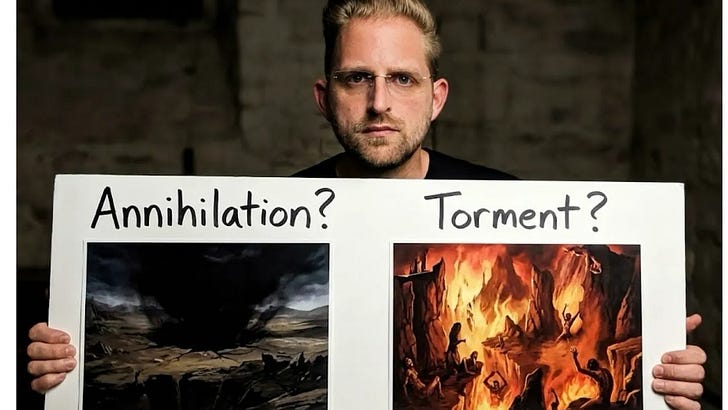
Is Hell Eternal Torment or Annihilation? Commentary
Dec 20, 2025 · 34m
Prefer sermons downloaded automatically?
About this sermon
To Access our full library, articles, videos, courses, podcast and more.. subscribe here
Watch on Youtube…
Few topics stir as much tension in biblical study as the question of hell’s final outcome. Is hell a place of unending conscious torment, or does Scripture point instead to final destruction—annihilation—for the wicked? Both views claim biblical support. Both appeal to God’s justice. And both draw from images and language woven through the Old and New Testaments.
This study aims to cut through tradition and emotion by returning to Scripture itself. What does the Bible actually say? What language does it use? And how did early believers understand the final destiny of the lost?
1. The Traditional View: Eternal Conscious Torment (ECT)
The historic church position, especially since Augustine, teaches that the lost remain forever conscious, experiencing ongoing judgment. The key word is eternal, not merely in consequence but in duration.
Biblical Support Often Cited
1. Eternal Fire & Unquenchable FlameJesus uses striking language when He warns,
“Where their worm does not die, and the fire is not quenched.”— Mark 9:48
Fire that never goes out suggests ongoing punishment.
2. The Smoke Rising ForeverJohn’s Revelation offers another vivid picture:
“The smoke of their torment goes up forever and ever.”— Revelation 14:11
The imagery resembles the ruins of Sodom—a city God destroyed so thoroughly that smoke symbolized its lasting testimony.
3. The Devil’s Fate Used as ComparisonRevelation also states:
“They will be tormented day and night forever and ever.”— Revelation 20:10
While this is specifically about the devil, beast, and false prophet, supporters of eternal torment argue the wicked share a similar destiny (20:15).
The Justice-Based Argument
If God is infinitely holy, sin is infinitely offensive. Therefore punishment that reflects God’s nature must also bear eternal weight.
2. The Conditionalist View: Final Destruction (Annihilation)
Conditional immortality—often called annihilationism—teaches that the wicked are destroyed, not preserved forever. Only the redeemed receive immortality as a gift.
Key Scriptures That Support This View
1. “The Wages of Sin Is Death” (Not Endless Life in Torment)Paul writes plainly:
“The wages of sin is death, but the gift of God is eternal life.”— Romans 6:23
Death is the opposite of life. Conditionalists argue the lost do not receive eternal conscious existence—only eternal consequences.
2. “Destruction” Means… DestructionJesus warns:
“Wide is the gate that leads to destruction.”— Matthew 7:13
Similarly Paul says:
“They will be punished with everlasting destruction.”— 2 Thessalonians 1:9
“Everlasting destruction” is read as a permanent result, not an ongoing process.
3. Fire Consumes—It Doesn’t PreserveJohn the Baptist declared:
“He will burn the chaff with unquenchable fire.”— Matthew 3:12
An unquenchable fire keeps burning until everything is reduced to ash. It is unstoppable, not endlessly torturous.
4. Only God Is ImmortalPaul states:
“He alone has immortality.”— 1 Timothy 6:16
Immortality is not inherent in human souls but granted through Christ (1 Cor. 15:53). Therefore, conditionalists argue the wicked cannot be eternally alive unless God sustains them.
Justice Argument
A loving God does not inflict eternal suffering but brings an end to sin, rebellion, and the existence of evil entirely.
For them, annihilation is just, permanent, and aligned with God’s character.
3. What Did Jesus Emphasize?
Jesus spoke more about judgment than anyone else in Scripture. Yet His imagery varies:
* Some illustrations depict ongoing consequences (e.g., the worm that does not die).
* Others depict final death (e.g., destroyed in Gehenna—Matthew 10:28).
* Others portray banishment (e.g., outer darkness, weeping and gnashing of teeth).
This variety suggests Jesus wasn’t giving a single mechanical description of hell, but revealing the severity of rejecting God.
A Key Verse Often Overlooked
“Fear Him who can destroy both soul and body in hell.”— Matthew 10:28
The word destroy (Greek: apollymi) rarely means torment. It consistently refers to death, ruin, elimination, or perishing.
This verse alone is one of the strongest cases for annihilation.
4. What Did Early Christians Believe?
The early church was not unanimous:
* Eternal torment was taught by Tertullian and later Augustine.
* Annihilation was taught by Arnobius and others.
* Universal reconciliation (a small minority view) was taught by Origen.
This shows the debate isn’t modern.
5. So Which View Is Right?
Simple Recap & Final Thoughts
Eternal conscious punishment comes directly from Jesus’ teaching. In Matthew 25:46, He places the destiny of the righteous and the wicked side by side:
“And these will go away into everlasting punishment, but the righteous into eternal life.” — Matthew 25:46
The same Greek word for eternal (aiōnios) describes both destinies. If eternal life is unending, then—according to Jesus—so is eternal punishment. This parallel is one of the strongest scriptural anchors used to support the view that hell’s consequences are not temporary or finite.
This verse in Revelation lets us know that Hell is not the final place for those who die without Christ but it is an Intermediate state until the Final “Great White Throne Judgement in Revelation”
“Then Death and Hades were cast into the lake of fire. This is the second death.” — Revelation 20:1
Hell is often viewed as a temporary holding place for the dead before a final judgment, while the Lake of Fire is the permanent, eternal destination for those who have been judged and found without a place in the book of life. The Lake of Fire is described as the “second death” from which there is no resurrection, and into which hell (Hades) itself will eventually be cast.
Hell
* Temporary holding place:
In many biblical interpretations, “hell” (also referred to as Hades or Sheol) is a temporary state or location for the spirits of the unsaved after death.
* Undergoes judgment:
At the final judgment, Hades and Death are said to give up their dead, who are then judged.
Lake of Fire
* Final destination:
The Lake of Fire is the ultimate, eternal punishment for the wicked, the devil, and his followers.
* Permanent judgment:
It is referred to as the “second death,” a state of complete and final separation from God.
* Includes hell:
According to Revelation, hell itself (Hades) is cast into the Lake of Fire, indicating it is a greater and more final place of judgment.
“Then Death and Hades were cast into the lake of fire. This is the second death.” — Revelation 20:1
If Hell is eternal punishment & the Lake of fire is eternal punishment… and Eternity for the righteous with be the same
It is safe to say that while in Hell and In the lake of fire those who have died without Christ will suffer eternally and will not be annihilated.
5 Questions & Answers
1. If God Is Loving, Why Would He Allow Eternal Torment?
Answer:God’s love does not negate His justice. In Scripture, judgment is the necessary response of a holy God toward unrepentant sin. Eternal punishment exists not because God delights in torment, but because:
* Sin against an infinitely holy God carries eternal consequences.
* People choose separation from God by rejecting His grace.
* God honors human freedom—even when that freedom chooses darkness.
Key verses:
* “These will go away into eternal punishment, but the righteous into eternal life.” — Matthew 25:46
* “God is just.” — 2 Thessalonians 1:6
God’s love is shown in that Jesus took the full wrath of God to save us from this fate (John 3:16–18).
2. Why Is the Torment Described as “Forever and Ever”? Can It Really Mean Eternal?
Answer:Yes. In Greek, the phrase “eis tous aiōnas tōn aiōnōn” literally means “unto the ages of the ages,” the strongest possible expression for unending duration.
This exact phrase is also used to describe:
* God’s eternal nature
* Christ’s eternal reign
* Eternal life for believers
If “eternal life” is endless, then “eternal punishment” uses the same language and must also be endless.
Key verses:
* Revelation 20:10 — “tormented…
This is a public episode. If you'd like to discuss this with other subscribers or get access to bonus episodes, visit www.chrissbiblenewsletter.org/subscribe
More from Chris’s Bible Newsletter

Why does God Sometimes remain Silent when we Pray?
Nov 24, 2026 · 17m
Want to support us? CLICK HERE↗WATCH THE VIDEOBooks I recommend for you... (as an Amazon associate I earn from qualifying purchases at no additional cost to you)- Apologetics Series- End Times...

Why Atheism Fails to Explain What You Already Know
Nov 22, 2026 · 15m
________Episode Resources CLICK HERE↗Want to support us? CLICK HERE↗Watch This on YouTube CLICK HERE↗_______00:00 Why atheism lacks a foundation for logic and morality02:23 How the universe’s...
Was Abraham's Bosom a Parable or Did it Really Happen?
Nov 21, 2026 · 19m
Want to support us? CLICK HERE↗WATCH THE VIDEOBooks I recommend for you... (as an Amazon associate I earn from qualifying purchases at no additional cost to you)- Apologetics Series- End Times...

Still Waiting? The Prophecies God Hasn't Fulfilled Yet
Nov 18, 2026
WATCH NOW ON YOUTUBESUBSCRIBE TO CHRIS'S BIBLE NEWSLETTERSUPPORT THE NEWSLETTERFULL BIBLE STUDY ARTICLESo, what does the Bible say is still yet to occur? When it comes to Bible prophecy, the Bible...

Does the Bible Really Say the Earth Is 6,000 Years Old?
Nov 16, 2026
WATCH NOW ON YOUTUBESUBSCRIBE TO CHRIS'S BIBLE NEWSLETTERSUPPORT THE NEWSLETTERFULL BIBLE STUDY ARTICLEListen to the PodcastSupport the NewsletterMy Book RecommendationsNavigating the debate between...
Why Fulfilled Prophecies Prove the Bible Is God's Word
Nov 13, 2026
WATCH NOW ON YOUTUBESUBSCRIBE TO CHRIS'S BIBLE NEWSLETTERSUPPORT THE NEWSLETTERFULL BIBLE STUDY ARTICLEListen to the PodcastSupport the NewsletterMy Book RecommendationsWhy fulfilled prophecies...
Take these sermons with you.
Follow Chris’s Bible Newsletter in the Getsermons app to get every new sermon, build playlists, and pick up right where you left off.

