
Conversing with Mark Labberton
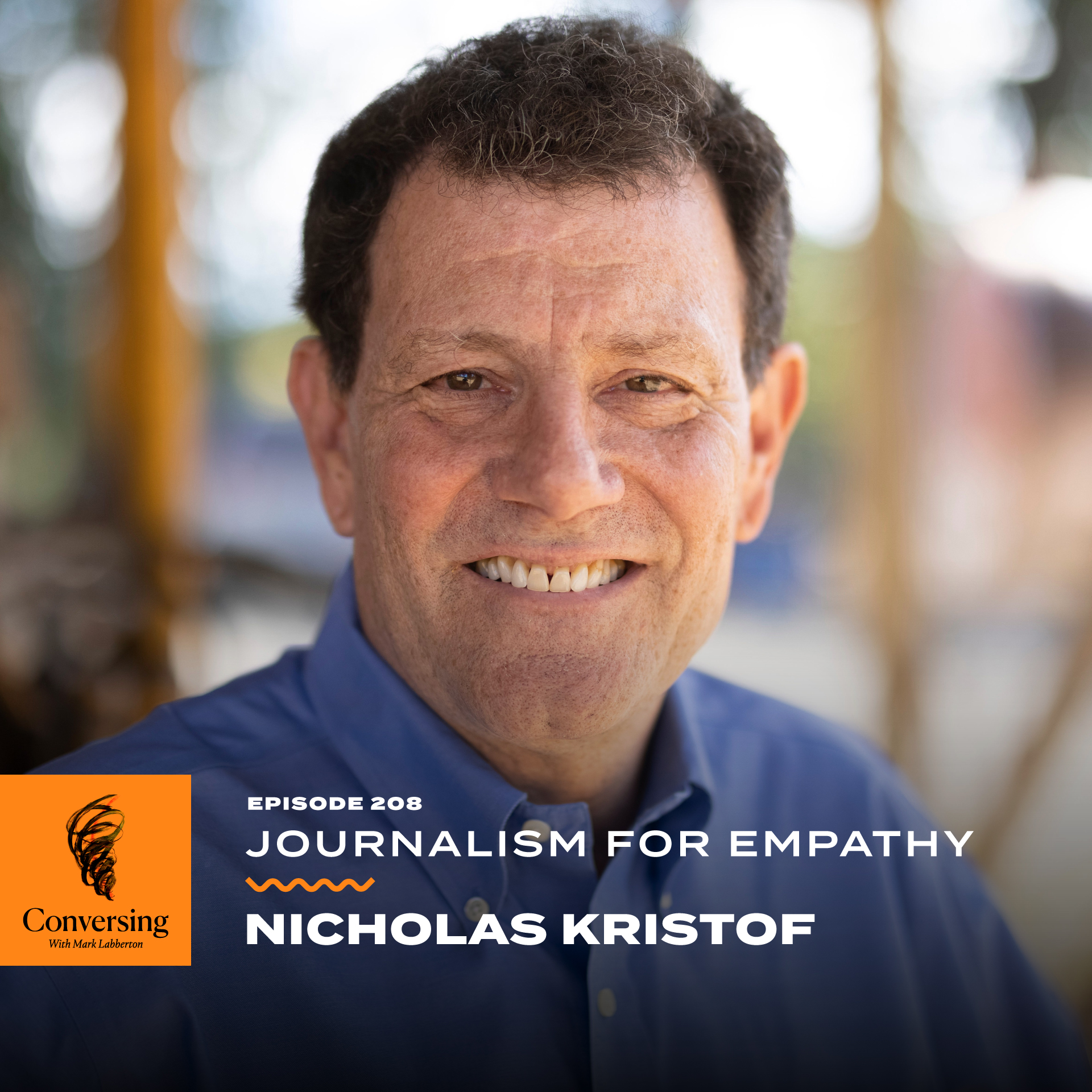
Journalism for Empathy, with Nicholas Kristof
Apr 22, 2025 · 48m
Prefer sermons downloaded automatically?
About this sermon
Two-time Pulitzer Prize–winning journalist Nicholas Kristof (opinion columnist, the New York Times) reflects on his career of reporting from the front lines of injustice and human suffering, discussing hope, human resilience, and the urgency of responding to global injustice.
An advocate for empathy-driven journalism that holds power accountable and communicates the stories of the most vulnerable, Kristof joins Mark Labberton in this episode to discuss his life's work of reporting from the world's most troubled regions—from Gaza to Congo, from rural Oregon to global centres of power. Known for his unsparing storytelling and deep empathy, Kristof shares the family roots and personal convictions that have shaped his lifelong pursuit of justice and hope.
They also explore how despair and progress coexist, the role of faith and empathy in healing, and how local acts of courage can ripple globally. Grounded in gritty realism, but inspired by everyday heroes, Kristof invites us to resist numbness and embrace a hope that fights to make a difference.
Stories from Gaza, Congo, Pakistan, and beyond
Balancing heartbreak and hope in humanitarian reporting
Why empathy must be cultivated and practiced
The global impact of Christian activism and its complexities
Episode Highlights
"Side by side with the worst of humanity, you find the very best."
"We focus so much on all that is going wrong, that we leave people feeling numb and that it's hopeless … but people don't want to get engaged in things that are hopeless."
"Empathy is something that, like a muscle, can be nurtured."
"The worst kinds of evil and the greatest acts of courage are often just one decision apart."
"We are an amazing species—if we just get our act together."
"You can be sex positive and rape negative. I don't think there's an inconsistency there."
About Nicholas Kristof
Nicholas Kristof is a two-time Pulitzer Prize–winning journalist, and is an opinion columnist for the New York Times, **where he was previously bureau chief in Hong Kong, Beijing, and Tokyo.
Born, raised, and still working from his rural Oregon home, Yamhill, he is a graduate of Harvard and was a Rhodes Scholar at Oxford.
He is the co-author, with his wife Sheryl WuDunn, of five previous books: Tightrope, A Path Appears, Half the Sky, Thunder from the East, and China Wakes. In 2024, he published a memoir, *Chasing Hope: A Reporter's Life.*
Books by Nicholas Kristof
Tightrope
A Path Appears
Half the Sky
Thunder from the East
China Wakes
Chasing Hope: A Reporter's Life
Helpful Resources
International Justice Mission
Dr. Denis Mukwege – Nobel Peace Prize
PEPFAR: The U.S. President's Emergency Plan for AIDS Relief
Tim Keller's Final Interview with Kristof (NYT)
Show Notes
A voice of conscience
How a global orientation for journalism developed
Kristof reflects on his humble roots in Yamhill, Oregon, as the son of two immigrants
"My dad was a Armenian refugee from Eastern Europe. His family had spied on the Nazis during World War II. They got caught. Some were executed by the Nazis, others were executed by the Soviet communists, and my dad was very lucky to make it out alive and was sponsored by a family in the US in 1952."
"I think that one fundamental mistake that bleeding hearts make, whether they're bleeding hearts in journalism or in the non-profit community or in advocacy, is that we focus so much on all that is going wrong that we leave people feeling numb and feeling that it's hopeless, so there's no point in engaging. And there's pretty good evidence from social-psychology experiments that people don't want to get engaged in things that are hopeless. They want to make a difference. And so I think that we need to both acknowledge all the challenges we face but also remind people that there can be a better outcome if they put their shoulder to the wheel."
Extraordinary changes for justice and what's going right
David Brooks: "A deeply flawed country that also managed to do good in the world."
"It just breaks my heart that kids are dying unnecessarily."
On losing PEPFAR foreign aid: "I hope that this damage can be repaired and that bleeding hearts of the left and the right can work together to try to help restore some of these initiatives."
The tragedies that followed from dismantling USAID
Kristof's book Chasing Hope
"The fact is that I've seen some terrible things, and I think I may have a mild case of PTSD from, you know, seeing too much."
Nicholas Kristof on Gaza: "I don't see Israel and Hamas as morally equivalent, but I absolutely see an Israeli child, a Palestinian child, and an American child as moral equivalents. And we don't treat them that way."
"What human beings share is that when terrible things happen, some people turn into psychopaths and sociopaths, and other people turn into heroes."
Cowardice and malevolent tendencies
Empathy can be nurtured
Children dying without anti-retroviral drugs in South Sudan
Empathy Project in Canada
Mass literature to inspire perspective taking
Uncle Tom's Cabin
Black Beauty and animal rights/well-being
Kristof's run for Oregon governor
Eastern Congo and UNICEF
"A child is raped every thirty minutes in Eastern Congo."
Dr. Denis Mukwege, Nobel Peace Prize laureate treating women brutally injured by militia rape in Bukavu, a city in eastern Democratic Republic of the Congo.
Small gestures of compassion as an empathy grower for local communities
"One of the lessons I think of Congo is that violence can be and inhumanity can be terribly contagious."
Genocide in Rwanda in 1994
The global sex-trafficking crisis
"We don't have the moral authority to tell other countries to do better unless we clean up our own act."
The American sex-trafficking crisis: systemic failures such as foster care pipelines into trafficking
"There are no statistics, but I think it's plausible that a girl in foster care is more likely to emerge to be trafficked than she is to graduate from a four-year college."
American sex-trafficking practices by PornHub and X-Videos: "Their business model is monetizing kids."
"You can be sex positive and rape negative. I don't think there's an inconsistency there, and I, I think we've just blurred that too often."
Christianity's disappointing response to injustice
Nicholas Kristof's engagement with the activism and theology of the Christian church
William Wilberforce's anti-slavery movement in the 1780s
President Bush's establishment of PEPFAR in 2003: "This incredible program to reduce the burden of AIDS that has saved 26 million lives so far. It's the most important program of any country in my adult lifetime in terms of saving lives."
"Evangelicals are very good in terms of tithing and donating money to good causes, but they've often opposed government programs that would create opportunity and address these problems."
"Liberals are personally stingy, but much more supportive of government programs that that make a difference."
Criticizing the dismantling of global aid programs like USAID: "How can you read the Gospels and think this is good?"
"I think being part of a religious community has led people to do good works together."
Christian advocacy for freedom of religion
Kristof on scripture and belief: "We read the Bible and develop our religious views, and I think so often just reflects our priors rather than what the text says."
A closing example of hope: The Afghan war
"We are an amazing species if we just get our act together."
Production Credits
Conversing is produced and distributed in partnership with Comment magazine and Fuller Seminary.
More from Conversing with Mark Labberton

Reordering Reality, with Mark Labberton
Nov 24, 2026 · 1h 38m
Consider the American church. How well does it bear the likeness of Christ? How credible is its witness to the gospel? In this conversation, which originally appeared on John Ortberg's podcast...

New Life for Old Prayers, with Pete James
Nov 17, 2026 · 53m
During spiritually dry and difficult seasons, prayer can feel emaciated, empty, or even like an echo in the abyss. Pete James, longtime pastor of Vienna Presbyterian Church, suggests that old...

Honesty, Cheating, and Performativity, with Christian Miller
Nov 10, 2026 · 1h 0m
Dishonesty is becoming more and more incentivized. The rise of AI has made it easier to hide cheating and harder to catch it. And a utilitarian attitude about bending the truth is leading to an...

Change, Prophets, and Power, with Andra Gillespie
Nov 3, 2026 · 51m
Political scientists once theorized that roughly every thirty years, a major election shuffles each party's constituencies. But Andra Gillespie, a political scientist at Emory University, disagrees....

Be Afraid or Fear Not?, with Kutter Callaway
Oct 27, 2026 · 54m
What would it mean to fear rightly—to both fear God and "fear not," to both validate the terror that fits with traumatic events and quell the fright and learn to regulate? For Kutter Callaway, there...

Live Laugh Love Propaganda, with Kristin Kobes Du Mez
Oct 20, 2026 · 59m
There is a secret history of white Christian women, says historian Kristin Kobes Du Mez (bestselling author, Jesus and John Wayne). And the thread of this history brings together Evangelicals,...
Take these sermons with you.
Follow Conversing with Mark Labberton in the Getsermons app to get every new sermon, build playlists, and pick up right where you left off.

