
Conversing with Mark Labberton
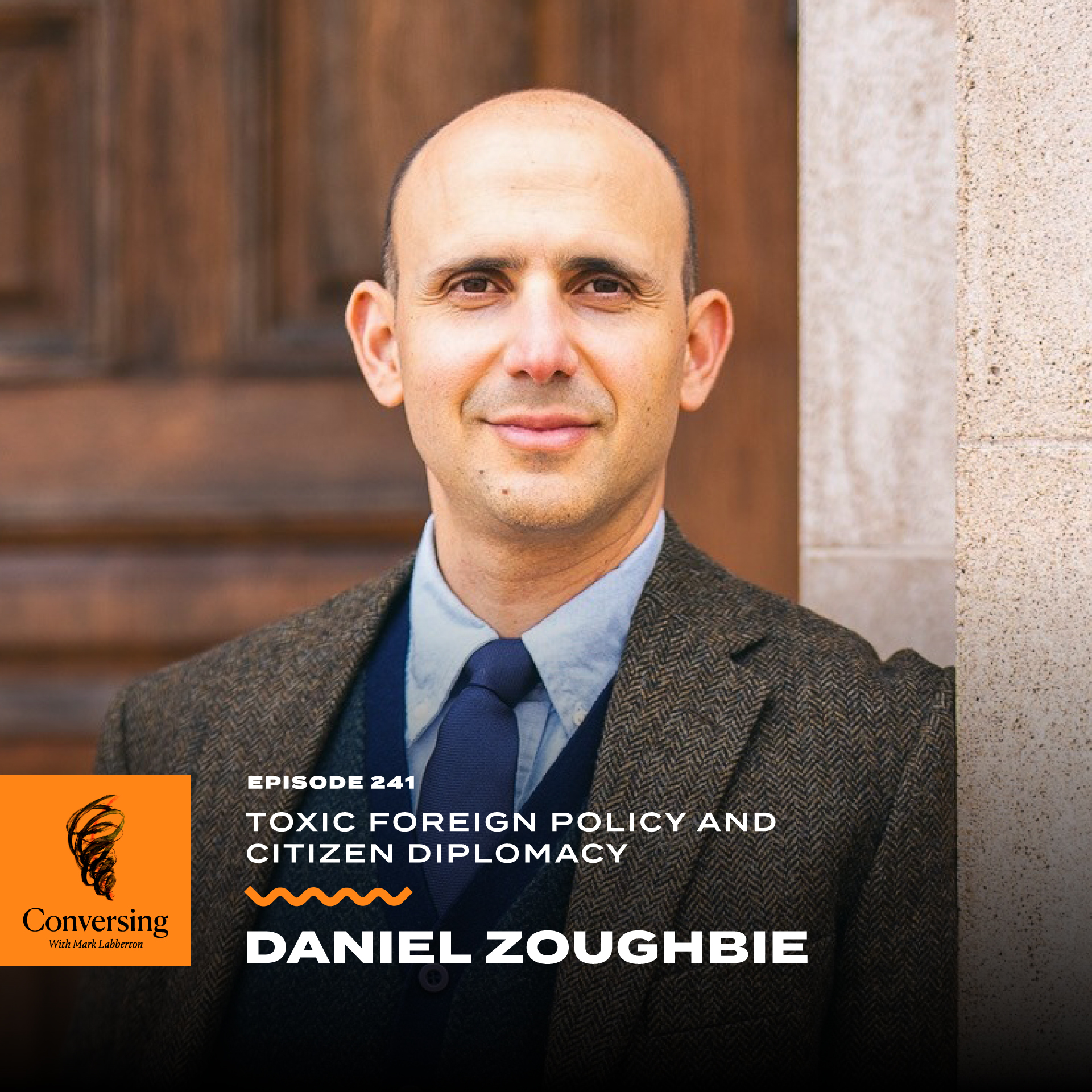
Toxic Foreign Policy and Citizen Diplomacy, with Daniel Zoughbie
Dec 9, 2025 · 49m
Prefer sermons downloaded automatically?
About this sermon
As global powers double down on militarism and defense, Daniel Zoughbie argues that the most transformative force in the Middle East has always come from citizen diplomacy.
A complex-systems scientist and diplomatic historian, Zoughbie joins Mark Labberton to explore how twelve US presidents have "kicked the hornet's nest" of the modern Middle East. Drawing on his work in global health and his new book Kicking the Hornet's Nest: U.S. Foreign Policy in the Middle East from Truman to Trump, Zoughbie contrasts the view from refugee camps and micro-clinic networks with the view from the Oval Office, arguing that American security rests on a three-legged stool of defence, diplomacy, and development.
He explains why Gerald Ford stands out as the lone president who truly leveraged diplomacy, how the Marshall Plan model of enlightened self-interest can guide policy now, and why nationalism, not mere economics, lies at the heart of Gaza's future. Throughout, he presses listeners toward "citizen diplomacy" that resists pride, militarism, and fatalism.
Episode Highlights
"We've constantly ignored diplomacy."
" You don't have to be enemies with people to get them to do what is in their own self-interest."
"You can build skyscrapers in Gaza. You can build the Four Seasons in Gaza and it's not going to work. You're just going to have another war until you address that core issue of nationalism."
"These three D's, defense, diplomacy, development, are the three-legged stool of American security and we know how important diplomacy and development are."
"From Truman to Trump, only one president, and that is Gerald Ford, surprisingly the only unelected president, gets this right."
"Pride—national pride, the pride of any one individual—is toxic. It's toxic to the individual. It's toxic to the nation. It's toxic to the world."
"Foreign policymaking is not just something for secretaries of state and those in power. All of us in a democracy have a role to play."
Helpful Links and Resources
Kicking the Hornet's Nest: U.S. Foreign Policy in the Middle East from Truman to Trump https://www.simonandschuster.com/books/Kicking-the-Hornets-Nest/Daniel-E-Zoughbie/9781668085226
American University of Beirut (founded as Syrian Protestant College), a key example of long-term educational diplomacy https://www.aub.edu.lb
Al-Ahli Arab (Gaza Baptist) Hospital in Gaza City https://en.wikipedia.org/wiki/Al-Ahli_Arab_Hospital
Max Weber, "Politics as a Vocation" https://dn790009.ca.archive.org/0/items/weber_max_1864_1920_politics_as_a_vocation/weber_max_1864_1920_politics_as_a_vocation.pdf
Quaker Friends School, Ramallah: https://www.rfs.edu.ps/en
Amman Baptist School: https://baptist.edu.jo/
American Colony Hotel in Jerusalem founding in the Husseini Estate by the author of "It is Well" https://www.loc.gov/exhibits/americancolony/amcolony-family.html and https://en.wikipedia.org/wiki/American_Colony_Hotel
Foreman Christian College, Pakistan (Presbyterian) https://en.wikipedia.org/wiki/Forman_Christian_College
American University of Cairo (Presbyterian) https://en.wikipedia.org/wiki/American_University_in_Cairo
About Daniel Zoughbie
Daniel E. Zoughbie is a complex-systems scientist, historian, and expert on presidential decision-making. He is associate project scientist at UC Berkeley's Institute of International Studies, a faculty affiliate of the UCSF/UCB Center for Global Health Delivery, Diplomacy, and Economics, and principal investigator of the Middle East and North Africa Diplomacy, Development, and Defense Initiative. He is the author of Kicking the Hornet's Nest: U.S. Foreign Policy in the Middle East from Truman to Trump and of Indecision Points: George W. Bush and the Israeli-Palestinian Conflict. His award-winning research has appeared in journals such as PLOS Medicine, Mayo Clinic Proceedings, and Social Science and Medicine. A Phi Beta Kappa graduate of UC Berkeley, he studied at Oxford on a Marshall Scholarship and completed his doctorate there as a Weidenfeld Scholar.
Show Notes
Middle East Background and Micro-clinic Origins
Daniel Zoughbie recalls visiting the Middle East as a child—"frankly horrified" by what he saw
UC Berkeley protests over the Iraq War and post-9/11 US policy in the region
Metabolic disease and type 2 diabetes as an overlooked "greatest killer in the region."
Neighbours in the West Bank sharing food, medicine, and blood-pressure cuffs—leads to the "micro-clinic" concept
Good health behaviours, like bad ones and even violence, can be contagious through social networks
Social Networks, Anthropology, and Security
Social anthropology, political science, and international relations
Medical problems as simultaneously biological and sociological problems
Understanding Middle East security demands attention to decisions "at the very bottom" as well as "the view from above"
October 7 and 9/11 illustrate how small groups of people can "change the world with their decisions."
Complex Systems and Foreign Policy
Complexity is always increasing, and diplomacy and development exist to slow it down.
Definition of "complex system": as one where many inputs produce outcomes that cannot be reduced to single causes.
"We almost have a new law here, which is that complexity is always increasing in the universe. And the role of diplomacy and development, as I see it in international relations, is to slow things down. It's to stop complexity from advancing so that people have time to cool their tempers and to solve major security crises."
Type 2 diabetes as a model for thinking about how city planning, economics, relationships, and habits interact
He applies that lens to international relations: nations, leaders, institutions, and history form a "cascade of complexity."
From Refugee Camps to Presidential Palaces
George Shultz and Tony Blair: decision-makers as "real human beings," not abstractions
Theological and ideological forces—such as certain apocalyptic readings of Scripture—that shape US foreign policy
Gnosticism and eschatology within American right-wing Christianity
Painstaking global health work on the ground and sweeping decisions made in Washington, Brussels, or New York
Twelve Presidents and One Exception
Kicking the Hornet's Nest: analysis of twelve presidents from Truman to Trump through the lens of Middle East decision-making
Core claim: Only Gerald Ford truly rebalanced the three D's of defence, diplomacy, and development.
US policy in the Levant: heavy reliance on militarism, coups, and covert actions while underinvesting in diplomacy and development
Claim: "Far better alternatives were on the table" for every administration, yet consistently passed over.
Gerald Ford, Kissinger, and the Path to Peace
Daniel contends that the 1967 and 1973 wars were both preventable and nearly became global nuclear catastrophes.
Ford inherits the presidency amid Watergate and national division, but keeps Henry Kissinger at State.
Ford presses Israel and Egypt toward serious negotiations, empowering Kissinger's shuttle diplomacy and personal ties.
A sharply worded letter threatening to "reconsider" the US-Israel relationship
Ford's diplomacy and the development of Camp David and the enduring Egypt-Israel peace based on "land for peace."
Pride, Personality, and Presidential Failure
Did Ford's temperament keep him from making himself the center of the story?
In contrast, many presidents and other leaders write themselves "thickly" into the narrative of the conflict.
Pride—personal and national—as a toxic force that repeatedly undermines US policy
The Iraq War and democracy-promotion agenda and the self-defeating nature of moralistic, militarized crusades
Marshall Plan and Enlightened Self-Interest
George Marshall and harsh punishment after World War I helped produce Nazi Germany
The Marshall Plan models an "enlightened way of viewing the American self-interest": rebuilding Europe and Japan to secure U.S. security.
He contrasts that with the neglect of the Levant, where aid and institution-building never matched military activism.
Marshall's genius lies in locating the intersection between others' deepest needs and American capabilities.
Militarism, Iran, and Nuclear Risk
Recent US-Israel-Iran confrontation as an "extremely dangerous moment"—with 60 percent enriched uranium unaccounted for
JCPOA as an imperfect but effective diplomatic achievement, but dismantled in favor of militarism
Claim: Bombing Iran scattered nuclear material and increased complexity rather than reducing the threat.
He warns that one nuclear device could be delivered by low-tech means—a boat or helicopter—endangering civilians and US forces in the Gulf.
The only realistic path forward: renewed multilateral diplomacy between US, Israel, Iran, Russia, China, Pakistan, India, and regional actors
Ethical Realism and Max Weber
"Ethical realism"—Max Weber's distinction between the ethic of the gospel and the ethic of responsibility
Statespeople bear responsibility for using force, yet the greatest can still say "here I stand and I can do no other."
Claim: True leadership seeks a higher ethic where national interest aligns with genuine concern for others.
Gaza, Nationalism, and Two States
Welcoming the end of active war between Israel and Hamas and critiquing reconstruction plans that ignore politics
Conflict is fundamentally nationalist: a struggle for self-determination by both Jewish and Palestinian peoples
Claim: Economic development without a credible political horizon will not prevent "another October 7th and another terrible war."
In his view, only partition of mandatory Palestine into two states can meet legitimate self-determination claims.
For example, "You can build skyscrapers in Gaza… and it's not going to work" without addressing nationalism.
Citizen Diplomacy and a Better Way
Foreign policy is not only the work of secretaries of state; democratic citizens have responsibilities.
American University of Beirut and the Gaza Baptist Hospital as fruits of citizen diplomacy
Claim: Educational and medical institutions can change lives more profoundly and durably than military campaigns.
Redirecting resources from bombs to universities and hospitals to reduce the need for future military interventions
An invitation to citizen diplomacy: informed voting, sustained attention, and creative engagement for a more just peace
Production Credits
Conversing is produced and distributed in partnership with Comment magazine and Fuller Seminary.
More from Conversing with Mark Labberton

Reordering Reality, with Mark Labberton
Nov 24, 2026 · 1h 38m
Consider the American church. How well does it bear the likeness of Christ? How credible is its witness to the gospel? In this conversation, which originally appeared on John Ortberg's podcast...

New Life for Old Prayers, with Pete James
Nov 17, 2026 · 53m
During spiritually dry and difficult seasons, prayer can feel emaciated, empty, or even like an echo in the abyss. Pete James, longtime pastor of Vienna Presbyterian Church, suggests that old...

Honesty, Cheating, and Performativity, with Christian Miller
Nov 10, 2026 · 1h 0m
Dishonesty is becoming more and more incentivized. The rise of AI has made it easier to hide cheating and harder to catch it. And a utilitarian attitude about bending the truth is leading to an...

Change, Prophets, and Power, with Andra Gillespie
Nov 3, 2026 · 51m
Political scientists once theorized that roughly every thirty years, a major election shuffles each party's constituencies. But Andra Gillespie, a political scientist at Emory University, disagrees....

Be Afraid or Fear Not?, with Kutter Callaway
Oct 27, 2026 · 54m
What would it mean to fear rightly—to both fear God and "fear not," to both validate the terror that fits with traumatic events and quell the fright and learn to regulate? For Kutter Callaway, there...

Live Laugh Love Propaganda, with Kristin Kobes Du Mez
Oct 20, 2026 · 59m
There is a secret history of white Christian women, says historian Kristin Kobes Du Mez (bestselling author, Jesus and John Wayne). And the thread of this history brings together Evangelicals,...
Take these sermons with you.
Follow Conversing with Mark Labberton in the Getsermons app to get every new sermon, build playlists, and pick up right where you left off.

