
Conversing with Mark Labberton
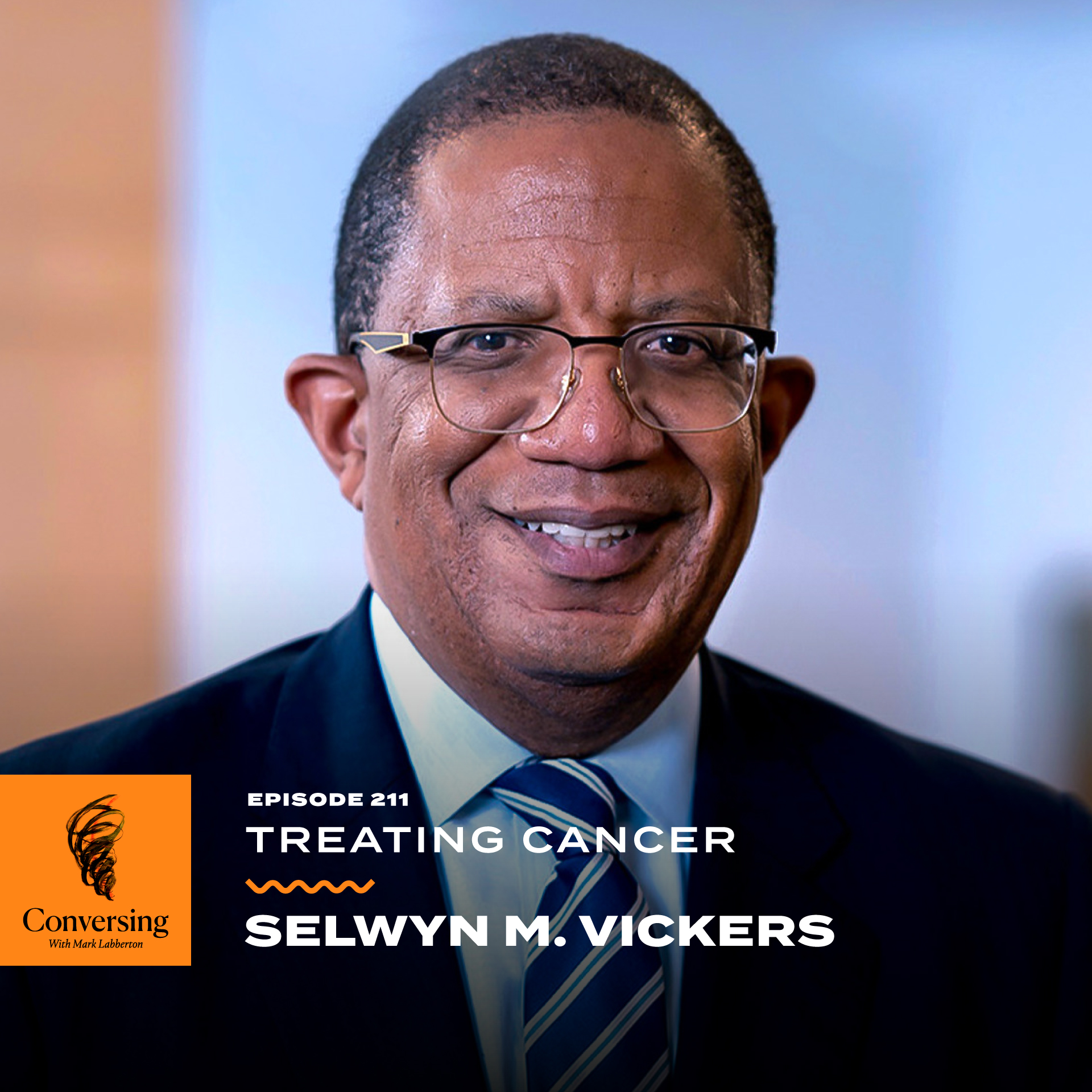
Treating Cancer, with Selwyn Vickers
May 13, 2025 · 52m
Prefer sermons downloaded automatically?
About this sermon
Cancer is among the most common and feared diseases in the modern world. Dr. Selwyn Vickers—president and CEO of Memorial Sloan Kettering Cancer Center—joins host Mark Labberton to discuss how precision oncology, data, and faith are transforming cancer treatment.
A distinguished cancer surgeon and pancreatic cancer researcher, Vickers explains how groundbreaking advances in genomics, immunotherapy, and AI are transforming once-lethal diagnoses into survivable and even chronic conditions. Together, they explore not only the cutting-edge science of cancer care but also the spiritual, emotional, and social dimensions that affect every patient and caregiver.
Resonating with themes of suffering, hope, and resurrection, this conversation offers clarity, compassion, and courage for all who are affected by cancer—from those newly diagnosed, to medical professionals, to grieving families and curious listeners.
Episode Highlights
"We're getting to a point where we will, in the next five to seven years, have a much better chance to cure people—and to make pancreatic cancer a chronic illness."
"We are in what's somewhat coined the golden age of cancer research."
"Cancer is a disease that creates an existential threat in ways no other illness does."
"If a tumour forms, it means your body's immune system has made a social contract with the cancer."
"We changed the diagnosis in 10–12 percent of the patients who come to us—sometimes from cancer to no cancer."
"Cancer care is a team sport. And our patients often inspire us more than we help them."
Helpful Links & Resources
Memorial Sloan Kettering Cancer Center
BioNTech – creators of mRNA vaccines for COVID and cancer
CAR T-Cell Therapy Overview (Cancer.gov)
Tim Keller on cancer and hope
Emma Thompson's Wit (HBO)
BRCA1 and BRCA2 Genes and Cancer Risk
MSK-IMPACT: Next-Gen Tumor Profiling
About Selwyn Vickers
Selwyn M. Vickers, MD, FACS, is the president and CEO of Memorial Sloan Kettering Cancer Center (MSK) and the incumbent of the Douglas A. Warner III Chair. He assumed the role on September 19, 2022.
Vickers is an internationally recognized pancreatic cancer surgeon, pancreatic cancer researcher, and pioneer in health disparities research. He is a member of the National Academy of Medicine and the Johns Hopkins Society of Scholars. He has served on the Johns Hopkins School of Medicine Board of Trustees and the Johns Hopkins University Board of Trustees. Additionally, he has served as president of the Society for Surgery of the Alimentary Tract and the Southern Surgical Association. Vickers is the immediate past president of the American Surgical Association. He also continues to see patients.
In 1994, he joined the faculty of the University of Alabama at Birmingham (UAB) as an assistant professor in the Department of Surgery, where he was later appointed to professor and the John H. Blue Chair of General Surgery. In 2006, Vickers left UAB to become the Jay Phillips Professor and Chair of the Department of Surgery at the University of Minnesota Medical School.
Born in Demopolis, Alabama, Vickers grew up in Tuscaloosa and Huntsville. He earned baccalaureate and medical degrees and completed his surgical training (including a chief residency and surgical oncology fellowship) at the Johns Hopkins University. Vickers completed two postgraduate research fellowships with the National Institutes of Health and international surgical training at John Radcliffe Hospital of Oxford University, England.
Vickers and his wife, Janice, who is also from Alabama, have been married since 1988. They have four children.
Show Notes
The ongoing threat and fear of cancer
How Selwyn Vickers got into medicine
Pancreatic cancer: Vickers's expertise
"We are in what's somewhat coined the golden age of cancer research."
Sequencing the human genome
"Is there a drug that might target the mutation that ended up creating your cancer?"
Cancer as both a medical and existential diagnosis
The revolution of precision oncology through human genome sequencing
"It takes a billion cells to have a one centimetre tumor."
Immunotherapy: checkpoint inhibition, CAR T-cell therapy, and vaccines
Cellular therapy: "Taking a set of their normal cells and re-engineering them to actually go back and target and attack their tumors. … We've seen patients who had initially a 30 percent chance of survival converted to an 80 percent chance of survival."
"We know in many tumours there's something called minimal residual disease."
"Immunizing yourself against cancer is a significant future opportunity."
Managing the power of data with AI and computational oncology
Cancer-care data explosion: the role of computational oncologists
Cancer vaccines: breakthrough mRNA treatment for pancreatic cancer
"Didn't ultimately win. We had to suffer through her losing her life, but was so appreciative that she got much more than the six months she was promised."
Tumour misdiagnoses and the importance of specialized expertise
Pancreatic cancer challenges: immune cloaking and late-stage detection
In the past, one in four would die from the operation for removing pancreatic cancer
Long-term survival
Future of cancer detection: AI-based medical record analysis and blood biopsies
More accurate blood tests to confirm conditions
Using AI to select those who are high-risk for cancer
Pastor Tim Keller died of pancreatic cancer.
In the past, "your doctor … helped you learn how to die."
"[God's] given man the privilege to discover those things that have been hidden. And over time we've gradually uncovered huge opportunities to impact people's lives."
The state of breast cancer research and treatment
"If you get the diagnosis of breast cancer, you have a 90 percent chance to survive and beat it over a five-year period of time."
"In general, we're in a great state of understanding how to treat breast cancer, how to detect it early, and then have selective and targeted mechanisms to prevent it from coming back."
Prostate cancer research and treatment
Theranostics: using a specific antibody to target cancer cells specifically
Pediatric cancer: "We actually treat more children for cancer than any hospital in America now, but in general, the survival for pediatric cancers is greater than 80 percent."
Emotional, psychological, and spiritual toll of cancer: importance of psycho-oncology
How Sloan Kettering developed psycho-oncology to help cancer patients with mental and spiritual health
Personal story: how a cafeteria worker empowers patients through food choices
"We give back to them the right to choose what they get to have on their tray."
Cancer treatment is a team sport.
Wit (film, Broadway play)—actress Emma Thompson plays a cancer patient studying the work of John Donne on death
Socioeconomic and racial disparities in cancer care outcomes
The healing role of community, support teams, and compassionate listening
The importance of listening to cancer patients who are preparing to die
The spiritual courage of patients and the transformative power of faith
"Our patients often help us. We see the grace with which they often handle that journey."
The inspiration behind becoming a doctor: family legacy and human impact
Terminal care: the sacred responsibility of walking with patients to the end
Cancer research and treatment as a Christian vocation and expression of humanity
Production Credits
More from Conversing with Mark Labberton

Reordering Reality, with Mark Labberton
Nov 24, 2026 · 1h 38m
Consider the American church. How well does it bear the likeness of Christ? How credible is its witness to the gospel? In this conversation, which originally appeared on John Ortberg's podcast...

New Life for Old Prayers, with Pete James
Nov 17, 2026 · 53m
During spiritually dry and difficult seasons, prayer can feel emaciated, empty, or even like an echo in the abyss. Pete James, longtime pastor of Vienna Presbyterian Church, suggests that old...

Honesty, Cheating, and Performativity, with Christian Miller
Nov 10, 2026 · 1h 0m
Dishonesty is becoming more and more incentivized. The rise of AI has made it easier to hide cheating and harder to catch it. And a utilitarian attitude about bending the truth is leading to an...

Change, Prophets, and Power, with Andra Gillespie
Nov 3, 2026 · 51m
Political scientists once theorized that roughly every thirty years, a major election shuffles each party's constituencies. But Andra Gillespie, a political scientist at Emory University, disagrees....

Be Afraid or Fear Not?, with Kutter Callaway
Oct 27, 2026 · 54m
What would it mean to fear rightly—to both fear God and "fear not," to both validate the terror that fits with traumatic events and quell the fright and learn to regulate? For Kutter Callaway, there...

Live Laugh Love Propaganda, with Kristin Kobes Du Mez
Oct 20, 2026 · 59m
There is a secret history of white Christian women, says historian Kristin Kobes Du Mez (bestselling author, Jesus and John Wayne). And the thread of this history brings together Evangelicals,...
Take these sermons with you.
Follow Conversing with Mark Labberton in the Getsermons app to get every new sermon, build playlists, and pick up right where you left off.

