
Defending Faith and Family
The Case for Catechism
Mar 28, 2026 · 18m
Prefer sermons downloaded automatically?
About this sermon
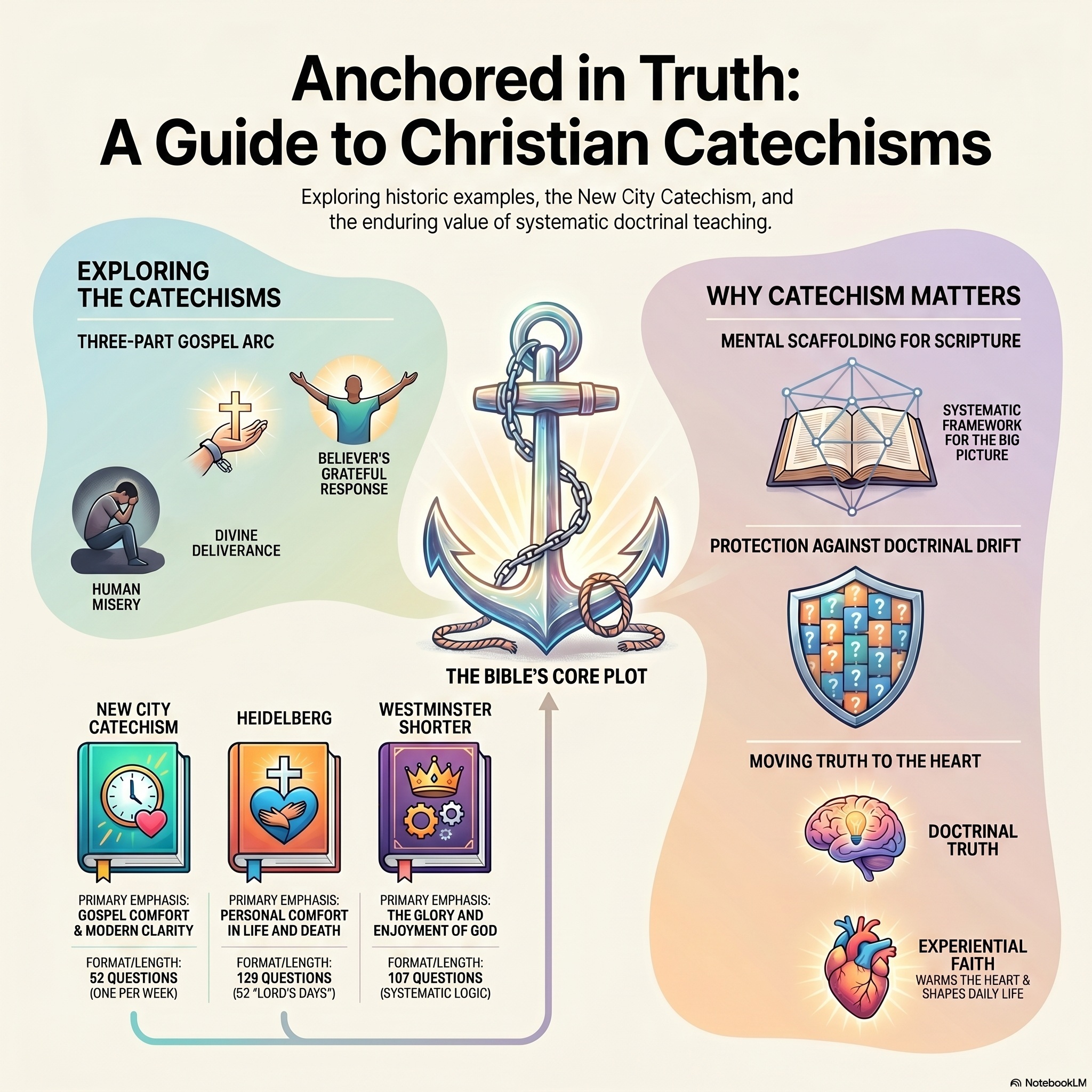
Men, are you ready to arm yourself with one of the most battle-tested tools for leading your home like a true protector and provider? In this episode of The Defending Faith and Family Podcast, we dive deep into why Reformed catechisms—the Heidelberg, the 1689 Baptist, and the New City—are essential field manuals for biblical manhood.
Kevin DeYoung’s The Good News We Almost Forgot and John Piper’s adapted Baptist Catechism aren’t dusty relics—they’re gospel fuel that distills Scripture’s grand storyline into memorable Q&A format. You’ll discover how they anchor you in your only comfort in life and death: belonging body and soul to Christ. We’ll fire up on the misery of sin that grieves God, celebrate the grace that delivers us, and show how gratitude shapes your daily leadership.
Whether you’re drilling one question a week with your wife and kids or steel-manning objections like “Isn’t the Bible enough?”, this episode equips you to build a durable faith that withstands cultural storms and raises the next generation of mighty men. Don’t miss it—hit play and start training today.
The 1689 Catechism
https://1689.com/wp-content/uploads/resources/THE-BAPTIST-CATECHISM.pdf
The Heidelberg Catechism
https://www.crcna.org/sites/default/files/HeidelbergCatechism.pdf
The New City Catechism
https://store.thegospelcoalition.org/assets/product_downloads/867/d7hT1UDD9NutpS7YvMmS8GD7Ne1S33ebJPx06kEa.pdf
Comprehensive Study Guide: The Good News We Almost Forgot ( https://a.co/d/0f2mLsob )
This study guide provides a detailed synthesis of the themes, theological arguments, and historical context presented in Kevin DeYoung’s The Good News We Almost Forgot, a commentary on the 16th-century Heidelberg Catechism.
Overview and Historical Context
The document explores the enduring relevance of the Heidelberg Catechism, first published in 1563 in Heidelberg, Germany. Commissioned by Elector Frederick III of the Palatinate, the catechism was designed to serve three primary functions: as a teaching tool for children, a guide for preachers, and a means of establishing confessional unity among Protestant factions.
The chief architect of the document was Zacharias Ursinus, a professor at the University of Heidelberg. The resulting work is widely regarded as one of the most devotional and beloved documents of the Reformation, translated into scores of languages. It is structured around 129 questions and answers, further organized into 52 "Lord’s Days" to facilitate weekly study or preaching throughout a year.
The Structure of Salvation: Guilt, Grace, and Gratitude
The Heidelberg Catechism follows a unique structural pattern mirrored after the book of Romans. This three-part division defines the Christian experience:
Guilt (Man’s Misery): Recognizing the depth of human sin and the inability to fulfill God’s law.
Grace (Man’s Deliverance): Understanding how Christ sets humanity free from sin and misery.
Gratitude (Man’s Response): Determining how to live a life of thankfulness for such deliverance.
Part I: The Knowledge of Misery (Guilt)
The document posits that true comfort cannot be experienced without first understanding the need for it. This knowledge comes through the Law of God, which requires perfect love for God and neighbor.
Human Depravity: The source context describes a "natural tendency" in humans to hate God and their neighbors. This corruption is not part of God’s original creation but stems from the Fall of Adam and Eve in Paradise.
Total Depravity: This theological concept suggests that humans are born with a warped nature, "poisoned" from conception. This does not mean humans are as bad as they could possibly be, but that they are "totally unable to do any good and inclined toward all evil" unless regenerated by the Holy Spirit.
The Justice of God: God is both merciful and just. His justice demands that sin against His "supreme majesty" be punished with the "supreme penalty"—eternal punishment of both body and soul. Humans cannot pay this debt themselves; in fact, they "increase [their] guilt every day."
Part II: The Knowledge of Deliverance (Grace)
Because humans cannot satisfy God’s justice, a Mediator is required. This Deliverer must be "truly human and truly righteous" to pay for human sin, yet "truer God" to bear the weight of divine anger and restore righteousness.
The Person of Christ: The text identifies Jesus Christ as this Mediator. His work is described through four key theological lenses:
Expiation: The removal of sin and guilt.
Redemption: Ransoming humanity from the curse of the law.
Reconciliation: Restoring the relationship between God and humanity.
Propitiation: Appeasing the wrath of God.
The Nature of True Faith: Faith is defined as more than just intellectual knowledge; it is a "deep-rooted assurance" created by the Holy Spirit. It is the instrument by which believers are "grafted into Christ."
Trinitarian Theology: The document emphasizes that there is one God in three distinct persons: Father, Son, and Holy Spirit. This doctrine is essential for understanding creation, evangelism, and the nature of eternal love.
The Offices of Christ: Jesus is described as fulfilling three roles:
Chief Prophet: Revealing the secret counsel of God.
Only High Priest: Setting humanity free by His sacrifice and interceding with the Father.
Eternal King: Governing and guarding His people by His Word and Spirit.
The Virgin Birth: This doctrine is presented as vital because it ensures Jesus’ full humanity and full divinity while exempting Him from the inherited curse of Adam’s sin.
The Atonement: The text discusses "Particular Redemption" (Limited Atonement), arguing that Christ’s death was sufficient for the whole world but intended to effectively redeem "the sheep"—those chosen by the Father.
Resurrection and Ascension: Christ’s physical resurrection is the guarantee of the believer’s future resurrection. His ascension means He currently pleads for believers as an Advocate in heaven, and His "session" (being seated at God's right hand) signifies that His work of salvation is finished.
Part III: The Knowledge of Thankfulness (Gratitude)
The final section of the study context focuses on the Christian’s life after being delivered. Good works are not done to earn salvation but as "fruits of gratitude."
Justification by Faith Alone: This "granddaddy" of doctrines asserts that believers are right with God solely through faith in Christ. This involves "alien righteousness" (righteousness from outside oneself) and "imputation" (crediting Christ's holiness to the believer's account).
Sanctification and Repentance: Genuine repentance involves two things: the "dying-away of the old self" (sorrow for sin and running from it) and the "coming-to-life of the new self" (joy in God and delight in doing good).
The Church and the Sacraments: The church is the community "chosen for eternal life" and "united in true faith."
Sacraments: Defined as "holy signs and seals," they do not create faith but confirm and nourish it. The two New Testament sacraments are Baptism and the Lord’s Supper.
Baptism: A sign of the washing away of sins. The document defends infant baptism (paedobaptism) based on the continuity of God’s covenant from the Old Testament circumcision to New Testament baptism.
The Lord’s Supper: A visible pledge of sharing in Christ’s sacrifice. The text explicitly rejects the Roman Catholic view of "transubstantiation" (the bread and wine becoming the actual body and blood) and the "Mass" as a sacrifice, instead promoting a view of "real spiritual presence."
The Keys of the Kingdom: The text identifies "preaching of the holy gospel" and "Christian discipline" as the mechanisms that open or close the kingdom of heaven.
Glossary of Key Terms
Active Obedience: The perfect life of Jesus Christ, lived to fulfill the law on behalf of believers.
Adoption: The legal act of God where, through Christ, He brings believers into His family as children and heirs.
Alien Righteousness: Righteousness that does not belong to the believer naturally but is given to them by Christ.
Arianism: A heresy that denies the full deity of Jesus Christ.
Catechism: A method of instruction using a series of questions and answers derived from the Bible.
Ex Nihilo: A Latin term meaning "out of nothing," referring to God's creation of the universe.
Federal Headship: The concept that Adam represented the entire human race in the Fall, and Christ represents His people in redemption.
Imputation: The legal crediting of one person's actions (either Adam's sin or Christ's righteousness) to another's account.
Intermediate State: The condition of the soul between death and the final resurrection, described as being "at home with the Lord."
Modalism: A Trinitarian heresy suggesting that the Father, Son, and Spirit are merely different modes or roles of one person.
Passive Obedience: Christ’s willingness to suffer and die to pay the penalty for sin.
Providence: The "almighty and ever present power of God" by which He upholds and rules all of creation.
Regeneration: The supernatural act of the Holy Spirit giving a sinner a new heart, often referred to as being "born again."
Simul Iustus et Peccator: A Latin phrase meaning "simultaneously justified and a sinner."
Transubstantiation: The Roman Catholic doctrine that the bread and wine in the Eucharist literally become the body and blood of Christ.
More from Defending Faith and Family

The Islamic Dilemma
Apr 24, 2026 · 28m
In this episode we present a critical comparative analysis between Islam and Christianity. Jay Smith utilizes historical and manuscript evidence from the seventh century to challenge the origins of...

Two Centuries of Christian Persecution
Apr 23, 2026 · 26m
John Foxe’s Book of Martyrs serves as a foundational historical record documenting the persecutions and deaths of Christian believers from the early church through the nineteenth century. This updated...
The Soil and the Sword : Samuel Whittemore
Apr 22, 2026 · 20m
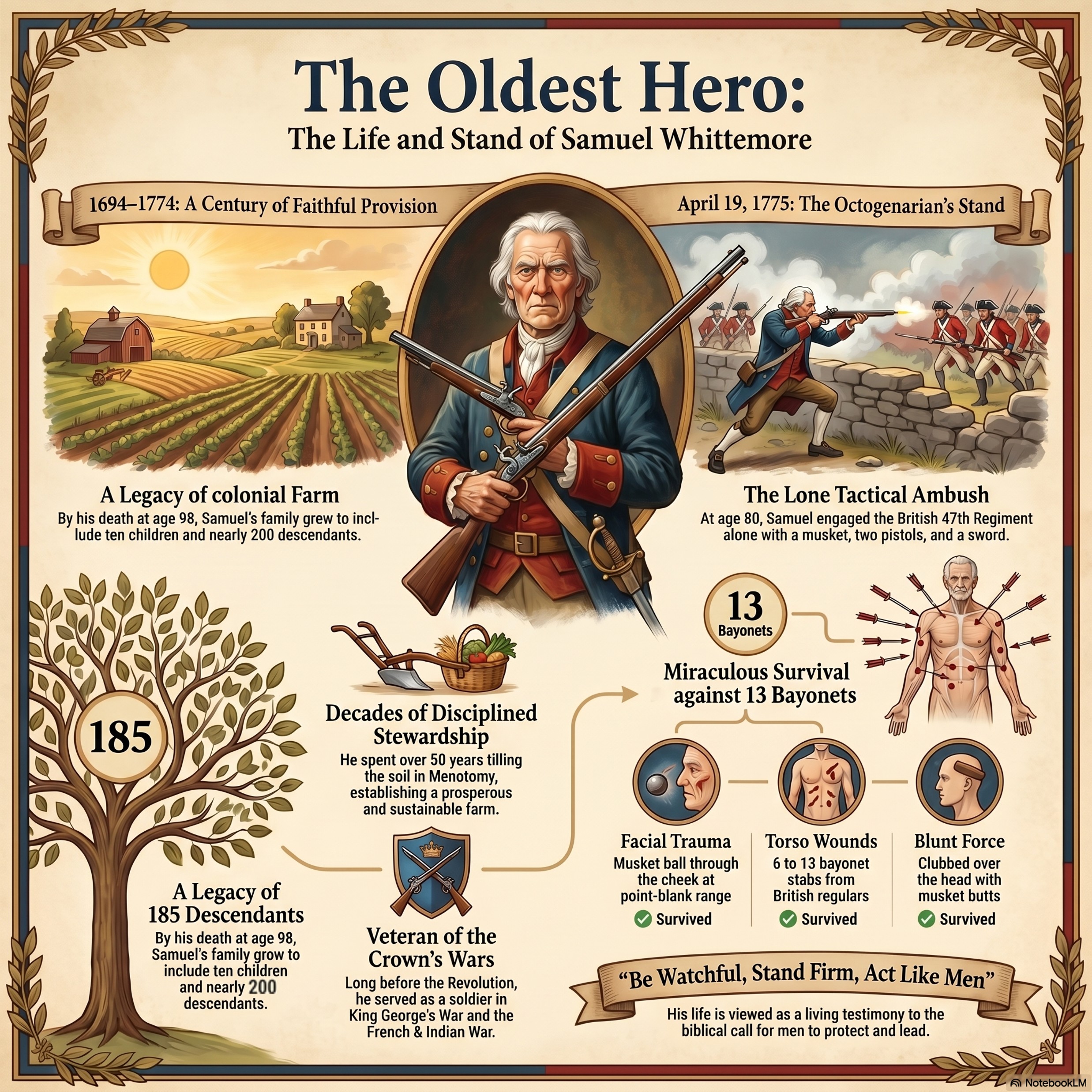
This episode highlights the life of Samuel Whittemore, an American colonial farmer who became a legendary figure of the Revolutionary War. The author presents Whittemore’s biography through the lens...

Stewardship & First-Fruits
Apr 21, 2026 · 22m
Biblical financial stewardship is a comprehensive process for men to lead their households by recognizing that all resources belong to God and must be managed according to His Word. The foundation...

The Divine Architect's Fine-Tuned Universe
Apr 20, 2026 · 29m
This podcast explores the fine-tuned universe argument for God's existence, framing scientific data as a "battle hymn" for Christian men to lead and protect their families. The various physical...

Make War!
Apr 13, 2026 · 27m
This episode serves as a call to action for Christian men to engage in a spiritual "war" against internal sin to protect their families and faith. Drawing heavily on the teachings of John Piper and...
Take these sermons with you.
Follow Defending Faith and Family in the Getsermons app to get every new sermon, build playlists, and pick up right where you left off.

