
Extra Credit Podcast
Hiding in (Not from) God
Sep 11, 2025 · 53m
Prefer sermons downloaded automatically?
About this sermon
Blessed is the one
whose transgressions are forgiven,
whose sins are covered.
(Psalm 32:1)
The Covering (Up?) of Sin
In a memorable phrase (not least because Paul quotes it in Romans 4) Psalm 32:1 says, “Blessed is the one…whose sin is covered.”
The language of “covering” is striking here. What does it mean to have your sins covered? This is a suggestive metaphor. And as with any suggestive material, we have to take care in how we hear it. It isn’t immediately clear.
In the winter of AD 412 St. Augustine of Hippo preached a sermon on Psalm 32 to the people of Carthage in the city’s most famous basilica. In explaining what the psalmist means be the covering of sins, Augustine brings up the parable of the Pharisee and the Tax Collector.
In Jesus’ parable both the Pharisee and the Tax Collector go to the temple to pray. The Pharisee thanks God that he is not like the adulterers, the robbers, or even the tax collectors. Unlike these filthy evildoers this pharisee says, “I fast twice a week and tithe on all that I get.” But the Tax Collector stands at a distance and beats his breast as he prays: “God be merciful to me a sinner.” Jesus says that it is the Tax Collector who is justified before God.
The Pharisee prays opposite of Psalm 32. Psalm 32 says that blessing is for those whose sins are forgiven, but the Pharisee says, “Blessed is the one who has no sins.” The Pharisee’s problem is that he is sinless—just like Saul of Tarsus or the Rich Young Ruler.
Augustine looks to his Carthaginian audience and says:
The Pharisee was indeed guilty of sin; but he was looking the wrong way, and failed to realize where he was standing. He was like someone in need of healing who had come to a doctor’s surgery, but presented only his sound limbs and covered up his wounds.
Notice Augustine says the Pharisee’s problem is that he “covered up” his sins. But doesn’t our psalm say having your sins covered is to be blessed? Yes, says Augustine, but there are two ways to cover sins: You can cover something in order to hide it or you can cover something in order to heal it. The first leads to death, the second leads to life.
Rather than letting God cover his sins, the Pharisee covers his own sins up to hide them from himself, from his neighbors, and ultimately from God. Augustine continues:
Let God cover your wounds; don’t cover them yourself. If you cover them up out of embarrassment, the doctor will not heal them. Allow the physician to cover and cure them, because he covers them with a dressing. Under the physician’s dressing the wound heals; under the patient’s covering it is merely hidden. Anyway, from whom are you trying to hide it? From him who knows everything?
The Pharisee presented his healthy limbs: “I fast and I tithe on all I get.” The Rich Young Ruler had kept the commandments from his youth. Saul of Tarsus was “flawless” in his righteousness under the law. Fasting, tithing, and obedience are all good things. But all three refused to present their wounded limbs to the Great Physician. And in the cases of all three the wounded limbs were their pride. Pride is the one thing the Doctor has the hardest time treating. Not because it is too hard for him, but because it keeps the patient from staying on the operating table.
Pride just is the covering up of our own sins. It’s blinding. It is the covering that is a hiding and just so it can never lead to the covering that is a healing.
So, Augustine says, present your sins to the Lord and come out of hiding.
Hiding in (Not from) God
But don’t the Scriptures themselves say that “we are hidden in Christ? Or don’t the psalmists often say things like: “Let me hide in the shadow of your wings”? Don’t we sing, “Rock of Ages cleft for me, let me hide myself in thee”?
Should we hide or not?
The language of “hiding” in Scripture works the same way that the language of “covering” does. As Augustine pointed out, there are two ways to “cover.” There is a way to cover up yourself and there is a way to be covered by God. The same dynamic is at work in the language of “hiding.” There are two ways to be hidden.
I’ve witnessed the two ways of hiding in my young children just this last week. A few nights ago my two oldest kids (5 and 2) were after me to play hide-and-seek. Because my daughter is only 2 years old, she often finds it scary to go hide by herself. So we take turns hiding with her. First my daughter and my son go hide together from me. But the next round my daughter and I would hide together from my son. The first round my daughter was hiding from me. The second round she hides with me.
And I can’t help but notice the absolute giddiness in her as we hide together. Her giggling can’t be contained. Most all of us will all have had the experience of building forts when we were young. There is an excitement and even a giddiness in being safely hidden. Like being in a tent in the rain. I suspect this is the reason most of us sleep with “covers.” There’s a comfort in being hidden.
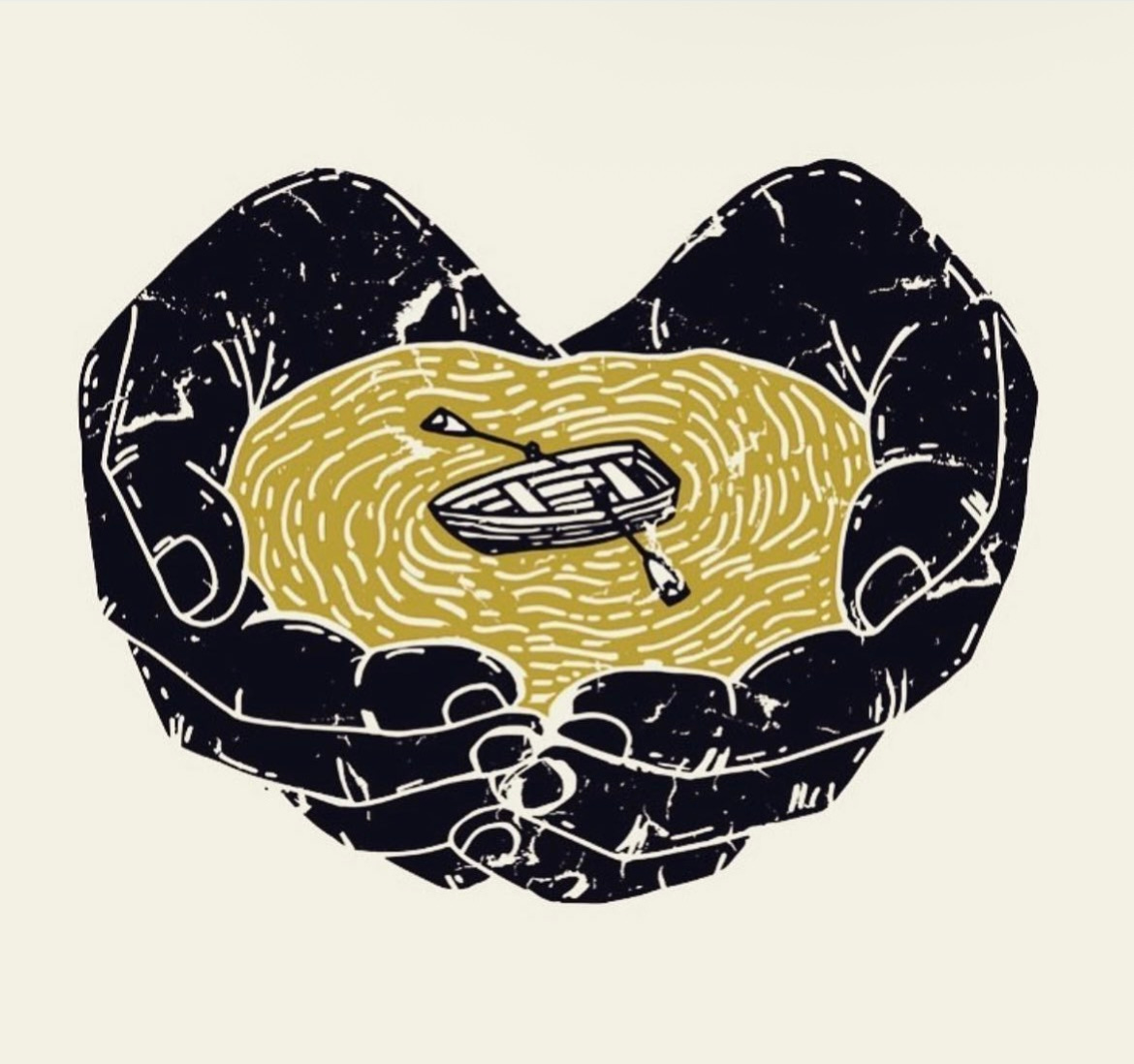
When the psalmist asks to be hidden under God’s wing he is not asking be hidden from God, but hidden in God. Notice the song Rock of Ages says, “Let me hide myself in thee” not, “Let me hide myself from thee.”
I’m convinced this difference is at the heart of whether or not we grasp the gospel. We have all heard sermons in which the preacher says something like, “If you believe in Jesus, then when God looks at you he doesn’t see you, he sees Jesus.” This is one of the biggest mistakes we can make because what we are suggesting is that we are being hidden in Christ from God. Rather than being hidden in Christ, who is God.
When the psalmist asks to be hidden in the shadow of God’s wings he is comparing God to a mother bird. But a mother bird does not hide her chicks under her wings so that she doesn’t have to look at them. She hides them to be close to them, to comfort them, to protect them from the dangers around them.
For many of us our theology has gone off course here. We have imagined that what Christ does for us is hide us in himself from the Father, so that the Father does not destroy us out of his just wrath.
But this is a perversion of the gospel.
This came home to me reading a book by a modern day shepherd named James Rebanks. Rebanks says that when it is lambing season they have mothers that die in the birthing process and little lambs that die. They have motherless lambs and childless mothers.
He says an old shepherding trick is to take the dead body of the lamb who died in birth and skin it from the neck to the hoofs. The shepherd then takes that skin and covers one of the orphan lambs with it like a jacket. Then he takes that orphaned lamb and gives it to the mother who lost her lamb in childbirth. The orphan lamb smells like her baby. And, Rebanks says, she almost always will mother it and feed it as if it is her own. But, and I love this, he says you can tell that she knows something is up. He says the ewe looks at the shepherd with a look that says, “I know you did something and I know this isn’t my lamb.” But after a few moments of skepticism she still feeds and cares for the lamb like it is her own.
Reading this I could feel a version of my former self gearing up to preach it straightaway. “Jesus is the lamb of God who has covered us in himself so that the Father accepts us as if we were him.” But this isn’t what the New Testament bears witness to.
If we press into this metaphor we can see its many problems. The first—and biggest—problem it suggests if taken literally is that Jesus (God the Son) is tricking God the Father into loving you. God doesn’t actually want you, in fact he can’t stand to look at you because you are too sinful. But because his Son is perfect and has covered you, the Father accepts you because you “smell” like his Son.
This is not the gospel. That would be hiding from God. The gospel promises that you are being hidden in God. He is your home and in him you find your true self—your true identity. You don’t…
This is a public episode. If you would like to discuss this with other subscribers or get access to bonus episodes, visit cameroncombs.substack.com
More from Extra Credit Podcast

Q&A with Chris E.W. Green
Nov 23, 2026 · 59m
Office Hours Q&A w/ Dr. Chris Green from TheoCon 26 Our midweek Bible study will not meet this week so I thought I’d share the Office Hours Q&A session with Dr. Chris Green from this year’s TheoCon....
On the Antichrist: “Are You the Antichrist or Should We Look for Another?”
Nov 19, 2026 · 58m
1 John Ep. 3 For many of us it will be shocking to learn that the only uses of the term antichrist in the scriptures come in the letters of John (1 John 2, 4, and 2 John 1). And what may be more...
Christ Is Tempted in Me
Nov 12, 2026 · 55m
1 John Ep. 2 This week we come to the famous division of the three temptations common to humanity that John gives in 1 John 2: the lust of the flesh, the lust of the eyes, and the pride of life. Many,...
The Contradiction of Grace
Nov 5, 2026 · 54m
1 John Ep. 1 “As long as I am imperfect and unruly, neither being obedient to God through the practice of the commandments, nor becoming perfect in knowledge in my mental faculties, Christ must be...

On Self-Love
Oct 29, 2026 · 57m
The Garden of the Heart Ep. 6 This week we turn to the difficult question of self-love. Does the gospel call us to love ourselves? The answer to the question is not a simple or straightforward Yes...

The Erotic Love of God
Oct 15, 2026 · 58m
The Garden of the Heart Ep. 5 This week we turn to discuss Eros—both its terror and its grandeur—and the way in which it reveals the depths of God’s heart for us. It is hard for us to believe, but the...
Take these sermons with you.
Follow Extra Credit Podcast in the Getsermons app to get every new sermon, build playlists, and pick up right where you left off.

