
Extra Credit Podcast
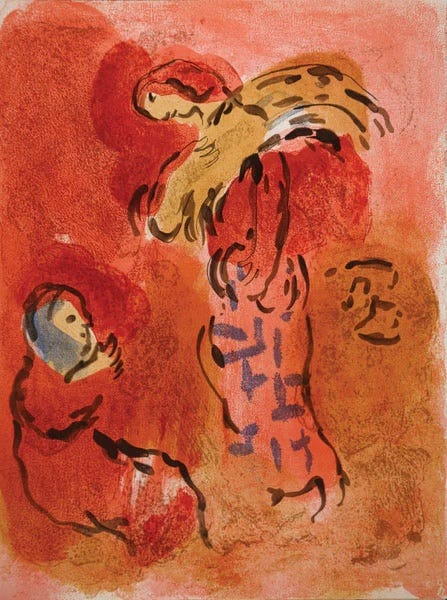
Ruth, the Canaanite Woman, and Outsiders
May 1, 2025 · 1h 2m
Prefer sermons downloaded automatically?
About this sermon
"The tree of life, the cross of Christ, the center of God’s world..."
-Dietrich Bonhoeffer, Creation and Fall
Insider/Outsider Paradigm
The book of Ruth, as we’ve said, is subversive. It’s challenging the dominant narrative of the day as seen in people like Ezra and Nehemiah. Upon reading Deut. 23, Ezra and Nehemiah conclude that there are insiders and there are outsiders. God loves and accepts Israel, but he has excluded the gentiles like the Ammonites and Moabites.
Ezra/Nehemiah have set up what some sociologists have called a “bounded-set community.” Bounded-set communities are defined by a strong boundary that marks off the insiders from the outsiders. By making a strong distinction between insiders and outsiders, you make the identity of your community very clear, very black-and-white. It’s a simplifying move: “This line marks the insiders from the outsiders.”
In bounded-set communities it is the boundary marker that defines the community. That’s the most important thing. “Are you a pure-blooded Israelite? Or do you have Moabite blood?” This is the criterion that creates the distinction.
The book of Ruth was written to complicate this seemingly simple delineation.
The genealogy that concludes the book makes the point clear. King David, the ultimate insider, is the son of Ruth the Moabite, the ultimate outsider. This is how the book of Ruth ends—with the boundary marker between insider and outsider blurred.
The Gospel of Matthew picks up where the book of Ruth leaves off: with an updated genealogy. Matthew gives us the genealogy of Jesus the Messiah, the son of David, but he does something odd. Matthew not only gives us the fathers of Jesus, but also a few of Jesus’ mothers. And the mothers Matthew decides to include are significant: Tamar the Canaanite, Rahab the Canaanite, Ruth the Moabite, and Bathsheba the wife of Uriah the Hittite.
The Messiah’s own family tree is filled with outsiders. As Stephen Fowl puts it:
Right at the outset of his Gospel, at the beginning of this story that seems to be by Jews, for Jews, and about Jews, Matthew inserts three Gentile women and ‘the wife of Uriah the Hittite’ into the genealogy of the Messiah. Through cunning, pluck, courage, steadfast love, and even murder, adultery, and unconventional sexual encounters, Tamar, Rahab, Ruth, and Bathsheba insert themselves, or find themselves inserted, into the story of God’s dealings.
Once again the boundary line between insiders and outsiders seems to be scrambled. Matthew plays on the insider/outsider paradigm throughout, sometimes making you think he’s reinforcing it. But if you read the whole arc of Matthew’s story, you can see that he is out to dismember it.
The Canaanite Woman
This makes it all the more puzzling when we come to the story of Jesus with the Canaanite woman. It’s an infamous story. Jesus seems to have a brief lapse in being Jesus. He seems not only unloving, but unkind. But, as Chris Green writes, “The spirit of Ruth the Moabite haunts Matthew’s [Gospel].” Something is afoot.
The Canaanite woman forces her way to Jesus on behalf of her daughter who is being tormented by an evil spirit. Jesus refuses to see her. He tells his disciples, “I came only for the lost sheep of the house of Israel.” In other words, “I’m here for insiders, not outsiders like this Canaanite.”
The Canaanite woman persists. She makes her way to Jesus and pleads on behalf of her unwell daughter. Jesus rebuffs her again. “It is not right to take the children’s bread and toss it to the dogs.” Jesus reinforces the insider/outsider distinction again. But the woman seems to know Jesus better than that. She knows that his words cannot mean what they appear to mean. She knows his character.
“Yes, Lord,” she says, “but even the puppies eat the scraps that fall from their master’s table.”
Jesus responds, “Woman, great is your faith! Let it be done for you as you wish.”
If we’ve read Matthew closely up to this point, we already know that Jesus’ words cannot mean what they seem to mean. The spirit of Ruth is all over this text.
First, we have to recognize that this is a Canaanite mother. Matthew has already told us that Jesus has two Canaanite mothers in his family tree. Jesus and this Canaanite woman have a branch of their family tree in common. But this is not just a Canaanite mother, this mother bears a striking resemblance to the gentile mothers in Jesus’ genealogy. She shows cunning, pluck, courage, and steadfast love just as Jesus’ mothers did. She forces her way through the disciples to Jesus (pluck, courage), she goes back-and-forth with Jesus on what he should do for her (cunning), and she does this all for the sake of her sick daughter (steadfast love).
Just like her (and Jesus’!) mothers before her, she is an outsider who—precisely because she is an outsider—is a true insider.
This is the irony all throughout Matthew’s Gospel. At times he seems to be reinforcing the insider/outsider distinction. But if you read through Matthew, it is easy to see that he is subverting it.
Just a few, quick examples.
Magi.The first people to worship Jesus are the magi—gentile kings—following a star (astrologers!) that is leading them to the newborn Jesus. They come from “afar” (from other nations), bearing gifts for Jesus (gold, frankincense, and myrrh).
As Richard Hays points out, Matthew is playing on Isaiah 60 here.
1 Arise, shine, for your light has come, and the glory of the Lord rises upon you. 2 See, darkness covers the earth and thick darkness is over the peoples, but the Lord rises upon you and his glory appears over you. 3 Nations will come to your light, and kings to the brightness of your dawn…
6b They shall bring gold and frankincense, and shall proclaim the praise of the Lord.
The outsiders are insiders.
Blind and Lame. Throughout Matthew’s Gospel it is the outsiders who correctly identify Jesus—including the Canaanite woman. It is the blind, the lame, the lepers, the excluded who know that Jesus is “the son of David.” (See for example Matt. 9 and Matt. 20.)
Centurion(s). Matthew gives us two Roman centurions (outsiders) who recognize Jesus. The first centurion with a sick servant knows that Jesus has authority to heal. Jesus doesn’t even need to come to the centurion’s house. If he says the word, it will be done. Jesus says, “I have not seen faith like this in all of Israel!” This outsider has more faith than any insider.
The second centurion in Matthew is at the foot of the cross. The very one who had just nailed Jesus to the cross sees the truth. “Truly this was the Son of God.” None of the disciples are there at the foot of the cross in Matthew. They’ve all abandoned him. Only the outsiders remain.
The Great Commission. Matthew opens his Gospel with a genealogy of Jesus that includes “the nations” and he concludes with Jesus commissioning his disciples to go to “all nations” and make disciples.
In a very real way, the inclusion of the gentiles is “[the end-goal] toward which Matthew’s whole narrative has been driving.”
Matthew is intentionally blurring the lines between insiders and outsiders. Over and over again the outsiders are shown to “get it” while the insiders (the religious leaders and even the disciples!) do not.
The Cross, the Center of the World
The Gospel of Matthew (and Ruth) complicate and blur the typical understanding of insiders vs. outsiders. What Matthew offers in its place is what sociologists call a “centered set community.” In a centered set community it is not the outward boundary that creates the community but rather the magnetism of the center point.
In a centered set community it is not always easy to tell who is in and who is out (and that’s the point). The boundaries are porous, fuzzy, grey. They can’t be easily discerned (hence, the Canaanite woman!).
For Matthew (and Ruth) the magnetic center is the crucified Jesus. The question is not whether or not you are in based on some arbitrary boundary marker. The question is In which direction a…
This is a public episode. If you would like to discuss this with other subscribers or get access to bonus episodes, visit cameroncombs.substack.com
More from Extra Credit Podcast

Q&A with Chris E.W. Green
Nov 23, 2026 · 59m
Office Hours Q&A w/ Dr. Chris Green from TheoCon 26 Our midweek Bible study will not meet this week so I thought I’d share the Office Hours Q&A session with Dr. Chris Green from this year’s TheoCon....
On the Antichrist: “Are You the Antichrist or Should We Look for Another?”
Nov 19, 2026 · 58m
1 John Ep. 3 For many of us it will be shocking to learn that the only uses of the term antichrist in the scriptures come in the letters of John (1 John 2, 4, and 2 John 1). And what may be more...
Christ Is Tempted in Me
Nov 12, 2026 · 55m
1 John Ep. 2 This week we come to the famous division of the three temptations common to humanity that John gives in 1 John 2: the lust of the flesh, the lust of the eyes, and the pride of life. Many,...
The Contradiction of Grace
Nov 5, 2026 · 54m
1 John Ep. 1 “As long as I am imperfect and unruly, neither being obedient to God through the practice of the commandments, nor becoming perfect in knowledge in my mental faculties, Christ must be...

On Self-Love
Oct 29, 2026 · 57m
The Garden of the Heart Ep. 6 This week we turn to the difficult question of self-love. Does the gospel call us to love ourselves? The answer to the question is not a simple or straightforward Yes...

The Erotic Love of God
Oct 15, 2026 · 58m
The Garden of the Heart Ep. 5 This week we turn to discuss Eros—both its terror and its grandeur—and the way in which it reveals the depths of God’s heart for us. It is hard for us to believe, but the...
Take these sermons with you.
Follow Extra Credit Podcast in the Getsermons app to get every new sermon, build playlists, and pick up right where you left off.

