
Extra Credit Podcast
Trauma and Re-membering the Dismembered
Apr 9, 2026 · 48m
Prefer sermons downloaded automatically?
About this sermon
The Joseph Story Ep. 3
A preliminary remark:
One of the gifts of Scripture is that its stories allow us to process our deep-seated personal pain in a safe way. I can talk about my own pain a lot easier by talking about Joseph’s pain. The topic of trauma is a sensitive one, but perhaps the Joseph narrative can give us enough distance from our own circumstances—even for a moment—to think about the nature of trauma, God’s promises in the midst of trauma, and especially to begin to pray.
Family Trauma
Old Testament scholar James Ackerman points out that the main theme of the Joseph story is the providential care of the family of Israel through Joseph’s career. But, he says, a very strong and related sub-theme is the reconciliation of family. We’ve been referring to this theme as “family wounds.”
The wounds in the Joseph story are deep. Joseph’s father, Jacob, loves him more than any of his brothers. This not only creates arrogance in Joseph, but it also has the unintended consequence of cutting him off from his brothers. His brothers hate him for this and it leads to their plot to “cast him into the pit” and be rid of him for good.
Avivah Zornberg observes that this is a traumatic experience for Joseph—one that will mark him the rest of his life. In other words, family trauma and the healing of that trauma is right at the heart of the story of Joseph.
Dismembered
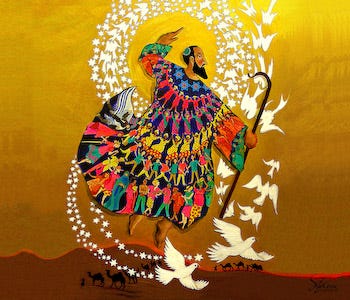
Zornberg points out that the themes of remembering and forgetting play a crucial role in the entire drama. Or as she has it: “Re-membering the Dismembered.” Joseph himself is dismembered by his brothers. They rip the coat of many colors from him, dip it in goat’s blood, send it to their father, and ask him to identify it: “Is this not Joseph’s coat we found?” Jacob cries out: “It is my son’s robe! A wild animal has devoured him; Joseph has surely been torn to pieces” (Gen. 37:33).
In Hebrew that last line is only three eerily rhyming words: Tarof toraf Yosef.
Joseph is torn apart. Jacob is wrong, but he’s also right. The brothers were the wild animals that “flayed” and “dismembered” Joseph so that he would not be a threat to them ever again. They were Cain and he was Abel.
The rest of the story is about re-membering what was dismembered. Putting the broken, fragmented pieces of Joseph (and his brothers) back together through the act of remembering.
Re-membered
Zornberg asks: What happened at the pit that day? It seems straightforward. We tell the story to children and we reprise Genesis 37. But is it so simple? Perhaps not.
At the beginning of Genesis 37 the 10 brothers decide all together to kill Joseph. They are of one mind on the issue. But Reuben speaks up. He’s the oldest. Reuben saves Joseph by saying, “Let us not commit murder.” Zornberg says that in Hebrew it’s the coldest, most legal way of stating the matter. In other words he is saying, “Let us not commit the crime of murder.” His plea is not filled with compassion for Joseph’s sake. It’s not an appeal for Joseph’s life but an appeal that they not become guilty of the crime of murder. But the narrator says that Reuben said this so that he might rescue him from the pit later.
Twenty-two years pass. Joseph has been a slave in Potiphar’s house, accused of attempting to rape Potiphar’s wife, and thrown into prison (the pit, again!). But he rises out of prison to the right hand of Pharaoh. He is the most powerful person in Egypt.
The famine hits the land and the brothers journey to Egypt to find grain. In Gen. 42 the brothers are all standing together again but the circumstances have been completely reversed. Joseph knows who they are but they do not recognize him. He accuses them of being spies that have come to check out the land. He begins his masquerade—pulling them this way and then that way.
He says that in order from them to prove they are not spies they must go get their youngest brother, Benjamin, and bring him back to Egypt. While they do this he will keep one of the other brothers in prison.
It is at this moment that we get the first confession of what they had done to Joseph twenty-two years earlier. As far as we know, they have never once spoken about it with each other until this moment.
This is the first re-membering of what they dismembered. What do they remember? They re-member their cruelty. Not just the fact that they are guilty of a crime, but that they were overly cruel in a completely callous way. They say:
“Alas, we are paying the penalty for what we did to our brother; we watched him in the anguish of his being when he begged us for his life and we did not hear it. That is why this anguish has come upon us.” (Gen. 42:21)
Joseph was crying for his life but they didn’t hear it. It did not affect them in the moment. Immediately Reuben starts justifying himself:
“Then Reuben answered them, “Did I not tell you not to sin against the child? But you would not hear it.” (Gen. 42:22)
But in Genesis 37 he didn’t say anything like that. Then it was a cold statement that did not show any compassion towards Joseph: “Do not commit the crime of murder.” But now he remembers himself as being compassionate for Joseph. He remembers telling them: “Do not sin against the child!” But, he says, you would not hear it.
So, what really happened by the pit? Zornberg then asks: Is Reuben editing the past to make himself look better? Is he trying to justify his own cruel actions? It’s possible. Memories often do work in the vein of wish-fulfillment. But, Zornberg observes, we do know that it was in his heart to save the child in some way—the text told us he said that calloused thing in order to save him.
The 12th century Rabbi Maimonides says that Reuben did actually say, “Do not sin against the child,” but the brothers wouldn’t hear it. That’s why he shifted to talking about not committing the crime of murder. Genesis 37 does not record it because they did not hear it. It was as if he did not say that at all.
This seems odd until we remember this little detail: “You would not hear it.”
There was something else the brothers would not hear on that day. Did Joseph cry out from the pit? In Genesis 37 we are not told anything about Joseph crying out, begging for his life. We are only told that the brothers went and celebrated with a meal while Joseph was stuck in the pit. But now, twenty-two years later, we are finding out that he did cry.
The brothers re-member. But before this moment it was as if it didn’t really happen. By not hearing Joseph’s cries they dismembered him. They tore him apart. Broke him into pieces.
Zornberg then observes that it is only when someone hears you, acknowledges you, re-members the truth of what has happened to you, that the wound—the trauma—can start to heal.
Joseph has been living a dismembered, broken life ever since that day at the pit. The only way for something that’s been dismembered to be healed is for it to be re-membered.
When Joseph overhears them telling the story of the pit and all that they did to him, he is beginning to be re-membered. They did hear him cry. Reuben did see him as the little child that he was. Joseph is remembered and he begins to weep. Joseph has been in the world of the pit this whole time. His identity has been lost. He is fragmented and dismembered. He himself celebrates the fact that he has forgotten the trauma of the pit.
He names his firstborn son Manasseh for “God has made me forget completely my hardship and my parental home” (Gen. 41:51).
He’s grateful that God has made him forget. He’s thankful he is not haunted by the memory of what they did to him. But the irony of the name is clear: If you name your son “amnesia” have you really forgotten? Something in Joseph wants to remember that he has suffered a wound.
Eventually in the story Joseph cannot continue the masquerade. He has to reveal his true identity to his brothers. He begins to weep again and orders all his Egyptian servants out of the room. He turns to his brothers and says: “I am J…
This is a public episode. If you would like to discuss this with other subscribers or get access to bonus episodes, visit cameroncombs.substack.com
More from Extra Credit Podcast

Q&A with Chris E.W. Green
Nov 23, 2026 · 59m
Office Hours Q&A w/ Dr. Chris Green from TheoCon 26 Our midweek Bible study will not meet this week so I thought I’d share the Office Hours Q&A session with Dr. Chris Green from this year’s TheoCon....
On the Antichrist: “Are You the Antichrist or Should We Look for Another?”
Nov 19, 2026 · 58m
1 John Ep. 3 For many of us it will be shocking to learn that the only uses of the term antichrist in the scriptures come in the letters of John (1 John 2, 4, and 2 John 1). And what may be more...
Christ Is Tempted in Me
Nov 12, 2026 · 55m
1 John Ep. 2 This week we come to the famous division of the three temptations common to humanity that John gives in 1 John 2: the lust of the flesh, the lust of the eyes, and the pride of life. Many,...
The Contradiction of Grace
Nov 5, 2026 · 54m
1 John Ep. 1 “As long as I am imperfect and unruly, neither being obedient to God through the practice of the commandments, nor becoming perfect in knowledge in my mental faculties, Christ must be...

On Self-Love
Oct 29, 2026 · 57m
The Garden of the Heart Ep. 6 This week we turn to the difficult question of self-love. Does the gospel call us to love ourselves? The answer to the question is not a simple or straightforward Yes...

The Erotic Love of God
Oct 15, 2026 · 58m
The Garden of the Heart Ep. 5 This week we turn to discuss Eros—both its terror and its grandeur—and the way in which it reveals the depths of God’s heart for us. It is hard for us to believe, but the...
Take these sermons with you.
Follow Extra Credit Podcast in the Getsermons app to get every new sermon, build playlists, and pick up right where you left off.

