
Gnostic Reformation, Clear and Simple
Questioning the Basics
Jul 25, 2026 · 31m
Prefer sermons downloaded automatically?
About this sermon
Welcome to Gnostic Insights and the Gnostic Reformation on Substack. Before I get into this week’s episode, let me tell you that the entire uninterrupted interview with Bishop Nathan Wilson of The Gnostic Union is now available on YouTube under Cyd Ropp Gnostic Insights playlist. I’ve tried and tried to upload the captioned transcript underneath the video, but neither YouTube nor my video editing software will cooperate. I can only chalk it up to Demiurgic interference, so this must be one important interview! The link is provided here to go straight to it on YouTube. Please “like” it and forward it to friends. Thanks.
This week I exchanged emails with a podcast subscriber that presented me with some excellent questions prompted by recent episodes. I asked his permission to share them with you anonymously. I always treasure sincere observations and questions from subscibers because it prompts my gnosis. So here we go.
Hi Cyd how’s it going? I hope that all is well with you. I just wanted to say that I really enjoyed your series of podcasts with the Bishop. Very interesting to hear some stuff on the unpacking of the original Gnostic texts. I thought that today’s pod about your discussion was also very revealing as somebody who loves history, but it’s giving me an insight into why you are so suspicious of history—would I be right in thinking that you want your texts to be unfiltered from various historical takes from different flawed human recounters?
Yes. It is a common saying that history is written by the victors. This refers to the fact that the winners of wars, both physical killing wars and more subtle ideological wars, write the narratives of their opponents from then on. This is why we have had a couple of thousand years of hearing only one side of the gnostic story and one conventionally accepted version of Christian theology. And we have heard that version from Catholic Councils of the 4th century on down through the Protestant churches of today. The surviving descriptions of the nature of gnosticism were written by those who hated gnosticism, and their work is still read and venerated to this day. And I can tell you that even in the little village I live in, the church folks who have no idea what gnosticism even is are dead set against it and dead set against my efforts of sharing my gnostic insights with them and others—and they let me know of their disapproval.
I think these divisive times we are living through now also illustrate how what passes for truth is malleable and untrustworthy. We can all see for ourselves how half of the population characterizes the big picture one way and half of the population characterizes it in a completely different way—and these two sides of the ideological divide are incommensurate with each other. Incommensurate is one of those big words I learned during my graduate studies in rhetoric. It means exclusive—both can’t be right—you can’t hold both positions—it’s either or. So if you extrapolate the culture wars forward a few hundred or a few thousand years into the future, how will history frame the disputes that are currently raging through society? If, for example, socialism finally wins out do you think capitalism will be fairly represented? The reverse is also true, and the winner of this tug of war will be the one who lives to tells the tale.
My correspondent goes on to say:
I think it must be very appealing to be able to narrow down everything into one text and say that we are only going to look at this one source of right thing for the true knowledge. I think this approach has led us to the Bible and the Koran and other food containers which some followers take quite literally and interpret very strictly. There must be safety and comfort in this approach which could be described as textual at best—literal and possibly in a kind way, and without any judgement, fundamentalist, in its true essence. However, and I expect you are waiting for the but… What is listening whilst listening?
He continues:
It did occur to me that what you are basically saying is that everything in the Tripartite Tractate is correct. And all of the other texts are interesting, though they may be not to be taken seriously because they are myths. Surely it must’ve occurred to you that the writer of the Tripartite Tractate was also a human, and ergo—a product of the culture that surrounded him or her? Knowing you to be such a thoughtful and perceptive person, is there something I’m missing here? What is objectively different about the Tripartite Tractate, written by a human, just like all of those other gnostic texts? I am not trying to score points here, I genuinely would like an answer.
To which I respond: Truly I do not agree with everything the Tripartite Tractate says and, conversely, much of what the other books say is right, though obscured with layers and language of mythology.
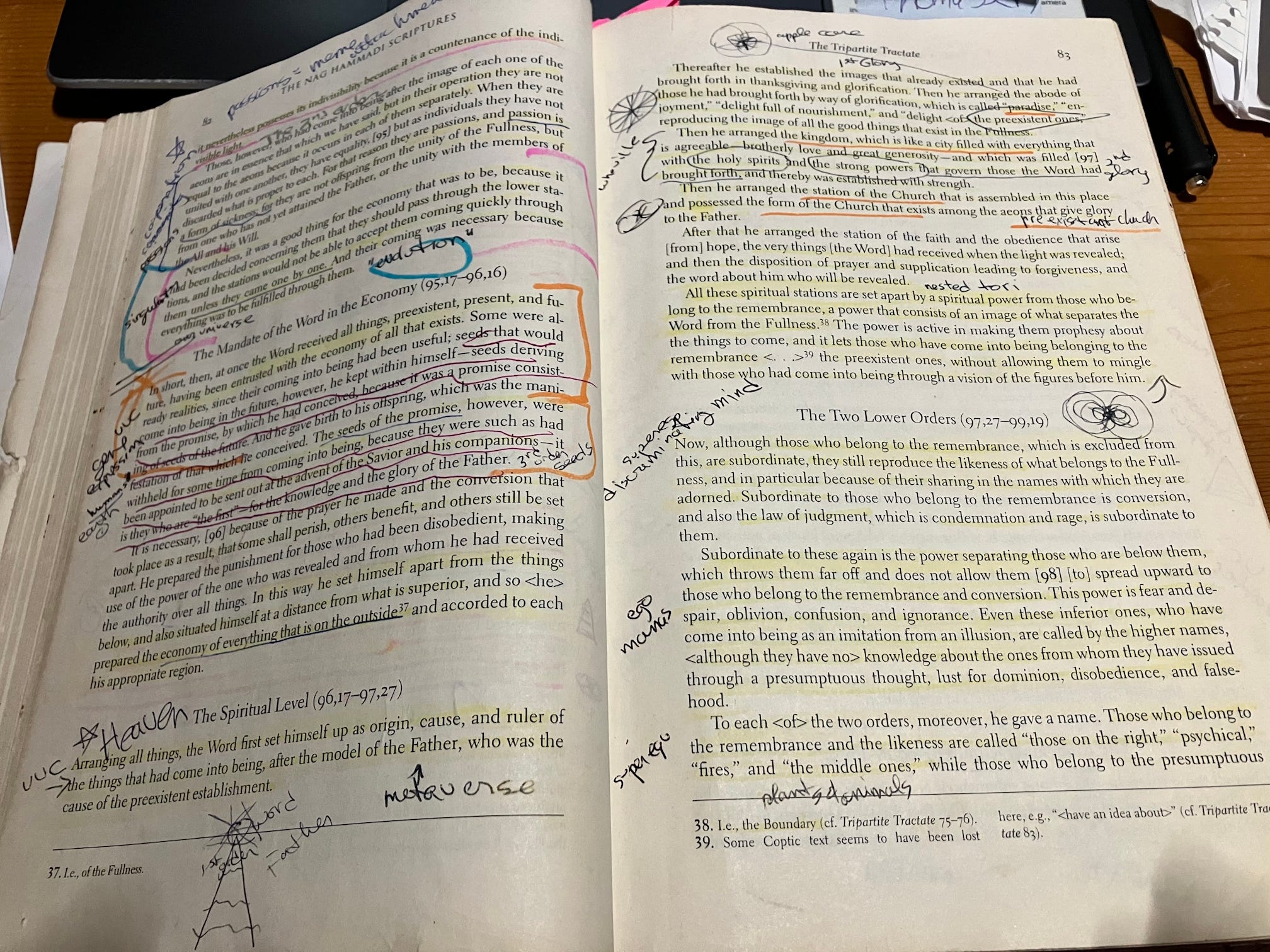
The difference between the Tripartite Tractate and the other gnostic texts is that it stands alone and doesn’t depend upon a preexisting mythology to make sense. By that I mean that the Tripartite Tractate is a logical argument that any Sophist would be proud of. It speaks in the language of symbolic logic rather than mythology or (purported) history. The Tripartite Tractate begins with a starting premise (a priori) that in the beginning was consciousness without form. It then proposes a method by which consciousness and its attendant qualities, such as power and love, emanate from the origin and make their way downstream into us and other living creatures. It calls the descent of consciousness a fall, but does not condemn the fall, as it was necessary to escape the purely ethereal and create matter. It describes the fall as a “presumptuous thought” choice by Mr. Rationality itself—Logos. I characterize this presumptuous thought as the first action of “ego” made independently outside of the cooperation of the Fullness. This all seems to me to be an entirely rational argument that simply describes the process of the distribution of consciousness. We don’t have to argue the originating premise because our consciousness is self-evident. We are asking where it came from and going upstream until we reach a logical a priori starting point.
A lot of what I share at Gnostic Insights comes from my own Theory of Everything—A Simple Explanation of Absolutely Everything—that I conceived and wrote 20 years ago, without benefit of any gnostic texts. So that lens informs my reading of the gnostic books. And I immediately recognized my own T.O.E. when I first read the Tripartite Tractate. The Simple Explanation is written using secular, non-religious language and lots of science and math. My illustrations and charts are different than my gnostic illustrations and charts. But the master chart is identical.
The Tripartite Tractate did give me an answer I had been chewing over within the Simple Explanation, that being the difference between living creatures and inert elemental matter. I appreciated that clarification and incorporated it into the Simple Explanation. Otherwise, the book still stands as True. What is meant by True in this philosophical sense is whether or not the argument is coherent and internally consistent and comports with direct observation of the world.
Now, as to whether or not I believe that only the Tripartite Tractate is true gnosis and the other gnostic books are mostly mythological–that is not the way I would put it. I don’t take the Tripartite Tractate as more holy than other books, and there are a couple of aspects I don’t fully understand or agree with.
For example, the Tripartite Tractate aligns with other gnostic books in saying that there are three types of humans—the spiritual—called the pneumatic; the ordinary, emotional type called the psychic; and the material, called the hylic. The Tripartite Tractate doesn’t seem to think that the hylic types are true second order powers and that they didn’t exist in the beginning and will not return to the et…
This is a public episode. If you'd like to discuss this with other subscribers or get access to bonus episodes, visit cydropp.substack.com/subscribe
More from Gnostic Reformation, Clear and Simple
Verse 16 Gnosis of the Tao
Nov 20, 2026 · 19m
Welcome back to Gnostic Insights and to the Gnostic Reformation on Substack. Recently, we’ve been looking at verses out of the Tao Te Ching by Lao Tzu.And for those of you who are new to the...
A Simple Model of Memes, part 3
Nov 12, 2026 · 19m
Over the past two podcast episodes, you’ve been introduced to a number of Simple Explanation memes, and we’re building up a nice sized meme chord of shared definitions. We have taken a brief tour of...

A Simple Model of Memes Part Two
Nov 6, 2026 · 21m
This publication explores philosophical, spiritual, and contemplative subjects whose meanings often depend upon nuance, context, and specialized terminology. Translations are provided as a service...
A Simple Model of Memes, pt. 1
Oct 30, 2026 · 27m
Memes are the cultural expressions of societies, and their content is information. Memes, in other words, are the “stuff” of symbolic thought. Everyone holds their own personal bundle of memes tightly...
Mining Gnosis Through the Tao Te Ching-- Verse 53.
Oct 24, 2026 · 19m
Welcome back to Gnostic Insights and to the Gnostic Reformation on Substack. For the past few weeks, we’ve been looking at the ancient Chinese wisdom book called the Tao Te Ching by Lao Tzu. I...

Mining Gnosis Through the Tao Te Ching, verse 6
Oct 17, 2026 · 21m
Welcome back to Gnostic Insights and to the Gnostic Reformation on Substack. We’re proceeding through a study of the Tao Te Ching and how it relates to our Gnostic beliefs. Today we’re going to have a...
Take these sermons with you.
Follow Gnostic Reformation, Clear and Simple in the Getsermons app to get every new sermon, build playlists, and pick up right where you left off.

