
Gnostic Reformation, Clear and Simple
Yearning for the Pleroma
Jun 20, 2025 · 26m
Prefer sermons downloaded automatically?
About this sermon
Ten years ago, back in July 22nd of 2015, I wrote one of my first articles about Gnosticism on my Simple Explanation blog, and I'm going to read from that for you today. This was very soon after I began to realize that the Orthodox Christianity that I had been strongly embracing for all of my life could be enhanced by this knowledge of Gnosticism.
I had been trained up to believe that Gnosticism was a heresy, and it takes many years for a very strong believer in Christianity to even be willing to consider Gnosticism as another sect of Christianity. So while not being willing to give up my belief in the Christ as our salvation, and not being willing to demote my relationship with Jesus, because I can't deny that since I personally know it to be true, I was at last able to begin reading the Nag Hammadi texts. I was particularly taken by the text called the Tripartite Tractate, which is the one that I share with you mostly on this Gnostic Insights podcast.
So let me share with you now this first article that I wrote in 2015 called Yearning for the Pleroma, which is still posted on my long-running Simple Explanation blog. This was originally broadcasted as an episode in August of 2021, which was before I started posting episodes to Substack, so my Substack readers have never seen or heard this episode. Also, for those of you who have been following Gnostic Insights from the beginning, you haven’t ever had a chance to read the transcript, so here it is. As I said, this article is ten years old. I hadn’t yet developed the illustrations that have become so familiar by now, which you can see throughout the Gnostic Insights transcripts and in The Gnostic Gospel Illuminated book from 2019. This episode features my first attempt at diagramming the gnostic cosmology. The concepts still hold up, although the artwork is more colorful and polished today.
This is called Yearning for the Pleroma.
Other words for the Gnostic word "pleroma" include the "Fullness," the "All," the "Totalities," and "the circle of divine attributes," which gives you a pretty good idea of what pleroma means. The way wikipedia defines the term is much more challenging and kind of discouraging because of its complexity, especially the section on Gnosticism. Wikipedia cites 17 uses of the Greek word kenoma that is usually translated as “fullness,” with only one usage of pleroma as we Gnostics would define it.Only one book of the Bible mentions the Pleroma--a letter written to the church in Colosse by the apostle Paul. In the translation of Colossians 2:9 below, Pleroma has been rendered as "the fullness.""For in Him [Christ] dwells all the fullness of the Godhead bodily; and you are complete in Him, who is the head of all principality and power" (Col. 2:9).The footnote under this verse in my edition of the New King James Version goes on to completely misinterpret the meaning of the statement in its rush to dismiss the Gnostic implications of the verse. The Nelson editors contend that "the Gnostics thought the fullness of God had been divided among a number of angelic beings, the last creating the material world. In contrast, Paul says that the fullness of God exists in Christ... This contradicts the Gnostic idea of the inherent evil of physical bodies and the claim that Jesus is merely a spirit (p. 2014, Nelson Study Bible. 1997).While I do agree with the opening premise that "the Gnostics thought the fullness of God had been divided among a number of ... beings," there are at least four misrepresentations I see in the Nelson explanation of the verse.First, the idea that the fullness can't be both completely in Christ and at the same time divided into aeons. No need to say, "In contrast," since the two traits are not mutually exclusive. Let's imagine how that would work.
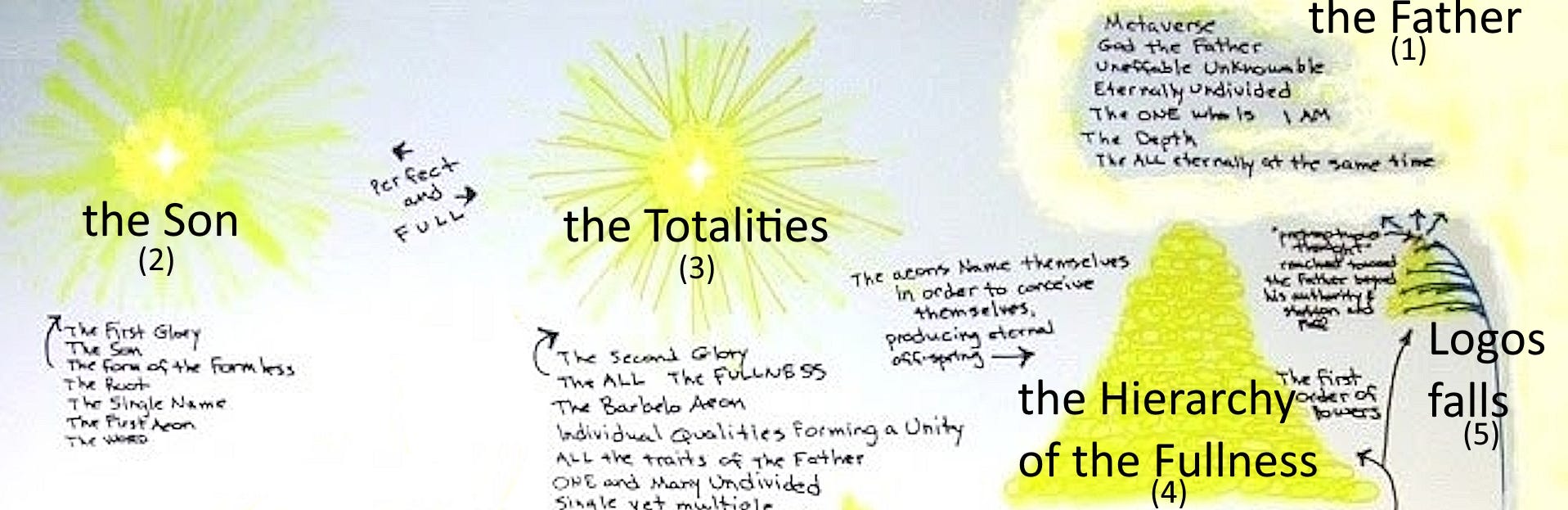
Here are the first four phases of Gnostic Cosmology, according to the Tripartite Tractate. Upper right corner: God the Father represented as the background paper of the entire poster. Upper left corner: I've represented the Son as a diffuse cloud of will. Middle: the Pleroma/the fullness represented as the Son's cloud with distinct lines representing the aeonic traits. The pyramid to the right represents the individual aeons after they have named themselves and differentiated the Son's will into hierarchies of traits and powers.
We begin with the Father, since this is the ground state underlying all else. We all know that the Father is unknowable. Too big, too exalted for us mere mortals to contemplate directly. The Father is the Immortal One who never changes and without whom nothing would exist. The indisputable buck-stops-here God. This being is pure consciousness, without form or distinctions, all quiet, eternally undivided. This is the One Who Is; the Great I Am. In my drawings, the Father is represented as the paper that makes up the poster--all other manifestations arise as images upon the paper and are fully contained by the paper.The Son is represented by the starburst cloud at the upper left, although the starburst is not really light energy, since this is before the creation of Light. This entity is also called the First Aeon, the Root, the Single Name, and The Form of the Formless. The Son contains all of the qualities of the Father, but in a circumscribed form. In today's lingo we would call the Son a holographic representation of the Father, where a small fragment perfectly emulates the larger image. You could think of the Father as the ocean, and the Son as a big bucket of ocean water. It's the same fluid. And if the bucket remains immersed in the ocean, then not only is the water within and without the bucket identical, the ocean continues to fully contain the bucket of water.The Tripartite Tractate describes how the Son is part of the Father, and then goes on in the same verse to declare the Son as the cause of the Pleroma:"He exists by the Father having him as a thought--that is, his thought about himself, his sensation of himself and of his eternal being... He possesses power, which is his will. For the moment, however, he holds himself back in silence, he who is the greatest, being the cause of the generation of the members of the All into eternal existence" (Tripartite Tractate, verse 56).By this one verse we can see that the Son is within the Father and he also contains the Fullness, in full agreement with Colossians 2:9.My second problem with the Nelson notes is their description of aeons. Aeons are not the same as angels--they're more like features or capabilities. The Tripartite Tractate describes them as "the properties and qualities in which the Father and the Son exist" and equates them with the pre-existent Church (Tripartite Tractate, verse 58). "His offspring, the ones who are, are without number and limit and at the same time indivisible. They have issued from him, the Son and the Father... The Church exists in the dispositions and properties in which the Father and the Son exist... Therefore it subsists in the procreations of innumerable aeons" (Tripartite Tractate, verse 59).While some Aeons are beings with their own self-aware personalities, other aeons are best described as traits and capabilities of the Father and Son."...they were unable to know the depth in which they were; nor was it possible for them to know themselves, nor for them to know anything else. That is, they were with the Father; they did not exist for themselves. Rather, they only had existence in the manner of a seed... like a fetus... not yet come into being" (Tripartite Tractate, verse 60).Third, the Nelson Study Bible footnote confuses Jesus, the physical incarnation of Christ on Earth, with the eternal spirit of Christ, the first Son of the Father, whose image and dwelling predates the Earthly appearance of Jesus. "Now the Savior in fact was a bodily image of something unitary, namely the Fullness" (Tripartite Tractate, verse 116).
The Gnostic gospel I've been studying has …
This is a public episode. If you'd like to discuss this with other subscribers or get access to bonus episodes, visit cydropp.substack.com/subscribe
More from Gnostic Reformation, Clear and Simple

It’s All About the Love
Nov 28, 2026 · 23m
Welcome back to Gnostic Insights and to the Gnostic Reformation on Substack. I hope you all had a good Thanksgiving. We have much to be thankful for.What I’d like to share with you today is possibly...
Verse 16 Gnosis of the Tao
Nov 20, 2026 · 19m
Welcome back to Gnostic Insights and to the Gnostic Reformation on Substack. Recently, we’ve been looking at verses out of the Tao Te Ching by Lao Tzu.And for those of you who are new to the...
A Simple Model of Memes, part 3
Nov 12, 2026 · 19m
Over the past two podcast episodes, you’ve been introduced to a number of Simple Explanation memes, and we’re building up a nice sized meme chord of shared definitions. We have taken a brief tour of...

A Simple Model of Memes Part Two
Nov 6, 2026 · 21m
This publication explores philosophical, spiritual, and contemplative subjects whose meanings often depend upon nuance, context, and specialized terminology. Translations are provided as a service...
A Simple Model of Memes, pt. 1
Oct 30, 2026 · 27m
Memes are the cultural expressions of societies, and their content is information. Memes, in other words, are the “stuff” of symbolic thought. Everyone holds their own personal bundle of memes tightly...
Mining Gnosis Through the Tao Te Ching-- Verse 53.
Oct 24, 2026 · 19m
Welcome back to Gnostic Insights and to the Gnostic Reformation on Substack. For the past few weeks, we’ve been looking at the ancient Chinese wisdom book called the Tao Te Ching by Lao Tzu. I...
Take these sermons with you.
Follow Gnostic Reformation, Clear and Simple in the Getsermons app to get every new sermon, build playlists, and pick up right where you left off.

