
IM Podcasts
Tyler Robinson | Excessive Punishment?
Sep 19, 2025 · 14m
Prefer sermons downloaded automatically?
About this sermon
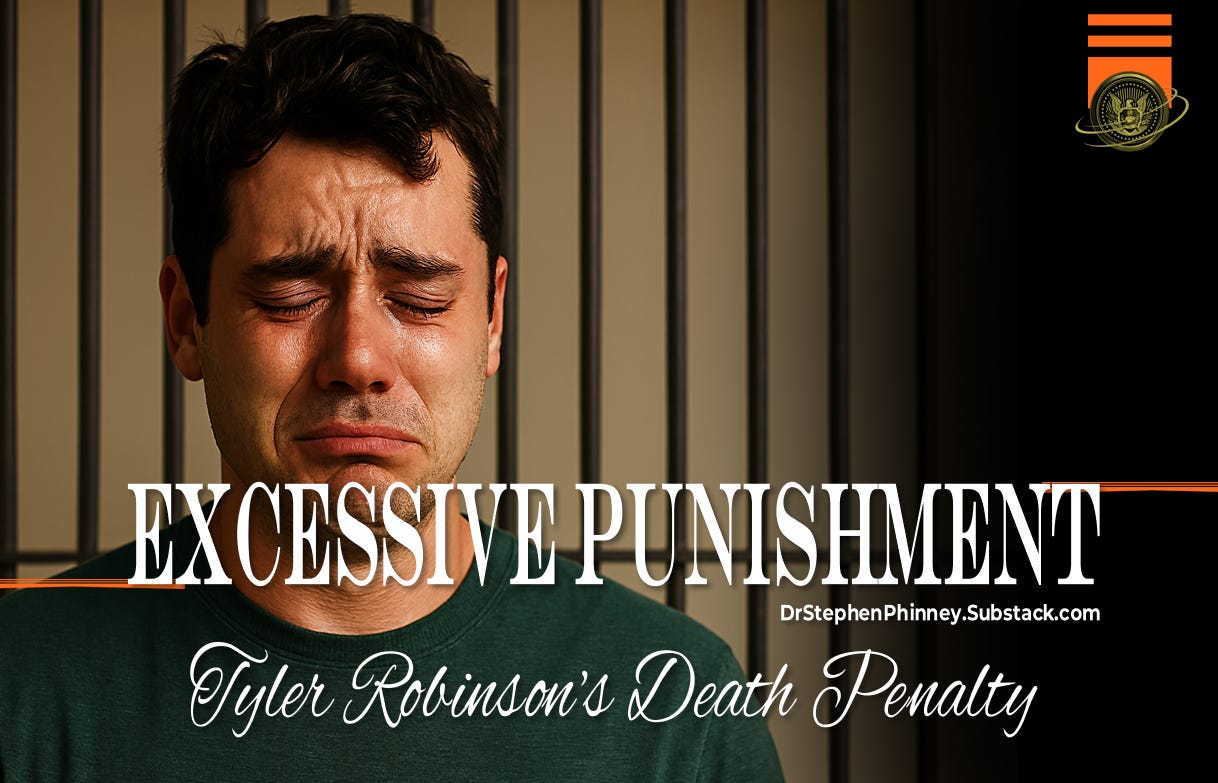
EXCESSIVE PUNISHMENT
This podcast and essay were originally prepared for our Identity Politics Series on our secondary Substack channel, scheduled for release on October 27, 2025. However, at the strong urging of my publisher, we’ve chosen to share it now on our primary platform—The End Times Chronicles. May this message stir your convictions and challenge your thinking. - Dr. Phinney
The Eighth Amendment protects individuals from excessive bail, fines, and cruel or unusual punishment, anchoring the justice system in humane and proportionate treatment.
The Ninth Amendment, often overlooked, affirms that the enumeration of specific rights in the Constitution does not mean that other unlisted rights are denied to the people. Together, these amendments form a vital defense of personal liberty—ensuring that justice is not only fair, but that freedom, particularly in Christ, is not confined to what is merely written. They remind us that the Constitution is a living covenant, designed to protect both the dignity and the divine worth of every citizen.
Justice or punishment? You decide.
In Utah, the decision to pursue the death penalty against Tyler Robinson—the man accused of murdering conservative activist Charlie Kirk—has ignited a national debate over justice versus punishment. Utah County Attorney Jeff Gray stated that the move was made independently, based solely on the nature and evidence of the crime, which included political targeting and endangerment of children. The question remains: is this justice, or retribution? Biblically, justice seeks restoration and accountability under divine order, while punishment alone can reflect vengeance without transformation. In this case, the death penalty is being framed as a defense of sacred freedoms—particularly the right to speak without fear of violence. Whether viewed as justice or punishment, the decision underscores the gravity of the crime and the moral weight carried by those entrusted to uphold the law.
This may ruffle a few feathers, but here’s where I stand…
My belief regarding the death penalty is anchored in the redemptive heart of the Gospel. While justice must be upheld and consequences rightly administered, I hold that every soul—even one guilty of the most grievous crimes—should be given time and opportunity to encounter the saving grace of Yeshua. The Holy Spirit is not bound by prison walls or human verdicts; Biblical Paul proved that. He moves in the darkest places, calling the lost to repentance. To end a life prematurely is to potentially cut short the divine work of conviction, transformation, and salvation. I believe in justice, but I also believe in mercy—and mercy always leaves room for redemption.
Keeping the condemned alive is not a denial of justice, but a declaration of hope. Scripture teaches that “God is not willing that any should perish, but that all should come to repentance” (2 Peter 3:9). If we truly believe in the power of the indwelling Life of Christ, then we must also believe that no one is beyond His reach. The death penalty may satisfy the demands of law, but it can silence the possibility of eternal life. My conviction is simple: let the Holy Spirit have time to work. Let the Gospel be preached. Let grace be extended. Because even in the final hours, Yeshua still saves.
If Tyler were to truly accept Yeshua as his Lord, Savior, and redeeming King, the power of his testimony would be nothing short of transformative for the world.
It would stand as a living witness to the mercy and reach of God—a declaration that no soul is beyond redemption, no act too dark for the light of Christ to penetrate. In a culture gripped by vengeance and despair, such a testimony would pierce through the noise with the unmistakable sound of grace. It would not erase the consequences of his actions, but it would proclaim the miracle of a heart made new.
Tyler’s confession of faith would carry prophetic weight, especially in a time when justice and mercy are often seen as opposites. His story could become a vessel of warning and hope—a sobering reminder of sin’s cost, and a radiant display of Yeshua’s power to save. If genuine, his testimony would not glorify his past, but magnify the One who conquered it. And in doing so, it could call others—perhaps even those most hardened—to consider the reality of a Savior who still reaches into prison cells and whispers, “You are mine.”
Biblical justice is never void of grace, nor does grace negate the consequences of breaking the law. In God’s economy, justice and mercy walk hand in hand. Scripture reveals that true justice is not merely punitive—it is restorative. When a person violates divine or civil law, consequences are necessary to uphold righteousness and protect the innocent. Yet even in judgment, God’s heart remains fixed on redemption. As Romans 3:26 declares, “He is just and the justifier of the one who has faith in Jesus.” This means that justice, rightly administered, can become the very doorway through which grace enters.
When consequences are carried out with integrity and compassion, they create space for repentance. They expose the need for a Savior and invite the offender to encounter the mercy of Yeshua. Grace does not erase the law—it fulfills it through the cross. The thief on the cross still died, but he died redeemed. In this way, biblical justice becomes a sacred instrument: not just to correct behavior, but to awaken hearts. When justice is rooted in truth and tempered by grace, it doesn’t just punish—it restores. And in that restoration, the Gospel shines brightest.
Matthew 5:38–39 (ESV) | “You have heard that it was said, ‘An eye for an eye and a tooth for a tooth.’ But I say to you, Do not resist the one who is evil. But if anyone slaps you on the right cheek, turn to him the other also.”
While “an eye for an eye” may seem logical and even fair in the realm of human justice, it ultimately falls short of solving the deeper problem of sin and spiritual death. Retribution may satisfy the law, but it does not transform the heart. In fact, it can close the door to redemption by ending a life before the soul has a chance to encounter the indwelling Life of Yeshua. God’s justice is not merely about balancing scales—it’s about restoring what was lost. When we prioritize punishment over grace, we risk silencing the very testimony that could emerge from a repentant heart. True justice leaves room for mercy, and mercy opens the way for salvation.
I have no desire to see Tyler burn in Hell—that is not justice, that is eternal loss. My deepest hope is to one day see him standing beside me on Heaven’s side, redeemed by the mercy of Yeshua. No matter the weight of his sin, the cross is heavier still. If the Holy Spirit reaches his heart and he surrenders to the Lordship of Christ, his testimony could become a beacon of grace, not a monument to judgment. That is the power of redemption—and the heart of the Gospel.
How are those features doing?
I was honored to lead an online discussion for a major news network on the deeply controversial topic of delaying the death penalty for a convicted individual. Anchored in my biblical conviction—that every soul deserves time to encounter the indwelling Life of Yeshua—I presented the case for mercy without compromising justice. My premise was simple yet profound: while the law must uphold consequences, it must also leave room for redemption. In that moment, I witnessed something extraordinary—one of America’s leading atheists, known for his staunch opposition to faith-based reasoning, was moved by the spiritual depth and moral clarity of this position, and I was able to lead him to Christ. The conversation shifted from legal theory to eternal truth, and by God’s grace, he engaged not with resistance, but with curiosity. It was a powerful reminder that when biblical justice is presented with grace and conviction, even the most unlikely hearts can be stirred.
Another case I had the privilege of engaging with was that of …
This is a public episode. If you'd like to discuss this with other subscribers or get access to bonus episodes, visit drstephenphinney.substack.com/subscribe
More from IM Podcasts

AGGRESSIVE ATHEISM | Right & Wrong
Nov 15, 2026 · 2m
Atheists debate whether morality is merely subjective or whether a “godless moral realism” can somehow anchor universal moral behavior. But the moment someone claims that any moral truth binds all...

THE DAY AFTER
Nov 4, 2026 · 8m
God Turns a Nation Over to Its PassionsFor the wrath of God is revealed from heaven against all ungodliness and unrighteousness of men, who by their unrighteousness suppress the truth. (Romans...

AGGRESSIVE ATHEISM | Something from Nothing
Oct 11, 2026 · 2m
This question is not merely philosophical; it is existential. Scripture answers this question not with speculation, but with revelation: “In the beginning, God created the heavens and the earth.”...

ATHEISM VS. CREATIONISM (Part Two)
Sep 9, 2026 · 34m
CHRISTIANS WHO BELIEVE LIKE ATHEISTSIn this compelling episode, Dr. Phinney and Roddy Bullock address a growing and deeply concerning trend within the Church: the attempt by many believers to...

ATHEISM VS. CREATIONISM
Sep 2, 2026 · 33m
AGGRESSIVE ATHEISMMy conversation with Roddy Bullock opens the door to a bold new series confronting one of the most pressing ideological battles of our generation: Atheism versus Creationism. With...

AGGRESSIVE ATHEISM | The Problem with Evil
Aug 23, 2026 · 2m
For most atheists, the deepest objection to belief in the Living God centers on the existence of evil. They look at a world filled with suffering, injustice, violence, and tragedy, and conclude that...
Take these sermons with you.
Follow IM Podcasts in the Getsermons app to get every new sermon, build playlists, and pick up right where you left off.

