
Mosaic Boston - Sermons
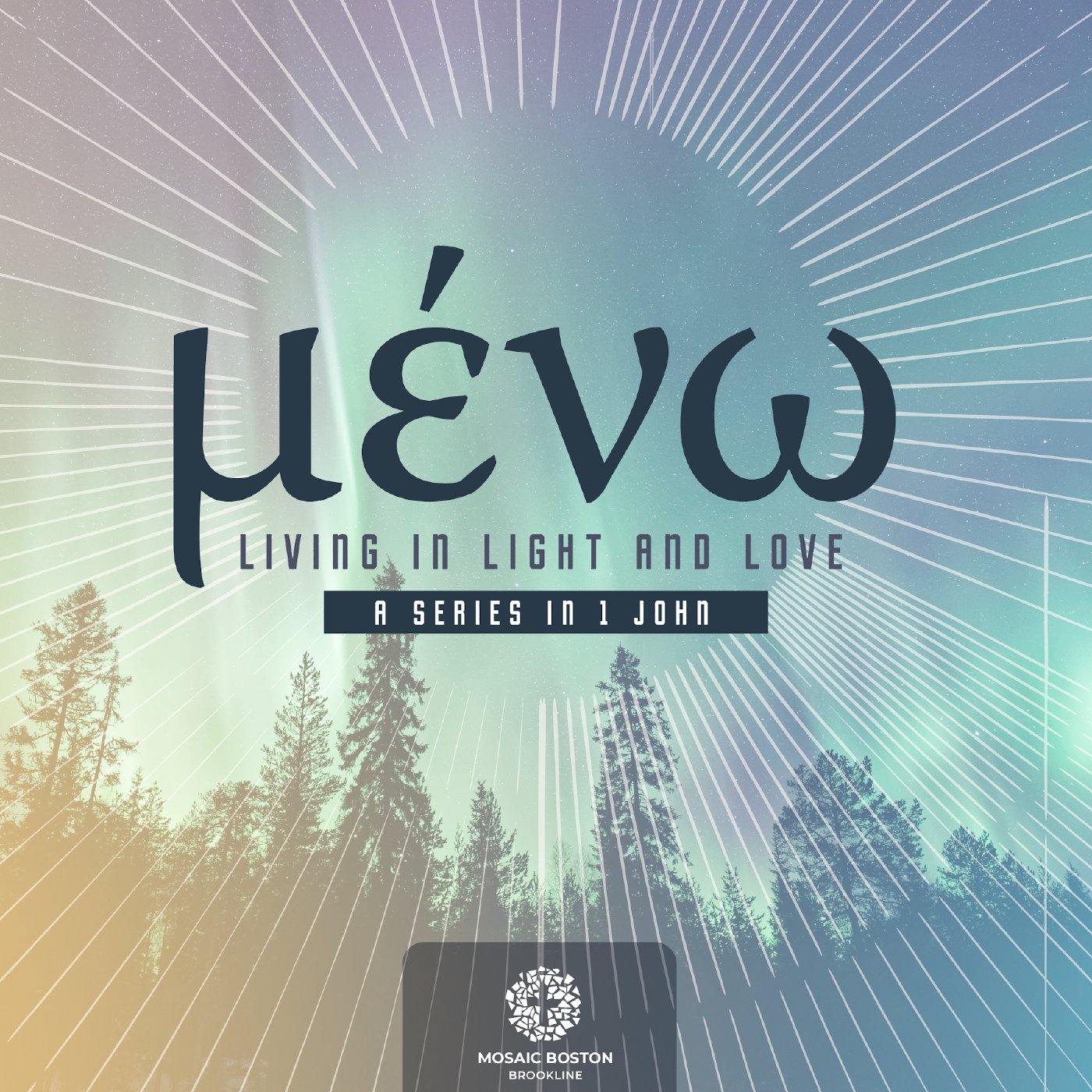
μένω: Living in Light & Love
Jan 5, 2020 · 44m
Prefer sermons downloaded automatically?
About this sermon
Audio Transcript:
You're listening to audio from Mosaic Boston Church. If you'd like to check out more resources, learn about Mosaic Boston and our neighborhood churches, or donate to this ministry, please visit mosaicboston.com.
Heavenly Father, we thank you that you, the God of all light did not leave us in the dark, did not leave us in our own darkness. Instead Lord, that you came and you exposed our darkness through the truth of your son, Jesus Christ. And we thank you Jesus that you didn't just expose our darkness with your light, but you also showed us your love, of how much you love us, that you are willing to die on the cross bearing the penalty for our darkness.
We thank you, Holy Spirit, that through you, we can have fellowship with the father and with the son and with one another because of the gospel. Lord, I pray that you bless our time in the holy scriptures. I pray that you give us grace to confess our sins, reveal where we are still in darkness, the patterns in our life that are still pulling us away from you. I pray, expose those, and as you give us grace to confess those sins, I pray both forgive us and cleanse us. And we pray all this in Jesus' name. Amen.
So we're kicking off the year with a brand new sermon series that we are calling, Meno, Living in Light & Love. And it's a series through 1 John. The word meno is from the Greek, they coined a Greek, the original Greek that the New Testament is written in.
The M, you understand, the next letter, then E, then the V is an N sound in the Greek, and then the W is an O sound, meno. So that's your Greek lesson for the day. You're welcome. So why this word? This word means to abide, to remain, to be connected to. John uses this over 20 times in his very short epistle. And the idea is that we thrive, we flourish, we live life to the fullest when we are connected to God and we are connected to God through Jesus Christ. And we remain in him by walking in light and walking in love because God is light and God is love.
And this whole idea of walking comes from the very beginning of scripture where Adam, he walked with the Lord in the quiet and the cool of the garden. He had a personal relationship, an experiential relationship with God, which then was severed through sin. But then, we see glimpses of this relationship come up in the Old Testament where Enoch walked with God, Noah walked with God, Abraham walked with God.
Jesus Christ comes and he calls his disciples. He said, "Follow me. Walk with me," and this is what the Christian life is. It's not just about rituals and rules, it's about a personal relationship with the god of the universe. Who wrote this epistle? It was the Apostle John, the Disciple John, one of the closest apostles that Jesus had, one of the closest disciples, he had three in the inner circle. He had 12 disciples, but three in the inner circle, Peter, James and John.
And he knew Jesus, he walked with Jesus, he was an eyewitness to the miracles of Jesus and he was actually the one who reclined closest to Jesus at the last supper. He was the one to whom Jesus Christ entrusted his mother, Mary, from the cross. She is now your mother and you are her son. He's the one that actually outran Peter to the empty tomb.
And how do we know that he outran Peter to the empty tomb, and how do we know that he was Jesus' favorite disciple? We get that from the Gospel of John. John wrote that about himself. If I outran the first apostle, I'd write that too. And he's like, "Yeah, Jesus loved me more than anyone else." So John is the guy who he understood Jesus' heart.
Early on, he had anger issues along with his brother, James. They were called the sons of Zebedee. Jesus actually gave them a nickname, the sons of thunder. They would go into a village and the village wouldn't repent. And they're like, let's call down fire from heaven and incinerate everyone. Jesus like, "Hold on." And then actually, the love of Jesus Christ transforms him. And by the end of his life, he's called the apostle of love.
So he writes as a father. He's probably in his late 80s, perhaps early 90s and he's writing to these Christians who are second generation Christians. He calls them beloved. He calls them my little children in the faith. And he writes to them with the purpose of showing them that God's word is timeless, therefore, it's always timely.
They're second generation Christians and the false teachers are coming in and the world is pulling them away from the Lord by saying, "Hey, don't believe in that stuff. It's outdated, it's outlandish, it's outmoded, it's regressive, we're progressive, it's antiquated and we're modern, it's old school, we're new school."
And John says, "No. I'm not even having that argument. I want to show you that this isn't about progression, it's about being outside of time, that we are people in time and we need a word that is outside of us, outside of time. We need an eternal word," and that's how he begins his epistle. This is 1 John 1:1-10. Would you look at the text with me?
That which was from the beginning which we have heard, which we have seen with our eyes, which we looked upon and have touched with our hands concerning the word of life. The life was made manifest and we have seen it and testified to it and reclaim to you the eternal life which was with the father and was made manifest to us that which we have seen and heard.
We proclaim also to you so that you too may have fellowship with us and indeed our fellowship is with the father and with his son, Jesus Christ. And we are writing these things so that our joy may be complete. This is the message we have heard from him and proclaim to you that God is light. In him is no darkness at all.
If we say we have fellowship with him while we walk in darkness, we lie and do not practice the truth, but if we walk in the light as he is in the light, we have fellowship with one another and the blood of Jesus, his son, cleanses us from all sin. If we say we have no sin, we deceive ourselves and the truth is not in us. If we confess our sins, he is faithful and just to forgive us our sins and to cleanse us from all unrighteousness. If we say we have not sinned, we make him a liar and his word is not in us.
This is the reading of God's holy, inherent, infallible, authoritative word, meaning, write these eternal truths upon our hearts. Four points to frame up our time. First of all, you can know Christianity is true. Second, you can know that you're a true Christian. Third, you can show that you're a true Christian and you can show Christianity is true, and those three at the end are the doctrinal test, the moral tests and relational test and I'll explain what that means.
So first of all, you can know Christianity is true. John is writing as a person who has seen Jesus Christ, has heard his words, has actually touched him, has had fellowship with him on a physical level and on a spiritual level and he understands that this is true, like you and I are true, you and I are alive. This is as true as life and death and this is really important because here at Mosaic, and this is what historic Orthodox Christians believe, that Christianity isn't just true because we choose to say it's true.
It's true for everybody if you choose to believe or not, just like gravity is true for everybody, and this is exceptionally counter-cultural because we live in a day and age where the only thing you're allowed to be certain about is that we can't be certain about anything. The only thing that you're allowed to be sure about is that we can't be sure about anything. The only thing you can have true conviction about is that we can't have true conviction about anything. The only authority we're allowed to talk about is the authority that we question.
So John comes in and he's incredibly countercultural. He says that you can know that this is true. You can know that Christianity is the truth from God. And he uses these words over and over. Uses the word ginosko 15 times. The word ginosko in the Greek means to observe and to experience. You observe the truth, you observe Christians, you observe the church, you observe world history and church history and you got to experience it.
Oida is used 25 times, that you can know by reflection. When you take God's truth and you meditate upon it with an open heart, it comes inside your heart. Phaneroo means to make known. It's used nine times. Parrésia, confidence used four times in this epistle. And what he wants is he wants to leave us with certainty that this is true.
1 John 1:1-3, that which was from the beginning, which we have heard, which we have seen with our eyes, which we have looked upon, which we have … By the way, the first time I've ever read this, eyes glare, like what is he talking about? If you separate each one of the words, you're like, "Yeah, I understand those words." But when you bring them together, you're like, "Why in the world?"
And by the way, this is his introduction. I remember at homiletics class in seminary, I was told, whenever you give a speech, whenever you give a sermon, you got to give a very clear introduction that captures people attention, that shows them that you're worth listening to, et cetera, et cetera, et cetera. John does none of that. He begins this epistle with a word that, that which.
John, why are you doing that? Well, what he's doing is he's framing up the very central idea within a few sentences, and I'll explain exactly what he's doing, but what is the subject of this letter? What is the subject of this paragraph? He says, "That which was from the beginning," and use the word which, which we have seen, which we have looked upon, and then at the very center is a subject concerning the word of life.
The life was made manifest and we have seen and testify to the eternal life, which was with the father, verse three, that which we have seen and proclaimed to you, et cetera, et cetera. He said, "This is the subject. The subject of everything I'm talking about is life." It's at the very center of this paragraph. And by life, I mean eternal life and by life and eternal life, I mean Jesus Christ who is the source of all life.
Everything was created through him, flows through him. He sustains all of life. It's the message of life and the messenger of life and they're rooted in eternity. It's unchanging. It's fixed. He's saying this to show us that this truth is eternal. This isn't a truth that can be deemed progressive or regressive, this is a truth that's outside of time because God is outside of time.
There's a church in Coolidge Corner, a very nice building. They have a sign outside that says, putting the progressive back in Christianity. And John was saying, "No, no. Christianity isn't about regressive or progressive, it's actually outside of time because God is outside of time." 1 John 1:8 says, that which was from the beginning.
He's talking about the life, the life that which was from the beginning, Jesus Christ said, "I am the way, the truth, and the life. No one comes to the father, but through me." Jesus has always existed. There was never a time when he was not. He had no beginning, will have no ending. The preexistence of Jesus Christ is the presupposition to the incarnation. He was before he was born.
John actually talks about this in John 1:1-3 in his gospel and there too, he doesn't have a very captivating introduction, but it's theologically sound. In the beginning was the word and the word was with God and the word was God. He was in the beginning with God. All things were made through him and without him was not anything made that was made. In the beginning was the word. The logos in the beginning was Christ.
And what's fascinating is that in both our epistle, 1 John 1 and in the gospel of John, in the Greek, he doesn't use a definite article because in the Greek, there were no definite articles. And the definite article, by the way, this is English refresher from ninth grade. Definite articles are the, indefinite articles are a, and here where it says in the beginning, definite article, that's not in the Greek.
So in the Greek, what it says is in beginning was the word, in beginning was word. And in 1 John it says, that which was from beginning. I'm going somewhere with this. Hold on for just a little second. It doesn't make any sense in English because we need the definite articles to make sense of it. But if you speak another language, some other language don't have the definite articles. Russian for example, no definite articles, no indefinite articles.
So if you meet a Russian speaker and you're like, I have no idea what they're saying, now you know. They don't have definite articles. So if you read this text with the Russian accent, it makes all the sense in the world. That which was from beginning. Yeah, I get that. In beginning was word. Very good. If you wanted to develop the scariest accent that exists, the Russian accent, that's all you do. You just drop the definite and indefinite articles and just talk angry and there you got it.
And this is all to say which beginning, which beginning, which beginning is he talking about? The beginning for us. The beginning for us was not the beginning for the word because Jesus was outside of the word. He has always existed and he comes into the world to bring the light of God. The word became flesh and dwelt among us. And we have seen his glory as the gospel of John says.
So in 1 John 1b and 2b, John says, "This word, which was from the beginning, before the beginning, we have heard, we have seen with our eyes, which we looked upon, have touched with our hands concerning the word of life.
The life was made manifest and we have seen and testify to and proclaim to you the eternal life, which is what the father was made manifest to us, that which was eternal became temporal. The infinite became finite for a while, the spiritual becomes physical and we have seen the manifestation of this word in Jesus Christ. He is life itself."
Verse three, that which we have seen and heard, we proclaim also to you, this word that became flesh was spiritual and becomes the flesh and now, I proclaim to you that same spiritual word through the gospel of Jesus Christ. And he says three times in the first three verses, we saw the incarnate son of God. John is saying, "Why should you listen to me? What are my credentials? On which authority am I standing? Why listen to me? Is it because I have theological degree? No. Is it because I have studied the Greek? No, it's because I was with Jesus. I was with him. I've spent time with him."
John said, "I've heard his voice. I know the tone, the tenor, the cadence of his voice. I know what Jesus smells like. I've seen his miracles. We feasted together. I've seen him in a mountain of transfiguration. I saw his glory. I saw him and the crucifixion on Golgotha. I saw him bleeding for us. The eternal was dying," he said.
And by the way, he's not just saying this so that you can know factually that it's true, you can, because of the historical evidence, because these are true historic events, because the apostolic witness, you could know those things objectively. But John says, "No, it's deeper than that. I don't want you to just know the good news of Jesus Christ in your mind. It's not just cerebral." He says, "I want you to know it in your heart."
And here he talks about the subjective evidence, which is actually objective, and when you think about, but the subjective evidence is you know deep in your heart that it's true. There's nothing more true than the fact that Jesus Christ, the son of God, died for your sins and rose on the third day for your forgiveness.
He said, "I know it's true because the illumination of the Holy Spirit." The Holy Spirit allowed John not just to hear Jesus' voice, but to have it still ringing in his ears and in his heart. He saw Jesus, but now, he sees Jesus on a deeper level and hear what he's talking about is that Jesus Christ, the life, the reality underneath all of reality is the one who makes sense of all reality. The life underneath all of life is the one that makes sense of life.
He says, "I met him and I found meaning for my life through him. I know my purpose through him. I know where I came from. I know who I am and I know where I will spend eternity because of him. The life Jesus Christ." C.S. Lewis has this quote where he talks about Christianity and he says, "I believe in Christianity as I believe that the sun has risen, not only because I see it, but because by it, I see everything else. I believe in Christianity like I believe in the sun, not because I've seen it, but because by it, I see everything else."
This is what Jesus does. Jesus makes sense of every single part of our life, every single part of reality, and Jesus Christ is the only one who can truly satisfy our minds and our hearts. Why do I say that? Because we have these moments in life that you experience this moment and you're like, this is what life is all about, and they're so fleeting.
These little fleeting moments when you feel alive, you've had those moments. Perhaps it's graduating from a program, perhaps victory in something. Perhaps you're on vacation, you're traveling, this is life. I want this to always be, and then like three days later, you're like, I want to go home. They're fleeting. Like the first time you experienced romance or falling in love, you're like, God, this is life. I am pulsating. I'm fully alive.
The first time you get a job, you're like, this is my dream job. And then like a week later, it's just work. That's why they pay you, because you wouldn't do it for free. But it's like a thrill of victory. You won the Super Bowl last year and then every single year, everyone expects you to win every single game. Come on, let someone else win.
And he's saying Christianity is true because historical evidence, the apostolic evidence, you can know all that, but it's true in your heart. When the Holy Spirit illuminates your heart, regenerates your heart, you're given a knowledge, a certainty, a conviction and you don't need physical eyes to see it, to know that it's true.
Lots of people saw the historic Christ. Lots of people saw Jesus Christ come back from the dead. Not everybody believed. 1 Peter 1:8, though you have not seen him, you love him. Though you do not now see him, you believe in him and rejoice with joy that is inexpressible and filled with glory. He fills your heart with this joy in a spiritual level, it's inexpressible, and you see with the truest eyes that you can see the eyes of your soul.
So you can know that Christianity is true. We don't stop there. John doesn't stop there because some people say knows that Christianity is true, the demons believe and they're in trepidation at the fact of God, but there's no love for God. So John says, "You can know that it's true, but then also, you need to know that you're a Christian, that it's transformed you." And this is 0.2, you can know that you're a true Christian, and this is the doctrinal test.
And John does this all throughout the book, and I'll just give you these points here. But for him, the doctrinal test is that you cannot believe that Jesus Christ is the son of God who died on the cross for your sins and rose on the third day unless the Holy Spirit has quickened your heart, regenerated your heart, unless the Holy Spirit lets the lights go on, the illumination of your mind by the Holy Spirit, this illumination, you didn't invent, you didn't cause it to happen and you cannot undo it.
The Holy Spirit has shown this light in your soul and you can't turn it off if you tried. And this illumination, perhaps doesn't prove that Christianity is true. Objectively, that's a historic evidence, the apostolic evidence, but it proves to you that you are a Christian. The most important question that every single one of us needs to answer in this life today is, are you saved?
Are you saved from the wrath to come? Have you been delivered from the domain of darkness and transferred in the kingdom of God's light, the kingdom of his son? Are you saved? Are you a Christian? And if the answer is maybe, this book is for you. If you're not sure of your salvation, if you're not assured that you are a child of God, this book is for you. John wants you to have this assurance.
This is why he's written the book 1 John 5:13. I write these things to you who believe in the name of the son of God that you may know that you have eternal life. Do you know? Can you say with full conviction, full assurance? Yes. If I die right now, I will spend eternity with God. I will spend eternity with Christ. When it comes to Christianity, how you know that you're a Christian isn't because of the works that you've done or the works that you will do, we're saved by grace through faith.
The moment that you believe that Jesus Christ is the son of God who died on the cross for your sins and you repent of your sins, that very moment, you are a Christian because that repentance and that faith is a gift from the Holy Spirit. And if you're like, I'm not sure. This is what I recommend. I recommend you take the gospel of John and that you sit down with an open heart and you ask God, God, please reveal yourself to me. God, is this true? Is this true? Help my unbelief? Is this true?
And I promise you, he will reveal himself to you because the very fact that you would do that with an open heart and desire to be saved, desire to be a Christian is already a sign that he is working in your heart. That's already a gift. And to bolster our assurance, he gives us three tests in this book and we'll deal with this sequentially over the course of the next eight weeks in this series.
The doctrinal test is, do you believe this? Do you believe in the teachings, the word of God concerning Jesus Christ, the God-man and saving work? And then there's also the moral test. Now, if you are in the kingdom of light, if God has shown his light in your life, are you walking in the light? And that's a 0.3 and then 0.4 will be the relational test, so doctrinal, moral, relational.
Three is you can show that you're a true Christian. You can know that Christianity is true. You can know that you're a true Christian and you can show that you're a true Christian through the moral test. Does your life show it? 1 John 1:3, that which we have seen and heard, we proclaim also to you so that you too may have fellowship with us and indeed our fellowship is with the father and with his son Jesus Christ.
And then he uses that same word fellowship two more times on this text in verse six, if we say we have fellowship with him while we walk in darkness, we lie and do not practice the truth. So for him, light and truth are synonymous, darkness and lies are synonymous. But if we walk in the light as he is in the light, we have fellowship with one another and the blood of Jesus, his son, cleanses us from all sin.
Jesus is reality. The word fellowship in the Greek is koinonia. What the word fellowship means is a personal experience of sharing something that's significant. You share something that's significant. Fellowship is the deepest level of friendship. You make it faster. I remember in college one time, I went to a concert with a friend of mine, kind of a friend, he lived down the hall. And we went to the Mighty Mighty Bosstones. And after that, we were in the mosh pit together. And after that, he's like, "Man, I feel like we bonded." And then I never spoke to him again. Very superficial.
The deeper the thing that unites us, the deeper the thing that you share, the deeper your friendship. And the deepest thing that we can share with someone is God. Faith in God, love God, delight in God, desire to obey God. And he says, "We have fellowship with the father and with the son by the power of the Holy Spirit."
And Christianity is a relationship. It's a fellowship with God. It's not just about what you do for God or what God has done, it's about you walking together with God on a daily basis. The fellowship with God, he's saying, is a relationship. And every single relationship takes effort. We're saved by grace through faith. So our relationship with God is without earning, you can't earn it, but it's not without effort.
Every thriving, enduring, flourishing relationship, it takes work. And marriage, it takes work, with your children, it takes work, at friendship, it takes work, our relationship with God takes effort, and that effort is are you pursuing the light? Are you pursuing the light of God? Are you pursuing the truth of God? Are you pursuing to walk in the holiness of God?
And this 1 John 1:5, this is the message we have heard from him and proclaim to you that God is light, in him is no darkness at all. And this is really fascinating because he could have started with God is love. That's true, but he doesn't start with that. Although that's more inviting. Why not just start with God is love? God loves you, Jesus loves you, he starts with God is light.
And the reason why he starts with God is light is because that's how God reveals himself. God reveals himself first of all through his holiness, through his light and then through his love. This is the revelation of God. And John starts with the person of God, not us. And the reason why he does that is because our deepest problem, every single one of us, is that we're self-centered. We are so self-focused, we're selfish.
And I catch myself with this once in a while. How many times today this morning did you think of yourself? In December, I only preached one time here in Mosaic. And I got to listen to the sermons and I came to worship service and I came to every single one of the worship service and I love it. I love being here. But as I'm sitting here, I was just analyzing myself. I'm listening to a sermon and I'm worshiping and I worship for a little bit and then all of a sudden, I'm thinking about I'm hungry or it's too cold or it's too hot. What am I doing after church? Am I going to Los Amigos today?
The music is not as good as usual, or this, or that. And then as I'm sitting, I'm in the presence of God. I am here to focus on God. I'm here to encounter God. I'm just focusing on myself and I'm a professional Christian. And if I do this, you definitely do this. Every single one of us, we're focused on ourselves. Before I got married, I thought I was the most selfless person. I actually told my wife early on. I was like, "You have won the husband lottery. You're welcome. You are so lucky."
She has needs, but I have needs. And then we got through that by the grace of God and then we have a kid and my goodness, they are so selfish. It's all about their needs. What about mine? And here's the thing, a lot of people come to God like that and a lot of churches cater to people and allow people to come to God from a very self-centered place. You approach God and you say, what can God do for me? Why should I follow God? Why should I obey God? Why should I sacrifice for God?
Yeah. If he gives a little joy, I could have a little more happiness. Can God make me happy? Yeah, I want something. Could God give it to me? Or I've got so many problems, can God solve them? And when you approach faith from a very self-centered place, it only deepens your self-centeredness and never fixes it. So John starts here and he starts with, God is light. He's absolutely holy and there's darkness within us and something needs to be done about the darkness in our hearts, about the selfish and the self-centeredness in our hearts. We need to be delivered from it.
And here, the reason primarily why he does that is because we'll never understand God's love until we understand God's light. We'll never understand that when God's light shines into our hearts and exposes the sin and the vile darkness within, until we see who we are before God, we'll never understand his love. We'll never understand the cross, that the cross is the path of salvation. Why can't God just forgive me? He created everything with a word. Why can't he just say, I forgive you? Because he's holy. That's why.
We'll think of the cross as meaningless or unnecessary. And also, starting with God's holiness and God's light, exposes any false claims of fellowship with God. Yeah, I love God. Yeah. I pray in my spare time. I'm a spiritual person. To whom do you pray? Do you pray to a God who is love? Do you pray to a God who sees the sin in your life?
And also, starting with a God who is light allows us to understand what we truly deserve. And this is really important I think because we go through these moments in life when we suffer perhaps or we don't get the things that we expect that we deserve to get. An entitlement begins to creep in and you get something in life.
You're like, I deserve so much better. I expected that I'm going to be in a different place than I am now. God's light, God's holiness shows you know what we deserve? We deserve eternity in hell apart from God experiencing the conscious wrath of God. That's what we deserve. Everything else is grace and it gives us spiritual fortitude to go through the suffering, go through trials, understanding that God is sovereign and also starting with God's holiness.
When we understand this is what we deserve, but this is what God offers because the sacrifice of Jesus Christ on the cross, he offers us eternal life, he offers us forgiveness, he offers us cleansing of all of our sins, fills your heart with incredible light and love and joy and we deepen our fellowship with God by pursuing our walk in light, not in darkness. 1 John 1:6, one six I'm going to give you these three verses and just look at the parallelism.
If we say we have fellowship with him while we walk in darkness. If you say, yeah, I'm a Christian, yeah, my sins are forgiven, but you're pursuing darkness. He says, "We lie and do not practice the truth." Verse eight, if we say we have no sin, we deceive ourselves and the truth is not in us. Verse 10, if we say we have not sinned, we make him a liar and his word is not in us.
And John here is writing against the false teachers who came into this community. And one of the things that they said was, you know what, it doesn't matter how you live in the flesh, in the body, all that matters is what you believe. All that matters is what you do in your spirit. And by bifurcating the spirit from the body, from the flesh, they said nothing that you do in the flesh matters. You can live any way you want.
And then at some point, if you want, come to God, he'll forgive you of your sins and then you keep going to live any way you want. So your spirit is in the light. It doesn't matter what your flesh is. And John says, "That's not how it works. God doesn't just care about our souls. He cares about our bodies because we are embodied spirits. We're spiritual bodies. It's all interconnected." So God does care. And this is why Jesus comes into the flesh. And this is why we can't excuse sin by saying it was done in the flesh.
And here, he says, "Walking in light and walking in darkness." What is he talking about? What does he mean by darkness? He's talking about that sinful part in our hearts that we're deathly afraid to look into. You know it's there. Everybody knows it's there. We know that there's evil, a darkness inside. Movies and books have been written, songs have been written. There's a dark passenger inside.
My high school football coach, Coach Ogletree, great guy, kind of an alcoholic, and he would come to practice drunk. And I remember one time, sophomore year, I was in the varsity team and I was hanging out with some of the older students. So my coach comes to me, he takes me inside, he said, "Jan, do not go over to the dark side."
And I knew exactly what he meant. Just like, you know exactly what I mean. You know exactly what I'm talking to. There's a darkness deep inside. There's things inside that we are deeply ashamed of. It's in every single one of us. So the first thing that we need to do, and what it means to walk in the light, it means to approach God and say, God, you're light. There's darkness in me, but because of the grace of Jesus Christ, because of the blood of Christ, there is cleansing. There is forgiveness.
I'm going to take steps toward you as I do. I see more of my darkness because there's more of the light. I'm not running. I'm not turning away from the sin. I'm not ignoring. I'm not denying my sins. I'm not customizing truth to my life. I'm customizing life to the truth. I'm adapting my life. I'm approaching the light, not running from it.
1 John 1:7, but if we walk in the light as he is in the light, we have fellowship with one another and the blood of Jesus, his son, cleanses us from all sin. I love this verse because this verse shows us that despite how much darkness there is and despite how many times I fall, and despite how many times I dishonor God with thoughts and inclinations of the heart and desires that are far from God's will, when I approach him and I desire to walk in the light, there's always cleansing. There's always forgiveness.
And what's fascinating is, what he's saying is that there's cleansing not just for people who are in the dark. He's not saying the blood of Jesus cleanses us from sin when we're walking in the dark because we need cleansing, he's saying, even when you're walking in the light, meaning, even if you are walking with Christ every single day of your life from now on until you die, you still need cleansing.
The closer you come to the light, the more exposed, the more you realize that you need cleansing. And verse nine, if we confess our sins, he's faithful and just to forgive us our sins and to cleanse us from all unrighteousness. What's fascinating is he doesn't just say that Jesus forgives us of our sins. He doesn't just say that Jesus forgives us of our unrighteousness, he says that Jesus cleanses us from our sins.
I like that. Do you know why this is important? Because I feel this in my own heart, that as you're walking with the Lord, there are seasons where it's like, yeah, I know my sins are forgiven. I know I'm not under the condemnation of God, but I also feel like my soul is gunked up.
If you think about cleansing, perhaps it's after the holidays, you just ate so much junk and you're like, I need a cleanse. I need to fast. I need to become a vegan. I need to do something. I need a cleanse. Something like that happens on our souls. The best shower that I ever experienced of cleansing is from a long trip. You take a long trip, like you're traveling back from Europe, couple of planes, and you go home, that first shower.
Airlines know this. If you've ever flown Lufthansa, they give you that little warm towel. You're like, thank you. I had no idea how much I need it. I'm disgusting. We need cleansing. What he's saying is, yes, our sins are forgiven, but dear Christian, you still need cleansing. So where in your life do you need cleansing? Where in your life is there a darkness? Where in your life are you mired in sin? Perhaps a pattern or habitual sin that's pulling you away from God? Perhaps strongholds, secret sins, dark secrets.
And he says, come to God. Come to God, confess your sins and he is faithful and just to cleanse you and to forgive you. Christ didn't die to make us comfortable sinners. And 0.4 is you can show Christianity is true. And this is verse three, that which we have seen and heard, we proclaim also to you so that you too may have fellowship with us. And that's fascinating.
John with you? Yeah, he's talking about himself. He's talking about the apostolic witness. You can have fellowship with the apostles. What does he mean? Where's John right now? Well, he's dead, but his body would turn into a corpse. But where's John right now? He is in the presence of God. He is already experiencing eternity with God, but he's saying you could have fellowship with God the father and God the son, vertical fellowship.
And as you do, you can have a horizontal fellowship with Christians from before you and Christians that come after through this faith in the gospel of Jesus Christ. And it's a fellowship with the father, son and the Holy Spirit by the power of the Holy Spirit. Verse seven, but if we walk in the light as he is in the light, we have fellowship with one another as well. So we don't just have fellowship with God, we don't just have fellowship with Christians before us, the Christians after us, we have fellowship with Christians who are here now.
Do you have fellowship with Christians? Do you have fellowship with brothers and sisters? Because God is your father. Not just friendship, but a fellowship. Now I'll say, look at the connection in verse seven. If we walk in the light as he is in the light, we have fellowship with one another. What's the connection there? The more we pursue God's light, the more we pursue to walk with God. The more we want to spend time with God's children.
The farther we walk away from God's light, the less of a desire we have to spend time with God's children. I've seen this over and over and over where the first sign that someone is walking in the dark, is walking away from the Lord, is they walk away from community with other brothers and sisters who have the Holy Spirit.
So we are to pursue fellowship. We do that in Mosaic through our worship services and our community groups. We pursue fellowship with one another, fellowship that's deeper than friendship. Can you be friends with unbelievers? Yes. Can you have fellowship with unbelievers? No. You can't have the deepest form of connection, intimacy, spiritually speaking.
2 Corinthians says, do not be unequally yoked with unbelievers, but what fellowship has light with darkness? And what we try to develop is light in terms of sharing what's going on in our lives and sharing our failures and our fears and our flaws and our faults. Sin is like mushrooms. It grows in the dark. So we expose those areas to our brothers and sisters and we repent to God and we also confess to one another.
James 5:16, therefore confess your sins to one another and pray for one another that you may be healed and the prayer of a righteous person has great power as it is working. So John says, "The eternal life has come. We proclaim it to you and as we proclaim it to you by grace through faith, you believe in it. You have fellowship with God and we have fellowship with one another and it leads to joy."
And that's verse four 1 John 1, we're writing these things so our joy together may be complete, may be full, may be satisfying so you can know that Christianity is true, you can know that you are a true Christian, you can show that you are a true Christian by walking in the light and you can show the world that you are a Christian, that Christianity is true through your love for other Christians. That's what Jesus said. The world will know that you are my disciples because of your love for one another.
This time, we're going to transition to holy communion. Three things in the holy scripture are called the body of Christ Jesus' physical body, the church which is the body of Christ and also the bread at communion, the bread and the wine are called the body of Christ.
The reason why we celebrate communion is because Jesus told us, "Do this in remembrance of me." We come to holy communion with contrite repentant hearts. Who's the welcome to take part in communion? Anyone who repents of sin. If you are a Christian who is unrepentant, we ask that you refrain. If you are not a Christian and you haven't repented of sin, if you have not believed in Jesus Christ, we ask that you refrain, but even if today, you repent of your sins, say, "Jesus, I confess my sins, there's so much darkness inside. Please forgive me," he forgives you instantaneously and you're welcome to partake.
The usher is going to hand out the elements. The bread symbolizes the body of Christ that's broken for us. The cup symbolizes the blood of Christ that was shed for us to cleanse us from sin. Once you receive the elements, please hold onto them until everyone has received them and then we'll partake together. Would you please pray with me?
Jesus, we thank you for the gospel and we thank you that you didn't just give us words of light and words of love, but you brought both together and both your love and your mercy and your justice and your holiness come together on the cross where, Jesus, you connect us with God, the father. By grace, through faith we can have fellowship with you, fellowship with the father and fellowship with the Holy Spirit.
We want to take some time now to confess our sins. They are many. All too often, we do not love you as you ought to be loved. We don't love neighbor as self, we're too self-focused. Lord, right now, we ask that you ensconce us in your presence, clothe us in your presence so that we focus on you and turn our gaze to you and to the cross of Jesus. And we pray this in Christ's name, amen.
More from Mosaic Boston - Sermons
Jesus Prepares His People to Feast
Nov 22, 2026 · 56m
To Whom Shall We Go?
Nov 15, 2026 · 50m
Faith Is Work
Nov 8, 2026 · 47m
I Am, Do Not Be Afraid
Nov 1, 2026 · 48m
Jesus Feeds Needs
Oct 25, 2026 · 51m
We Are All Witnesses
Oct 18, 2026 · 48m
Take these sermons with you.
Follow Mosaic Boston - Sermons in the Getsermons app to get every new sermon, build playlists, and pick up right where you left off.

