
Pondering with Purpose Podcast
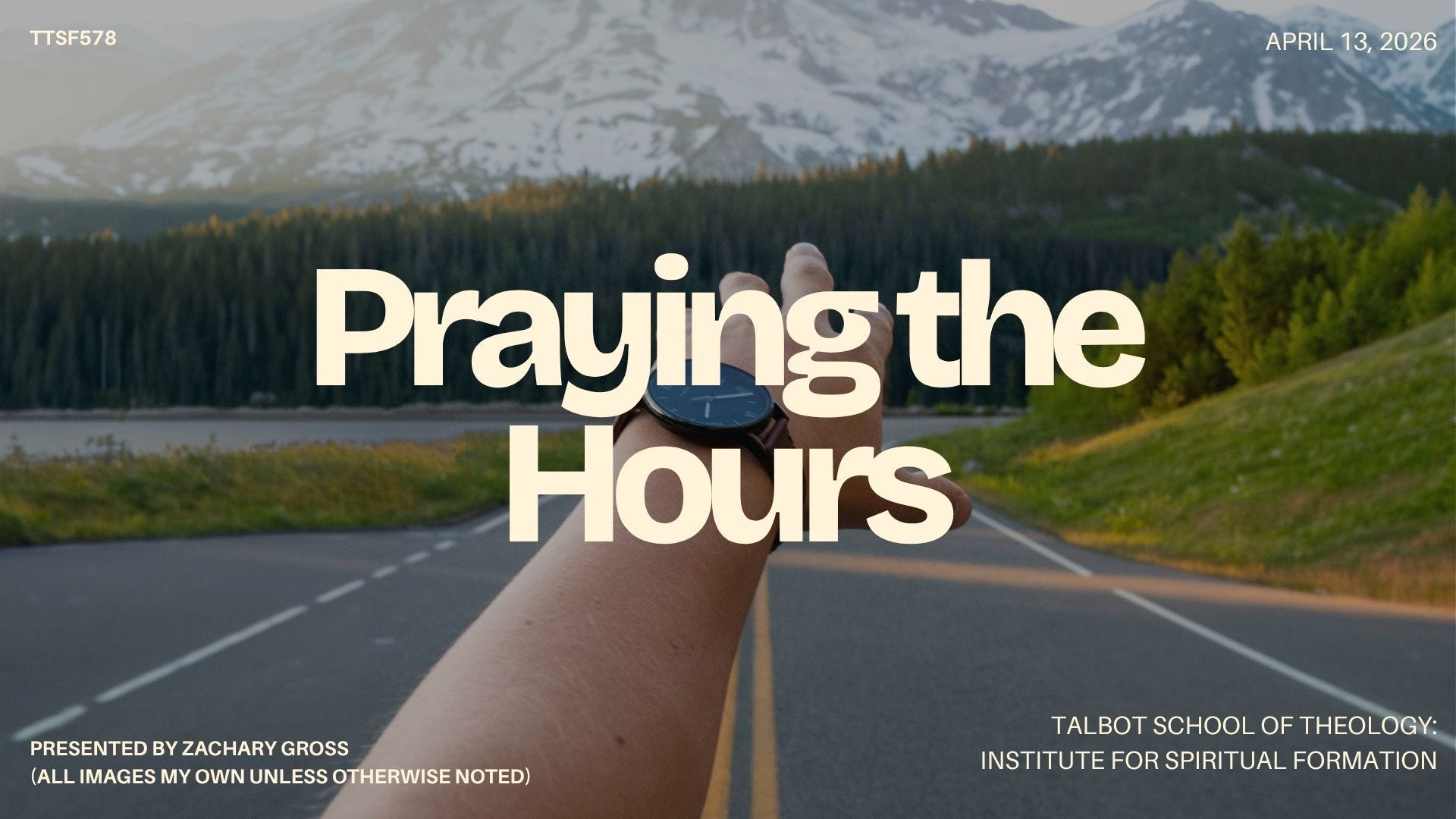
Praying the Hours
Apr 14, 2026 · 22m
Prefer sermons downloaded automatically?
About this sermon
This is an adapted version of a presentation I gave in class on April 13, 2026
Thanks for reading Pondering with Purpose! Subscribe for free to receive new posts and support my work.
I want you to imagine yourself in a world, a Roman world run by the forum bells, your day, your time, highly structured and organized. The bells signal the time for work to start. The bells signal the time for lunch. The bells signal the return to work at the end of the day loud and clear and these secular and ordinary rhythms come to serve as sacred markers. It’s at these times that you choose to pray. Regardless of where you are, you engage in a regular fixed practice of prayer. For the first few centuries of Christianity, this concept was not a thought experiment but reality.
See, the practice of fixed-hour prayer actually originates all the way back in early Judaism with the recitation of the Shema every morning and evening according to Deuteronomy 6:4-7.
The Psalmist even says that he prayed seven times a day (Psalm 119:164), and this practice was inherited and adopted by early Christians. In Acts, Peter and James heal a man on their way to the temple for fixed hour prayer (Acts 3:1). Peter is on the rooftop for fixed hour prayer when he sees the vision of the sheet (Acts 10:9).
This practice of fixed-hour prayer was seen by the early church fathers as a way to obey Paul’s command to pray without ceasing (1 Thessalonians 5:17).
Over the centuries, it has been known by many names. “Praying the hours”, “the daily office”, “the divine office”, “the divine hours” etc That language of “office” comes from Benedict, who described prayer as the “opus dei” which is translated “divine office” in the old English sense of “work”. Prayer is the work of God. For the sake of this project and presentation, I have used the term “fixed-hour” prayer as a way of catching all of these. But all of these names get back to one core idea, which is, that this is a practice of fixed-hour prayer throughout the day, which is structured around recurring times of worship, Scripture, and “psalmody”. It is a way of ordering our lives in such a way that we have regular interruptions that draw attention back to the reality that is the triune God and integrate that awareness into our life experience.
What I hope to show you is that Fixed-hour prayer is a historically continuous yet consistently adaptable Christian tradition that works to theologically structure time, transform attention through repeated liturgy, and aid spiritual directors and directees by externalizing prayer beyond subjective experience.
Bells Sound*
Oh, wait, there’s the bells. I guess before I tell you anymore about it, we’ll have to stop what we’re in the middle of and practice this because that’s how this works. When the bell sounds or the time comes, we pause whatever we’re doing and pray
So we’re gonna use a modern adaptation of fixed-hour prayer from Phyllis Tickle. This is actually how I was initially exposed to fixed-hour prayer, as my retreat partner incorporated this into my retreat and I have been using it ever since. Before each retreat, I will pull up the book for that season and find the morning, midday and evening prayers for the days of my retreat load in those days into my plan. We are going to pray together the morning prayer for the Monday closest to April 13th, which is to be prayed on the hour or half hour between 6-9am.
So let’s walk through this together. We are going to read each part together out loud. This is the specific prayer for the morning, but each of these aspects or titles is present for the midday and evening hours with different psalms. This practice was generally something that was done verbally, whether corporately or alone. Current research, like that published in the journal Psychological Science, says, “A growing body of research has revealed that labeling an emotion, or putting one’s feelings into words, can help to downregulate that affect”, and that is exactly what fixed-hour prayer and the reading of the Psalms can do for its participants. As we read this out loud, we have the opportunity to be helped as our emotions might be named for us as we verbalize it together. In practice, you would definitely slow this way down and leave room for silence, reflection, and meditation, but we’re mostly going to move through it for the sake of time. But let’s breathe for a second and enter a posture of prayer….
How was that for you? Any reflections?
Now that we have experienced it together, let me keep telling you about this sweet practice.
As the practice of fixed-hour prayer developed in early Christianity, it took on diverse forms. After the legalization of Christianity under Constantine, this practice exploded into the public arena with great diversity and with little conformity to standardization in terms of the content and format of the prayers themselves.
Then, with the rise of monasticism, this practice became a little more standardized (and by a little, I mean a little). Even with the significant role of St. Benedict and his rule upon western monasticism, there remained a great diversity and adaptability of this practice. There was diversity in which hours were practiced, what elements were incorporated, and so on.
This diversity remained a consistent aspect in my study of fixed-hour prayer. There was chapter after chapter laying out which elements were in each preserved version we have from every church father. And there were whole chapters dedicated to describing the differences between Eastern and Western fixed-hour prayer and between monastic and cathedral, which is to say for the lay person. In the monastery, the hours were independent of time and were intended to cultivate uninterrupted prayer, whereas the cathedral hours were developed in direct connection with the rising of the sun and the lighting of the evening lamps.
Our contemporary experience of fixed-hour prayer has been revitalized largely due to the Breviary of the Roman church in 1971 and through the Book of Common Prayer, which reformed fixed-hour prayer in the sixteenth century.
The two most ancient hours of prayer are the morning and evening prayers, whose origin, as has already been noted, can be traced back to the reciting of the Shema. The morning hour, which we just experienced together, is oriented around praise and the consecration of the day. Ours had a call to prayer, a request for presence, and of course the refrain, etc., oriented around those themes. The evening hour sees the close of the day through a lens of thanksgiving and repentance and accordingly thanks God for the day’s graces, asks for forgiveness for failures, and protection for the night and instead of a reading, Tickle and others will include a hymn. So even though it is very diverse in whatever form you encounter it the point is that it is highly structured, scripted, and repetitive.
Thanks for reading Pondering with Purpose! This post is public so feel free to share it.
In addition to these two, there rose up at most six more hours of prayer which resulted in eight total times of prayer in Benedict’s time. There were seven during the day in accordance with Psalm 119:164 and one more at night according to Psalm 116:62. These daytime prayers were interruptions in the workday to pray through your work.
There are a few underlying assumptions or foundational concepts that are helpful to name in understanding this practice.
Time as a theological category
Fixed-hour prayer in whatever form it is practiced, imposes meaning onto time. What this practice does is to provide us with a sort of “Sanctification of time” or “liturgy of time.”
Taft describes it this way, “In the liturgical mystery, time becomes transformed into an event, an epiphany of the kingdom of God.” Ultimately, fixed-hour prayer transforms time from a neutral medium into a theological reality. As Reed and Osmer described it this week this helps to foster the conviction that God is present in all of life (p. 1…
This is a public episode. If you would like to discuss this with other subscribers or get access to bonus episodes, visit zackgross.substack.com
More from Pondering with Purpose Podcast
Testing and Tempting
Oct 21, 2026 · 35m
Introduction:How do you figure out if you have real or fool’s gold? How do you figure out what is inside a wrapped present? How do you figure out if a chair can hold your weight? How do you figure out...
Pointing Out What’s Right in Front of Us
Sep 22, 2026 · 27m
The following is a lightly adapted sermon outline for this talk that I gave to my junior high students on October 10, 2024. IntroductionI am wondering how many of us have ever practiced technique...

Making Sense of Brokenness
Jun 16, 2026 · 26m
IntroductionBrokenness is an expected part of life. If I were to take a quick mental survey of the poeple in my life I could think of people who have had to make hard moves, experienced divorce, the...

The Reality of Dependence in Prayer
Jun 2, 2026 · 40m
The following is an adapted version of my teaching at Patmos Reality Discipleship July 2026 through the letter to the Ephesians.This is the final installation in an eight part series through...

The Reality of Our Preparation
May 5, 2026 · 34m
The following is an adapted version of my teaching at Patmos Reality Discipleship July 2026 through the letter to the Ephesians. IntroductionAs we look at this section of Ephesians, it is helpful...

The Reality of the Battle
Mar 31, 2026 · 45m
Thanks for reading Pondering with Purpose! This post is public so feel free to share it.Introduction:My dad has some friends that he likes to go on trips with. They will go to a cabin or go camping...
Take these sermons with you.
Follow Pondering with Purpose Podcast in the Getsermons app to get every new sermon, build playlists, and pick up right where you left off.

