
Science of Spiritual Reality with Mitchell K. Jones
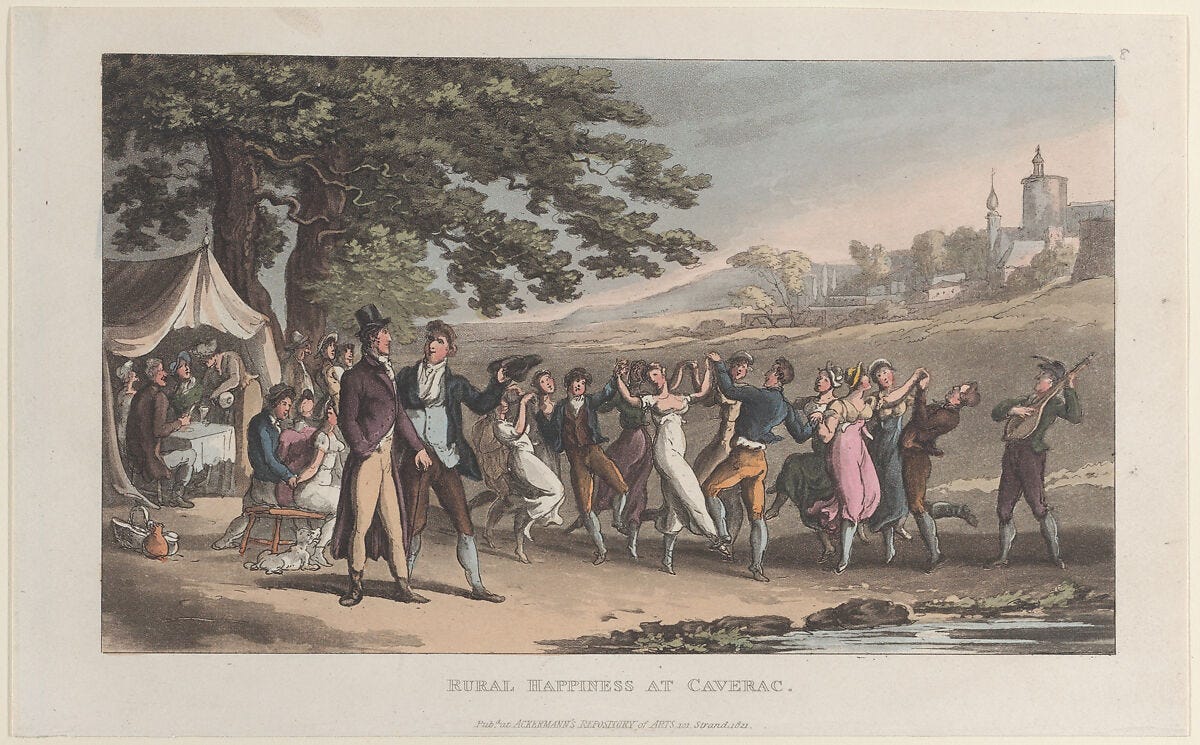
Happiness (1848) by J. B. W.
Jul 8, 2026 · 14m
Prefer sermons downloaded automatically?
About this sermon
“We hold these truths to be self-evident, that all men are created equal, that they are endowed by their Creator with certain unalienable Rights, that among these are Life, Liberty and the pursuit of Happiness.—That to secure these rights, Governments are instituted among Men, deriving their just powers from the consent of the governed…”
— Thomas Jefferson, Declaration of Independence, 1776
“Association is destined to reorganize society on the basis of harmony, for the happiness and elevation of the whole.”
— Albert Brisbane, 1843
Metaphysical meaning of joy (rw)joy--The happiness of God expressed through His perfect idea--man. Joy and gladness are strength-giving, especially if the mind is fixed on the things of Spirit. Affirm: "The joy of the Lord is my strength."
Happiness has long been one of the most contested ideas in modern thought. It appeared simple, almost self-evident, and yet every major intellectual tradition fractured it in a different direction. In the early nineteenth century, reform thinkers like Albert Brisbane argued that the principle of Association would reorganize society toward the “happiness and elevation of the whole,” suggesting that well-being was not merely individual but structural, something produced through properly arranged social relations. In contrast, later critical thinkers such as Slavoj Žižek complicated the very desire for happiness itself, suggesting that what human beings often wanted was not happiness in a direct sense, but participation in something meaningful, even if it involved struggle, contradiction, or dissatisfaction.
Between these poles, older philosophical and spiritual traditions offered another layer. Epicurus treated pleasure not as indulgence but as a sign of balance, an indicator that life was aligned with nature rather than excess or distortion. Swedenborg, in a different key, suggested that disorder and self-deception were not simply obstacles to happiness but already their own form of suffering, where separation from divine order produced its own kind of inner consequence. In the political language of modernity, this tension was already embedded: Locke’s triad of life, liberty, and property became Jefferson’s “pursuit of happiness,” subtly shifting from something secured through right order to something endlessly chased, and therefore perpetually deferred.
Modern psychology complicated this further. Abraham Maslow’s hierarchy of needs suggested that well-being was not a luxury or a bourgeois fantasy, but a layered human necessity that unfolded from survival to belonging to self-actualization. In that sense, happiness was not something reserved for the privileged, but something that emerged when basic needs, social connection, and purpose were held together in balance. It was less a static emotional state than a form of integration. This was why it could be said that happiness was not an escape from struggle, but a condition in which struggle became meaningful rather than disintegrating. It was something to do, someone to love, something to strive for, and something to be loyal to.
It was precisely this tension that early Harmonial and Fourierist Spiritualist writers attempted to resolve. In the pages of The Univercoelum and Spiritual Philosopher, an early Spiritualist periodical emerging in the late 1840s within the broader reform ferment of New York and the Northeast, questions of mind, society, and cosmic law were often treated as parts of a single unfolding system rather than separate domains. The journal stood at the intersection of Fourierist associationism, Transcendentalist reform currents, and the emerging Spiritualist movement associated with figures like Andrew Jackson Davis, and it helped articulate what came to be called Harmonial Philosophy—the idea that the universe was governed by laws of correspondence, attraction, and moral-spiritual equilibrium.
Within this intellectual atmosphere, authors writing in its pages often treated happiness not as a subjective feeling but as the natural outcome of alignment with universal law, particularly through the principle of “passional attraction,” which suggested that human desires were not inherently corrupt but structurally meaningful when properly organized within society. One such essay on happiness was signed only “J. B. W.” Despite its clarity of vision and philosophical coherence, the identity behind those initials remains uncertain. It does not appear in surviving Spiritualist or Fourierist directories, and no definitive biographical record has been found to connect the signature to a known figure in the movement. The author therefore remains a minor, almost spectral presence in the archive—visible through ideas but not through a recoverable life.
In this framework, happiness was neither a private pursuit nor a bourgeois privilege, but the lived expression of a correctly ordered world—where inner life, social form, and natural law moved in the same direction.
HAPPINESS.
But one object should engross the attention of the philanthropist—the production of universal human happiness. To rescue mankind from the depths of vice and degradation; to guide into their proper channels the misdirected faculties of the mind; to disseminate those pure and holy principles which elevate and refine the spiritual nature of man: this should become the delightful task of every lover of his species. To the accomplishment of this end, every lofty and generous spirit, longing for the emancipation of his fellow beings from the thraldom of ignorance and superstition, should direct all his energies with an unwavering zeal and untiring patience.
The first step to be taken for the improvement of the social world is to secure a clear and correct understanding of the cause and nature of those evils which render it a scene of desolation. In order to eradicate a disease, it is indispensable that the physician understand its cause and nature. A correct comprehension of the evils prevailing in the social world will suggest their proper remedies.
What then, let us inquire, are the laws which govern the human mind in respect to happiness? I answer, they may be resolved into one universal immutable law—the principle of Association. For a readier conception of this position, we will briefly consider the operations of this law as manifested throughout the whole fabric of Nature.
Chemistry teaches that there is a certain relationship existing between different substances, which under proper circumstances causes them to meet and unite; such substances are said to have an affinity or affection for each other. Thus oxygen and silicon, when left free, will harmoniously combine and form that substance which enters largely into the composition of the earth’s crust. Substances whose inherent dispositions and interior natures are similar, when brought in contact, will harmoniously associate, and, as it were, combine in a quiet and friendly manner.
Thus throughout the realms of infinitude there is no particle so refined but what it somewhere meets, as it were, with companions whose congeniality of nature provides it with a friendly and harmonious association; and none so gross as to prohibit a similar reception. Consequently, by knowing the inherent qualities or inclinations of a particle of matter, the nature of others which is indispensable for their chemical union is manifest.
The human kind is endowed with the same immutable principle that governs the material universe. Therefore, by knowing the inherent affections or affinities of the mind, the external circumstances and influences congenial to its own nature, satisfactory to its aspirations, and consequently with which it can harmoniously associate, are evident.
From the secret depths and inmost recesses of the human soul are continually springing up the living waters of its unchangi…
This is a public episode. If you'd like to discuss this with other subscribers or get access to bonus episodes, visit mitchellkjones.substack.com/subscribe
More from Science of Spiritual Reality with Mitchell K. Jones

Thanksgiving: Gratitude, the 5th Step in Affirmative Prayer
Nov 21, 2026 · 58m
What does it mean to live with gratitude, even when life presents challenges? In this lesson, we explore Gratitude: The Fifth Step in Affirmative Prayer, examining how appreciation transforms our...

Henry David Thoreau’s Civil Disobedience
Nov 17, 2026 · 56m
Discover Henry David Thoreau’s enduring call for conscience, justice, and resistance to unjust government in Civil Disobedience, presented in a historic 1968 spoken-word recording featuring...
Henry David Thoreau’s Civil Disobedience
Nov 17, 2026 · 56m
Discover Henry David Thoreau’s enduring call for conscience, justice, and resistance to unjust government in Civil Disobedience, presented in a historic 1968 spoken-word recording featuring...
The Twelve Powers of Man, Part 4
Nov 14, 2026 · 1h 26m
The Twelve Powers of Man, Part 4 with Dr. Mitchell K. Jones explores Chapters 7–9 of Charles Fillmore’s classic work on Unity metaphysics: Imagination, Understanding, and Will.What does imagination...
The Twelve Powers of Man, Part 4
Nov 14, 2026 · 1h 26m
The Twelve Powers of Man, Part 4 with Dr. Mitchell K. Jones explores Chapters 7–9 of Charles Fillmore’s classic work on Unity metaphysics: Imagination, Understanding, and Will.What does imagination...

New Harmony: An Example and a Beacon (1971)
Nov 11, 2026 · 28m
Explore the fascinating story of New Harmony, Indiana, in this 1971 documentary New Harmony: An Example and a Beacon, directed by Ledford C. Carter with insights from Donald F. Carmony and Helen...
Take these sermons with you.
Follow Science of Spiritual Reality with Mitchell K. Jones in the Getsermons app to get every new sermon, build playlists, and pick up right where you left off.

