
Science of Spiritual Reality with Mitchell K. Jones
Why We Need Utopian Art Now More Than Ever
Jun 24, 2026 · 16m
Prefer sermons downloaded automatically?
About this sermon
We’ve all heard by now that this is the time of monsters. The story about the government deporting a father while his daughter was deployed to kill people for that very government should remind us all that empires crumble, and this is how.
There is a recurring rule in history. When an empire begins to decay, whether by malice or negligence, it ceases to care for the very people who sustain its power. Some have described fascism as imperialism turned inward. At that point, decline becomes inevitable. Armies go unpaid. Officers forget what they’re supposed to be upholding. Service is rewarded with neglect or even outright contempt from those they’re supposed to be serving. These are signs that the system’s cohesion is dissolving from within.
Thanks for reading! Subscribe for free to receive new posts and support my work.
This pattern appears again and again. In the Roman Empire, unpaid and overstretched legions grew disloyal and fragmented. In the Ottoman Empire, the once-elite Janissaries became demoralized and politicized as the state failed to maintain discipline and purpose, which led to a series of rebellions that ended up tearing the empire apart. In the Spanish Empire, repeated bankruptcies left soldiers undersupplied and mutinous, which led to its gradual decline by financial and military exhaustion in the face of nationalist rebellions in the colonies. And in the Russian Empire, the breakdown of morale among troops and officials under the strain of war helped bring about total collapse and the establishment of the Union of Soviet Socialist Republics based on Marxist Communism, an entirely new form of government the likes of which the world had never seen.
The lesson repeats with almost mechanical certainty. Once an empire neglects those who defend and administer it, it begins to lose not just battles, but its inner coherence. From that point on, decline is no longer a distant threat but an unfolding reality.
But what is the new world? Who is struggling to birth it?
I recently listened to an interview by religious studies scholar Jeffery Kripal, where he said something like, “You can look at Netflix and see a thousand visions of the future, but they’re all negative, they’re all dystopias.”
Kripal, in The Superhumanities, argues that the humanities have been “lobotomized” by stripping out the extraordinary elements of human experience—visions, precognition, mystical states, leaving a narrow, depressing, and overly political view of humanity. He contends that this secular flattening reduces humans to mere data points, ignoring the “vertical dimension” of consciousness, where altered and transcendent experiences provide first-person knowledge of reality. Kripal calls for a “superhumanities” that reclaims the transformative and ecstatic power of literature, art, and intellectual history, treating them as amplifiers of consciousness. By acknowledging these “impossible” or extraordinary aspects of humanity, the humanities can move beyond the purely materialist and political frameworks, embrace utopian and visionary possibilities, and restore a richer, more imaginative understanding of human potential. Kripal urges putting the “weird” back on the table, integrating the immanent and transcendent to fully honor the fantastic dimensions of human life.
In many ways this is what I have tried to do with my dissertation and research on the intersections of enchanted Spiritualism and radical socialism, focusing on Andrew Jackson Davis, John Murray Spear and others.
But we need a utopian imagination now more than ever. The old world IS dying. A new world WILL be coming. The time is now to start building the next one. That starts with utopian imagination.
Edward Bellamy’s Looking Backward (1888) provides a vivid historical example of the power of utopian imagination that Kripal argues the humanities have largely abandoned. In Bellamy’s novel, a man from the late 19th century falls asleep and awakens in the year 2000 to find a society transformed. Industrial production has been collectivized, wealth and labor are equitably distributed, and social harmony has replaced competition and poverty. Bellamy’s vision offered concrete inspiration for rethinking social, economic, and cultural structures.
The book sparked the creation of the Nationalist Clubs, a network of organizations dedicated to spreading Bellamy’s ideas and exploring ways to implement them. Some of these groups even attempted small-scale experiments, establishing utopian colonies such as Kahweh, which sought to live out Bellamy’s principles in practice—communal property, shared labor, and social equality. While most of these experiments ultimately failed due to economic pressures and logistical challenges, they demonstrate the tangible power of imaginative vision to mobilize real-world action.
Ursula K. Le Guin’s The Dispossessed continues this project, depicting an anarchist society that tests the limits of human cooperation, labor, and social equality. It offers readers a chance to inhabit these worlds and experience the structures firsthand as lived possibilities in their imagination. Le Guin offers what she herself called an “ambiguous utopia.” Anarres, her fictional utopian world, is not a nightmare to be escaped, nor a paradise to be idealized. It is a living experiment, full of tensions, contradictions, and ongoing struggles. Conflict arises not from a monolithic tyrant, but from the difficulty of sustaining freedom in practice. The Dispossessed does something dystopian fiction rarely attempts. It treats the future not as a field of moral and social experimentation rather than a cautionary tale. It invites the reader to inhabit a world where better arrangements are possible, while refusing to deny the effort, discipline, and self-critique required to make them real.
That tension mirrors the internal dynamics of horizontal protest movements. In Occupy encampments, for instance, participants attempted leaderless assemblies, consensus decision-making, and shared resources. Like Anarres, these spaces revealed both the beauty and the fragility of cooperation without coercion. Le Guin helped people feel what such a society might be like from the inside, not as an abstract theory but as a daily practice full of friction. Movements like Occupy were not just reacting against capitalism. They were experimenting, often in real time, with forms of life that rejected centralized authority. Occupy’s famous insistence that “another world is possible” is almost a paraphrase of Le Guin’s literary project—showing that different social arrangements are not only conceivable but habitable, even if imperfect.
Le Guin herself articulated the deeper philosophical stake in one of her most widely cited lines:
“We live in capitalism. Its power seems inescapable—but then, so did the divine right of kings.”
That comparison reframes political reality as historically contingent rather than metaphysically fixed. Just as the doctrine of the divine right once appeared natural and eternal until it collapsed under pressure, so too can contemporary economic systems be imagined otherwise.
We remember Aldous Huxley for Brave New World while forgetting his constructive visions. Cultural memory prefers warning over possibility, dystopia over utopia, because dystopias feel urgent and plausible while utopias feel distant and unreal. We remember Aldous Huxley for Brave New World while forgetting that he spent the last decades of his life trying to articulate a constructive alternative. His final novel, Island (1962), was written deliberately as a counterpoint to Brave New World. Where the earlier book was a warning, Island was intended as an offering: a thought experiment about what a humane and spiritually integrated society might look like.
The novel follows Will Farnaby, a cynical Western jo…
This is a public episode. If you'd like to discuss this with other subscribers or get access to bonus episodes, visit mitchellkjones.substack.com/subscribe
More from Science of Spiritual Reality with Mitchell K. Jones
Thanksgiving: Gratitude, the 5th Step in Affirmative Prayer
Nov 21, 2026 · 58m
What does it mean to live with gratitude, even when life presents challenges? In this lesson, we explore Gratitude: The Fifth Step in Affirmative Prayer, examining how appreciation transforms our...
Henry David Thoreau’s Civil Disobedience
Nov 17, 2026 · 56m
Discover Henry David Thoreau’s enduring call for conscience, justice, and resistance to unjust government in Civil Disobedience, presented in a historic 1968 spoken-word recording featuring...
Henry David Thoreau’s Civil Disobedience
Nov 17, 2026 · 56m
Discover Henry David Thoreau’s enduring call for conscience, justice, and resistance to unjust government in Civil Disobedience, presented in a historic 1968 spoken-word recording featuring...
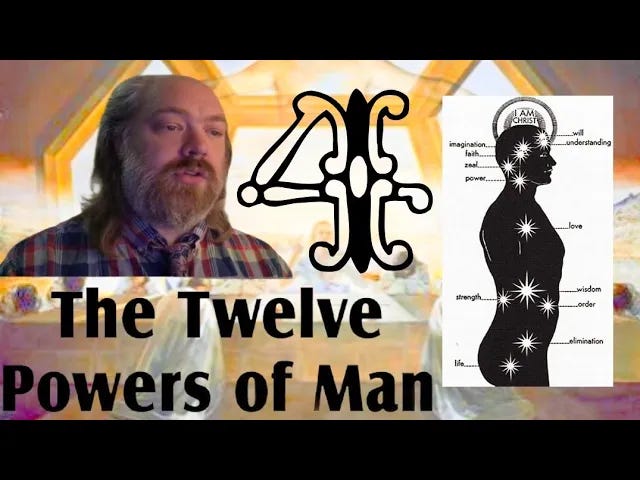
The Twelve Powers of Man, Part 4
Nov 14, 2026 · 1h 26m
The Twelve Powers of Man, Part 4 with Dr. Mitchell K. Jones explores Chapters 7–9 of Charles Fillmore’s classic work on Unity metaphysics: Imagination, Understanding, and Will.What does imagination...
The Twelve Powers of Man, Part 4
Nov 14, 2026 · 1h 26m
The Twelve Powers of Man, Part 4 with Dr. Mitchell K. Jones explores Chapters 7–9 of Charles Fillmore’s classic work on Unity metaphysics: Imagination, Understanding, and Will.What does imagination...
New Harmony: An Example and a Beacon (1971)
Nov 11, 2026 · 28m
Explore the fascinating story of New Harmony, Indiana, in this 1971 documentary New Harmony: An Example and a Beacon, directed by Ledford C. Carter with insights from Donald F. Carmony and Helen...
Take these sermons with you.
Follow Science of Spiritual Reality with Mitchell K. Jones in the Getsermons app to get every new sermon, build playlists, and pick up right where you left off.

