
Scripture-ish
Psalm 2 as Psalm 1: Medieval Jewish Evidence
Feb 12, 2026 · 34m
Prefer sermons downloaded automatically?
About this sermon
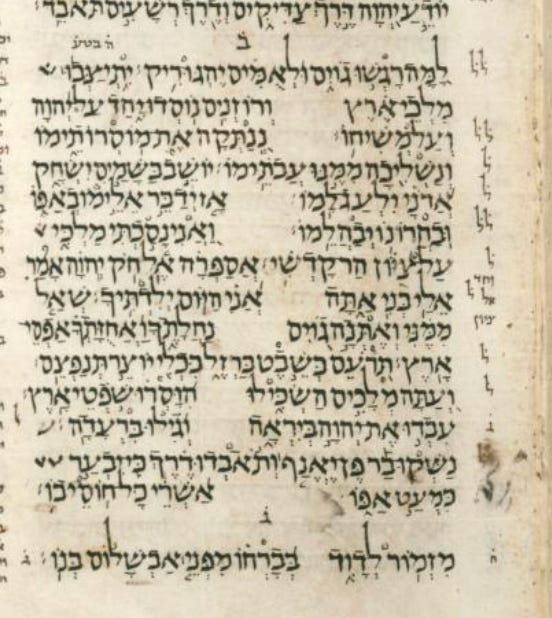
In this post—the last in the series—we cover the ancient evidence that some ancient people did, indeed, consider Psalm 2 (as we call it) the first psalm. How could they do such a thing? Either because Psalm 1 (as we call it) was considered a preface, or because Psalm 2 was considered the second half of Psalm 1.
Get caught up on the series with Part 1, Part 2, Part 3, and Part 4.
Thanks for reading Gallagher! Subscribe for free to receive new posts and support my work.
Rabbinic and Hebrew evidence for variability in psalm numbering
The Midrash on the Psalms 3.2 (sefaria) briefly discusses the reason that the psalms are not in their proper order. In other words, there is a recognition in this text that the Psalms are ordered strangely. The text gives a simple answer for this issue: that’s the way God wants it.
Among the sayings attributed to R. Joshua b. Levi, is this one that assumes that there are 147 psalms in the Psalter. This paragraph is from the Jerusalem Talmud (y. Shabb 16:1, Neusner’s translation, but see also sefaria at §7).
The hundred and forty-seven psalms included in the book of Psalms correspond to the number of years of the life of Jacob, our father [Gen 47:28]. This teaches that all the praises which Israel offer to the Holy One, blessed be he, correspond to the number of years of the life of Jacob, our father. What is the scriptural basis for this view? ‘Yet you are holy, O you that are enthroned upon the praises of Israel’ (Psa 22:3).
So, 147 psalms? In our Bibles, there are 150 psalms, and our English Bibles are translations of the Hebrew book of Psalms, so there should be (one would think) 150 psalms in the Hebrew Psalter. But, according to scholar William Yarchin, medieval Hebrew manuscripts present quite a bit of variation in the presentation of the psalms, even though the actual content is the same across all the medieval manuscripts.
In the quotation below, Yarchin uses the term “TR” for textus receptus, that is, the received text, or the traditional text of the Psalms (traditional for us). The number refers to the psalm number in what we regard as the traditional Psalter, i.e., TR 78 = the psalm we call Psalm 78 (according to the Hebrew, not the LXX).
This observation extends well beyond the commonplace that, for example, the occasional medieval Hebrew manuscript will show TR 1 and 2 as a single psalm, or that some manuscripts divide TR 78 into two psalms. There is much more here. The total body of evidence reveals at least twenty-five different attested conjoinments of what TR presents as two or more discrete psalms and at least thirteen different attested divisions of what TR presents as complete psalms. Moreover, these various conjoinments and divisions appear in a great variety of configurations. The result is that sēper tәhillîm [i.e., the book of Psalms] comes to us comprised of varying psalms totals ranging from 144 to 156, depending on which manuscript is in question. (Yarchin, p. 781)
Yarchin hints at something that we will examine more closely in a moment: that the first two psalms are sometimes treated as a single psalm. In the previous post (part 4 of the series), I mentioned that the Church Fathers occasionally attest to this aspect of the Hebrew Psalter.
Before getting to the Hebrew biblical manuscripts, let’s look at one more example from rabbinic literature in regard to different psalm numbers, and this passage is longer. It’s from the Babylonian Talmud, tractate Berakhot, and it argues from several angles for the combination of Psalms 1–2. The translation below is taken from the Soncino edition, but you can check out the text and translation at sefaria.org, where the passage begins at Berakhot 9b §25. The point of the passage is that the end of Psalm 19 (“let the words of my mouth…”) should be considered the conclusion of the eighteenth psalm, because in that way there would be a parallel with a famous Jewish prayer called the Amidah, a.k.a., the Eighteen Benedictions, a.k.a. the Tefillah. The importance of this passage is shown by its repetition in a briefer version in the Jerusalem Talmud (y. Taanit 2:2; in the Neusner translation at vol. 18, p. 185; or §3 at sefaria).
Here is the Soncino translation of the long passage from the Babylonian Talmud.
See that this verse ‘Let the words of my mouth be acceptable etc..’ [Psa 19:14, English version] is suitable for recital either at the end or the beginning [of the tefillah], why did the Rabbis institute it at the end of the eighteen benedictions? Let it be recited at the beginning?—R. Judah the son of Simeon b. Pazzi said: Since David said it only after eighteen chapters [of the Psalms], the Rabbis too enacted that it should be said after eighteen blessings. But those eighteen Psalms are really nineteen?
Let me pause here just to make sure everyone is following along. Again, the point of the passage is that the words “Let the words of my mouth…” should be considered the conclusion of Psalm 18, even though in our Psalter those words come at the conclusion of Psalm 19. So in the excerpt above, the rabbinic passage raises that objection. It’s “really nineteen” psalms, right? Not eighteen. Here’s the answer:
—‘Happy is the man’ [Psa 1:1] and ‘Why are the nations in an uproar’ [Psa 2:1] form one chapter.
So, the answer is that the first two psalms are combined. Now the text cites an authority as making the same point in a different way, some Rabbi called R. Judah the son of R. Simeon b. Pazzi.
For R. Judah the son of R. Simeon b. Pazzi said: David composed a hundred and three chapters [of Psalms], and he did not say ‘Hallelujah‘ until he saw the downfall of the wicked, as it says, Let sinners cease out of the earth, and let the wicked be no more. Bless the Lord, O my soul. Hallelujah. [Psa 104:35] Now are these a hundred and three? Are they not a hundred and four? You must assume that ‘Happy is the man’ and ‘Why are the nations in an uproar’ form one chapter.
So, again, the only way R. Judah son of R. Simeon b. Pazzi could have been correct in his statement is if he thought that the first two psalms were combined.
Now, here is the conclusion of the passage, presenting one further argument for their combination.
For R. Samuel b. Naḥmani said in the name of R. Joḥanan: Every chapter that was particularly dear to David he commenced with ‘Happy’ and terminated with ‘Happy’. He began with ‘Happy’, as it is written, ‘Happy is the man’, and he terminated with ‘Happy’, as it is written ‘happy are all they that take refuge in Him’.
That is, Psalm 1 begins with the word “happy” (or “blessed”) and Psalm 2 ends with a verse beginning with the word “happy,” and so actually Psalms 1–2 must be a single psalm.
Do I think those are good arguments? Um, no. But the passage does show that some Rabbis considered Psalms 1–2 to be a single psalm. And that explains what is going on with those manuscripts of Acts—and, more importantly (because more of them), the Church Fathers—that cite Psalm 2:7 as coming from “the first psalm.”
Psalm 1 as a preface to the Psalter
This is a pretty common idea in scholarship today: Psalm 1 forms a preface to the Psalter. Scholars usually don’t tie this idea to the psalm numbering, just to the interpretation of the book of Psalms. Gillingham’s 2018 study has an extensive discussion in this vein—or, actually, she argues that Psalms 1–2 both serve as a preface to the Psalter. If we’re looking for evidence that Psalm 2 counted as Psalm 1, Gillingham’s idea (which is not unique to her) wouldn’t work. Willgren’s 2016 study pushes back against the “preface” idea. At any rate, there is a common thought in modern scholarship on the Psalms that Psalm 1, and maybe Psalms 1–2, serve as an introduction or preface. Wenham (2012: 78) says matter-of-factly: “Psalm 1 is the introduction not only to the Psalter but also to the third section of the Hebrew canon, the Writings.” That doesn’t nece…
This is a public episode. If you would like to discuss this with other subscribers or get access to bonus episodes, visit edmongallagher.substack.com
More from Scripture-ish
Self-Control in Sense and Sensibility
Nov 23, 2026 · 39m
“Those who belong to Christ have crucified the flesh with its passions and desires.” (Gal 5:24)In Jane Austen’s debut novel, Sense and Sensibility, which was published 215 years ago, the best scene in...
Sense or Sensibility?
Nov 16, 2026 · 29m
He that is slow to anger is better than the mighty; and he that ruleth his spirit than he that taketh a city. (Proverbs 16:32)In the year 1811, there appeared a book with the following description...
Like Any Other Book?
Nov 9, 2026 · 38m
Should Christians interpret the Bible like any other book? The point of asking this question—the point of phrasing it in this particular way—is to echo a line in an essay written 150 years ago by...
What about the Giants?
Nov 5, 2026 · 22m
A few people recently posed to me a question about the Nephilim in the Bible, which are often identified as giants. Fortunately, I have actually written something about these characters. The following...
Dracula and Martyrdom
Oct 29, 2026 · 30m
I was telling you why I love the 1897 novel Dracula so much, and what lessons I think a Christian might learn from Bram Stoker. Last time I introduced the novel and ended my thoughts with a focus on...
Dracula and the Sacred Wafer
Oct 26, 2026 · 25m
On the morning of May 16, Jonathan Harker began his diary entry with the following words: God preserve my sanity, for to this I am reduced. Safety and the assurance of safety are things of the past....
Take these sermons with you.
Follow Scripture-ish in the Getsermons app to get every new sermon, build playlists, and pick up right where you left off.

