
Scripture-ish
The Minor Prophets in the Septuagint
May 28, 2026 · 17m
Prefer sermons downloaded automatically?
About this sermon
The Minor Prophets were translated into Greek probably sometime in the second century BC, probably either in Egypt or Palestine, and apparently all by a single translator. (See Tov 2019: 130–31.) The same translator was perhaps also responsible for the Greek translation of Jeremiah and Ezekiel. The translation is quite close to the traditional Hebrew text (the Masoretic Text; Tov 2019: 132).
The standard Greek edition of this translation was produced by Joseph Ziegler in 1943 and updated by Felix Albrecht a couple years ago. (For an English translation, see here.)
Thanks for reading Gallagher! Subscribe for free to receive new posts and support my work.
There are six majuscule manuscripts preserving the Minor Prophets.
* the Freer Codex (W), third century AD (information; some images)
* Codex Vaticanus (B), fourth century (images)
* Codex Sinaiticus (S), fourth century (info and images)
* Codex Alexandrinus (A), fifth century (images of a facsimile)
* Codex Marchalianus (Q), sixth century (images)
* Codex Venetus (V), eighth century (Vatican section images; Venetian section)
There are some commentaries on the Septuagint Minor Prophets—a few volumes of Brill’s Septuagint Commentary Series and then a few volumes of the French series La Bible d’Alexandrie.
Sequence
The sequence of books in the Minor Prophets differs between the Septuagint and the Masoretic Text. The difference affects only the first six books. The sequence in the English Bible is based on the Masoretic text, so the sequence likely familiar to you is not the LXX sequence.
* Masoretic Text: Hosea, Joel, Amos, Obadiah, Jonah, Micah
* LXX: Hosea, Amos Micah, Joel, Obadiah, Jonah
The first LXX manuscript that attests this order is the first LXX manuscript that we have (except for the Naḥal Ḥever scroll [DJD edition], which presents a Greek translation of the Minor Prophets revised toward the Hebrew text, possibly including the sequence of books)—yet, it is a third century AD manuscript, so we can still wonder whether the sequence of books in the Codex W reflects the original LXX sequence or whether it was itself altered at some point before this manuscript. At any rate, most Greek manuscripts of the Minor Prophets reflect this “LXX sequence,” but not all. Several ancient commentaries reflect the Masoretic sequence: the commentaries by Theodore and Theodoret. But, then again, these are both Aniochene authors, and the Antiochene Greek manuscripts also reflect the Masoretic sequence. The LXX sequence is reflected in the commentary by Cyril of Alexandria. And the LXX order also appears in 5 Ezra 1:39–40 and an aberrant sequence in Martyrdom of Isaiah 4.22 and the Lives of the Prophets.
Jennifer Dines (2012: 367) suggests that Origen may be responsible for the popularization within Christianity of a ‘Greek’ order that arose among Egyptian Jews.
One Book?
As I mentioned, LXX scholars seem agreed that the translation of all twelve Minor Prophets was produced by a single translator, which suggests that the twelve were seen as a single collection at the time of the translation.
On the other hand, LXX manuscripts—at least the ones I’ve looked at—seem to treat the individual prophets as their own book (as pointed out by Dogniez, pdf, p. 307).
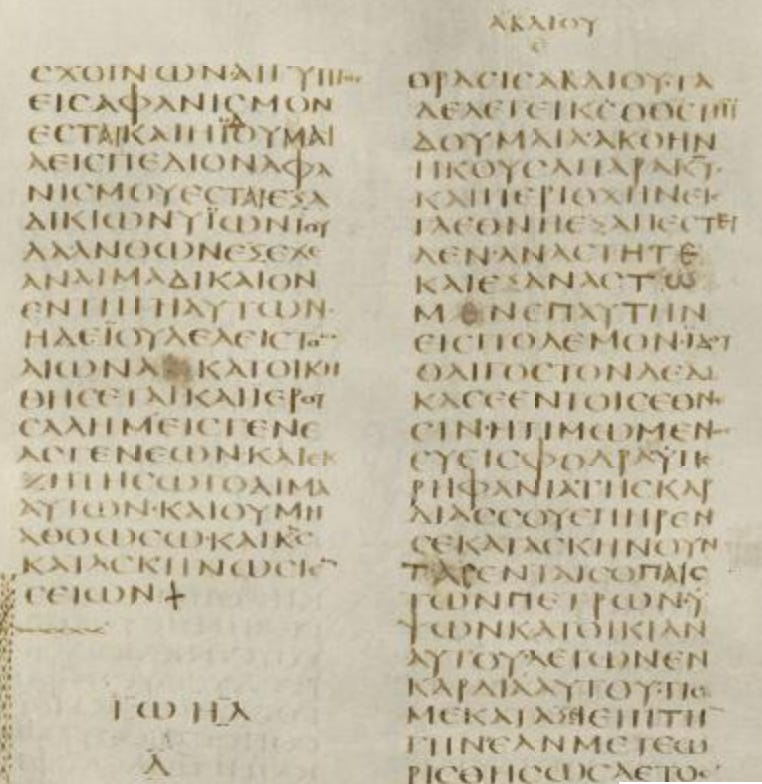
The following image shows Codex Sinaiticus, the end of Joel and the beginning of Obadiah. Note that Joel (ΙΩΗΛ), at the bottom of the left column (signaling the end of the book), has a Δ under it, the fourth letter of the Greek alphabet, showing that it is the fourth in a group of books (according to the Greek order). Obadiah (ΑΒΔΙΟΥ) then, at the top of the right column, is labeled with an epsilon (ε), the fifth letter.
Presumably this numbering suggests that the Twelve Prophets belong together in some way. On the other hand, the end of a book and the beginning of the next looks like the division between books, not parts of a book.
This next image shows Codex Vaticanus, the translation between Amos and Micah. Again, Micah is labeled with a gamma (Γ), the third letter of the Greek alphabet, showing that it belongs in a sequence of books, but the beginning of Micah sure does look like the start of a new book.
The end of Malachi and the start of Isaiah in Codex Vaticanus looks exactly the same, as the next image shows.
So, does the LXX present the Minor Prophets as a single book, or as a group of twelve books? I’d lean toward the idea that it’s a group of twelve books in the LXX, at least in these LXX manuscripts.
One more thing on this point: one of the ways in which scholars sometimes argue that the twelve Minor Prophets should be considered a single book is because of some catchwords linking the end of one book with the beginning of the next. (I’ll talk a little more about this phenomenon in a later post; but for now see here and here.) Modern proposals for such catchwords are usually based on the sequence in the Masoretic Text. There are probably some scholarly proposals for catchwords based on the LXX sequence, but I’m not familiar with those proposals, and—initially, at least—it would seem that the LXX sequence messes up the catchwords. So, again, I would lean toward seeing the weight of the LXX evidence as against the idea that the Minor Prophets are presented to readers as a single book.
Thanks for reading Gallagher! Subscribe for free to receive new posts and support my work.
This is a public episode. If you would like to discuss this with other subscribers or get access to bonus episodes, visit edmongallagher.substack.com
More from Scripture-ish

Self-Control in Sense and Sensibility
Nov 23, 2026 · 39m
“Those who belong to Christ have crucified the flesh with its passions and desires.” (Gal 5:24)In Jane Austen’s debut novel, Sense and Sensibility, which was published 215 years ago, the best scene in...

Sense or Sensibility?
Nov 16, 2026 · 29m
He that is slow to anger is better than the mighty; and he that ruleth his spirit than he that taketh a city. (Proverbs 16:32)In the year 1811, there appeared a book with the following description...
Like Any Other Book?
Nov 9, 2026 · 38m
Should Christians interpret the Bible like any other book? The point of asking this question—the point of phrasing it in this particular way—is to echo a line in an essay written 150 years ago by...
What about the Giants?
Nov 5, 2026 · 22m
A few people recently posed to me a question about the Nephilim in the Bible, which are often identified as giants. Fortunately, I have actually written something about these characters. The following...

Dracula and Martyrdom
Oct 29, 2026 · 30m
I was telling you why I love the 1897 novel Dracula so much, and what lessons I think a Christian might learn from Bram Stoker. Last time I introduced the novel and ended my thoughts with a focus on...

Dracula and the Sacred Wafer
Oct 26, 2026 · 25m
On the morning of May 16, Jonathan Harker began his diary entry with the following words: God preserve my sanity, for to this I am reduced. Safety and the assurance of safety are things of the past....
Take these sermons with you.
Follow Scripture-ish in the Getsermons app to get every new sermon, build playlists, and pick up right where you left off.

