
About this sermon
What do we do with a moment like this?
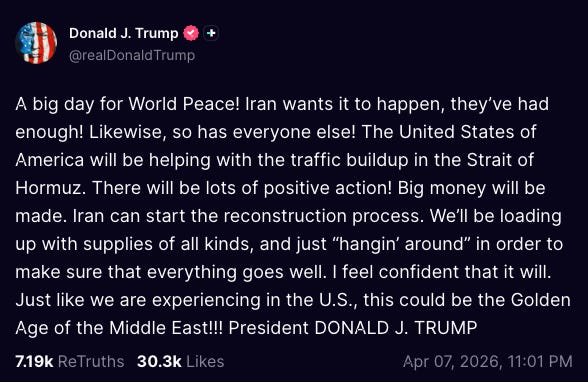
Over Easter weekend, Donald Trump posted a startling warning to Iran on Truth Social, using language many people considered far beneath the dignity of the office of President of the United States. It was not merely aggressive. It was vulgar, theatrical, and openly threatening. To many observers, it looked reckless, excessive, and deeply out of character.
And that is precisely why it deserves a closer look.
Because what if the excess is intentional?
What if going over the top is not a mistake, but part of the design? What if the outrage is not a side effect of the policy, but one of its instruments? That does not prove wisdom, and it certainly does not prove morality. But it does raise a serious question.
What if Trump is not simply stumbling into crisis?
What if he is deliberately forcing one?
At first glance, the mainstream interpretation seems obvious. Trump appears to be pushing the United States toward an unwinnable confrontation with Iran.
He appears to be inflaming allies, provoking trading partners, and straining the very institutions that underwrote the American-led order for decades. In that reading, he looks less like a strategist and more like a man tearing down the walls around him without any clear idea of what comes next.
But that interpretation rests on one major assumption.
It assumes that the visible objective is the real objective.
What if it is not?
What if the true aim is not to preserve the present system, but to break it? What if the goal is not to stabilize the American empire as it has existed since the Cold War, but to dismantle that order and force the emergence of a harsher, more self-contained structure beneath it?
To even consider that possibility, we have to begin with energy.
Modern civilization runs on chokepoints. And one of the most important chokepoints on earth is the Strait of Hormuz. A significant portion of the world’s oil supply still moves through that narrow corridor. If it is disrupted through war, blockade, or sustained instability, the consequences do not remain in the Middle East. They spread outward through every industrial economy dependent on imported fuel, transport, fertilizer, shipping, and food production.
Energy is not just another commodity.
It is the bloodstream of the modern world.
Restrict that flow, and everything downstream begins to tighten. Prices surge. Supply chains harden. Production slows. Food costs rise. Political pressure intensifies. The effects are not regional. They are civilizational.
And yet oil itself is not rare in absolute terms.
What matters is not merely where it exists, but who can secure it, refine it, transport it, and weaponize access to it. In that sense, North America remains uniquely powerful. The United States has massive reserves. Canada has massive reserves. Venezuela has enormous reserves. Taken together, the Western Hemisphere is still one of the richest resource zones on earth.
Now consider the strategic implication.
If Middle Eastern energy flows are restricted while North American production remains available, then the leverage of the Western Hemisphere rises dramatically. Europe becomes more exposed. East Asia becomes more exposed. Nations that have built their economies on steady access to imported energy suddenly find themselves more vulnerable than they appeared only months earlier.
Under those conditions, access to oil, natural gas, fertilizer inputs, transport routes, and industrial capacity becomes a form of hard power.
And that is where this theory becomes more unsettling.
For years, one of the deepest anxieties surrounding the United States has been debt.
America’s financial system has looked increasingly fragile, sustained in large part by global confidence in the dollar and by continued foreign appetite for U.S. Treasury debt. Under normal conditions, analysts worry that foreign creditors could gradually reduce their dependence on dollar assets, diversify into gold or alternative stores of value, and expose the instability beneath the American financial order.
But what if a geopolitical shock changes the entire equation?
What if the same countries that might wish to diversify away from the dollar become more dependent on American-linked resources at the very moment they would prefer to detach?
Then the dynamic reverses.
What appeared to be America’s greatest weakness becomes leverage. Debt no longer appears simply as a liability. It becomes embedded in a wider system of dependence: energy dependence, trade dependence, security dependence, supply-chain dependence. In that scenario, foreign holders of U.S. debt are not merely creditors.
They are also clients of a resource network they cannot easily walk away from.
And if that is true, then a crisis that appears to weaken the United States could actually deepen the world’s dependence upon it.
Seen through that lens, even apparent disorder begins to look different.
A president who appears to be alienating allies may actually be testing which relationships still matter once abundance disappears. A leader who seems willing to trigger an oil shock may be gambling that North America can absorb the shock better than its rivals can. And a government that appears to be tearing up the old rules may be betting that in a fragmented world, self-sufficiency matters more than legitimacy.
This is one reason some look at Russia’s long war posture and see a precedent.
Modern conflict is not only about battlefield gains. It can also function as a mechanism of economic restructuring. Under sanctions, prolonged pressure, and wartime demand, an economy can be redirected toward military production, domestic endurance, industrial adaptation, and strategic resilience.
The lesson some may draw is simple.
If the world is fragmenting anyway, do not cling to openness.
Build the fortress.
And perhaps that is the broader pattern we are seeing here.
Greenland matters because of Arctic access and mineral wealth. Canada matters because of energy, water, and raw materials. Mexico matters because of manufacturing geography and proximity. Venezuela matters because of oil. Panama matters because trade chokepoints always matter. These are not random names on a map. They describe a continental logic.
Secure the base.
Consolidate the hemisphere.
Control the resources.
Prepare for a world in which the old assumptions no longer hold.
If that is the real project, then Trump is not trying to preserve the American empire in its post-Cold War form. He is trying to end it and replace it with something narrower, harder, and more self-sustaining.
That would explain why he can appear so destructive while still serving a larger strategic aim. It would explain why disorder may be useful. It would explain why losing one kind of war could become a way of winning a different kind of struggle altogether.
This does not mean the strategy is moral.
It does not mean it is humane.
It does not mean it will succeed.
But it does make it intelligible.
And that is why the recent Easter post matters so much. It may not just be a rant. It may be a signal. A sign that the language is becoming cruder because the strategy is becoming harder. A sign that diplomacy is giving way to pressure, and pressure to crisis, because crisis is the mechanism through which a new order can be forced into being.
So yes, Trump may look to many people like the most reckless leader in modern American history.
Yes, he may appear to be destroying the very system he inherited.
Yes, he may appear to be stumbling toward a wider war.
But if the hidden objective is to bring the old order down, to lock key nations into renewed dependence on American-controlled resources, and to rebuild power on a narrower, harsher, more durable foundation, then what appears to be failure may be something else entirely.
Not incompetence.
Not madness.
But demolition with a blueprint.
And perhaps the real danger is not simply that Trump is reckless.
Perhaps the real danger is that he is not.
Perhaps what looks like chaos is more …
Get full access to Th30ry at realscottclarke.substack.com/subscribe
More from Th30ry
The Silver Key: Why 2030-2033 May Reveal the Son of Perdition, and finally Jesus Christ Himself
May 15, 2026 · 28m
Why was Joseph betrayed by Judah for 20 pieces of silver, but Jesus was betrayed by Judas for 30 pieces of silver? At first, the difference seems like a minor detail. But when the King James Bible...
The Silver Key: Why 2030 May Reveal the Son of Perdition, and 2033 - the Christ Himself
May 12, 2026 · 28m
What if one of the clearest clues to when Jesus Christ will return to earth has been hiding in two familiar Bible stories? Why was Joseph betrayed by Judah for 20 pieces of silver, but Jesus was...
The Dome of the Rock is Proof that 1948 Was NOT Bible Prophecy
Mar 25, 2026 · 25m
Get full access to Th30ry at realscottclarke.substack.com/subscribe
Take these sermons with you.
Follow Th30ry in the Getsermons app to get every new sermon, build playlists, and pick up right where you left off.

