
What's Better Today?
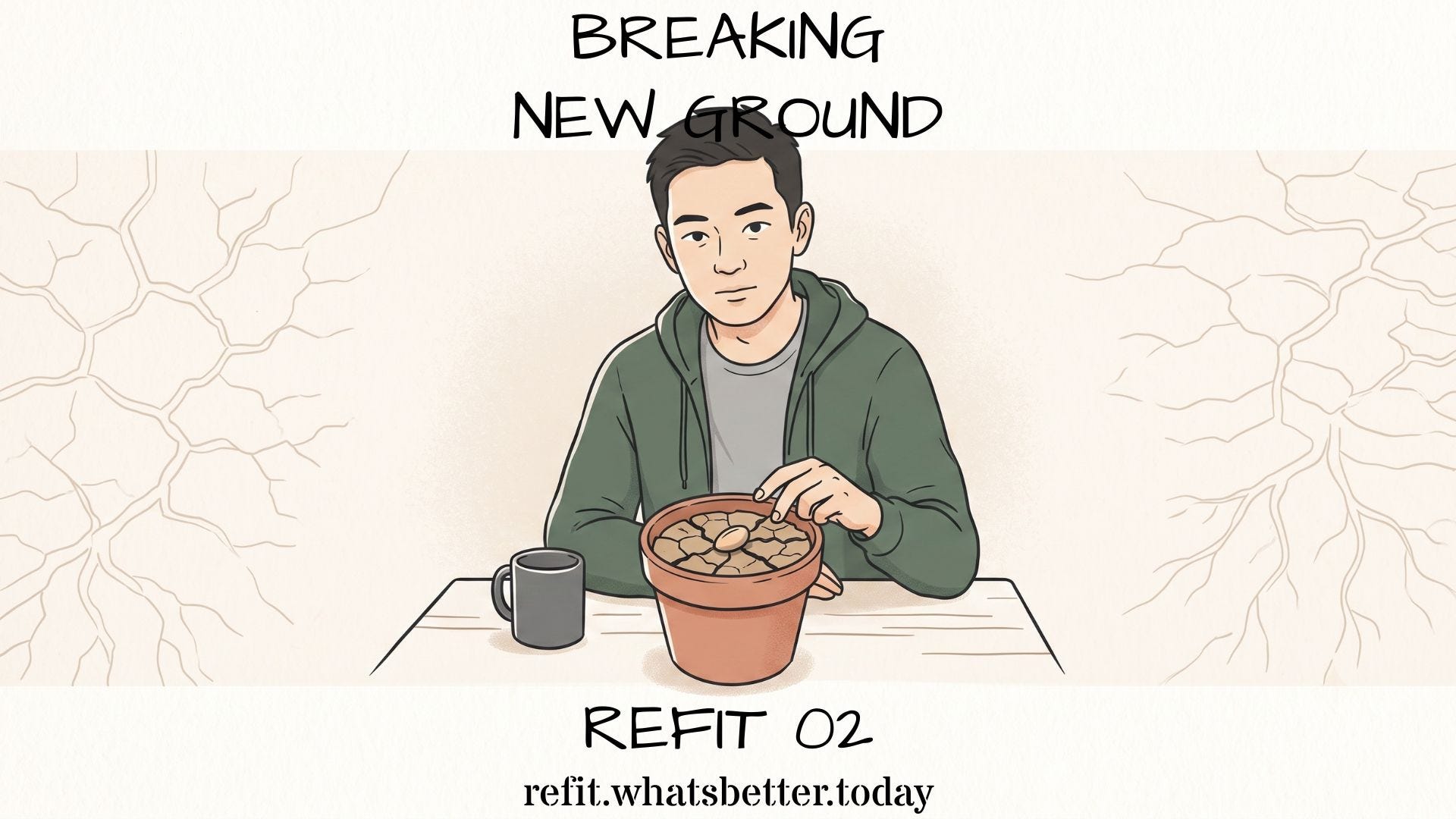
Refit Guide 02: Breaking New Ground
Sep 24, 2026 · 10m
Prefer sermons downloaded automatically?
About this sermon
David Chen told Sherman his story for the first time as he sat in the chair by the window, hands folded around a cup of tea long gone cold.
He didn’t come to Sherman seeking forgiveness or wisdom, just a witness. Someone to listen without judging.
“I knew what I should do,” he said quietly. “I’ve always known. The problem was never information.”
Sherman gave a small nod, a silent sign that he was listening.
“The problem was the moment the pressure came, I was somewhere else,” David continued. “Running the same scenario over and over again.”
Sherman nodded again. “You’ve been trying to stop the behaviour.”
“Everything I could think of.”
“And it keeps happening.”
“Always.”
Sherman set down the small pot of tea he used to make sure the plants in the courtyard survived. “You’ve been trying to prune what’s above the ground,” he said, gesturing toward the jade plant that had outgrown its pot. “And never the roots.”
David looked up at him. “How do I get to the roots?”
“You stop trying to prune everything from above,” Sherman said simply. “And you get a spade.”
What You’re Actually Fighting
Most people have fought their demons through willpower.
Not because they were ignorant of other options, but because they’ve never been taught what’s really happening.
Here’s what is actually happening: your habits, actions, and behaviours aren’t random. There’s always a story beneath it; a belief, usually unconscious, usually formed from childhood - that makes the habit, action, or behaviour seem like a good idea. It’s easy to think you’re just being lazy when you procrastinate. Just a lack of willpower, we’re told (or we tell ourselves). But there’s always a story being told beneath it. You procrastinate because there’s a story that says you need more time, you need to be in control, you need something to distract yourself from feelings you can’t manage. Or maybe, the story tells you that you can’t give up the other options.
Formation asks different questions. Instead of examining the leaf, it looks at the root. Instead of deciding if the habit is good or bad, it finds the belief that produced it.
You can’t kill a plant by taking its leaves. You kill it by digging up its roots and removing them. And that’s where real change always begins.
David’s Story
David’s rent was due on a Thursday. By Thursday evening, his betting app was open and waiting for his command. He’d been clean for four months. He’d told Emma. He’d been doing so well, and then the pressure came, and he was right back where he started. He knew why he’d done it. It wasn’t the money. It wasn’t a moment of weakness. It was always the same scenario: he was a failure, and he needed to prove to himself that he wasn’t by winning this bet. He was in control of one thing in his life, and he would be damned if he lost that too.
And still, the habit wasn’t the issue. The problem was in the root. David remembered the lesson his grandmother had taught him when he was little, Nai Nai kneeling in the dirt next to him, trying to plant sunflower seeds in soil as hard as concrete. “You can’t plant seeds on top of rocks, David,” she’d said, gently taking the tiny hands that were trying so hard to press seeds into the dirt. “You have to break up the ground first.”
He called Emma later that evening, using the word they’d chosen as their secret code… “soil”. She didn’t ask questions. She just came over. He didn’t fight the habit, only the story beneath it. I’m my own saviour. He held it up to the light and it withered when confronted with honest scrutiny. He didn’t win that night. He only didn’t lose as badly as before. And that was enough to get him started.
What’s Actually Happening
2 Corinthians 5:17 is a declaration:
“If anyone is in Christ, they are a new creation.”
But it’s also a description of exactly what happens to a person who is in the process of becoming new. You are not what you used to be, but you are still genuinely becoming something better. Your old root doesn’t have to nourish you, but it still has to be dug up and examined. It may have to be broken up. You have to choose something different.
Your neural pathways are not permanent. The pathways your brain has formed through years of repeating the same behaviours can be changed. New patterns can be formed, and old ones can be weakened. There’s no dispute about this in the neurological community. It’s all physics. Once you’ve established a pattern, it requires conscious effort to follow a different one. That effort builds new patterns in the brain. That’s all there is to it.
That’s not just poetic faith-speak. That’s how the renewing of your mind actually works. The physics behind it are pretty simple. Paul just didn’t have the words for them.
The PCPCR Walk-Through
Pick one habit. Not your worst habit, just one habit that represents a pattern, something you’ve done over and over again when faced with a particular stimulus, a behaviour you’ve tried to stop doing but always failed at.
Pause:. Before you do anything else, stop and breathe. This isn’t a battle you fight with sheer willpower. You can’t outrun the habit by thinking harder about not doing it. You need to create a moment of pause between the stimulus and response, even if it’s just one millisecond. Create a small gap. Everything happens in that gap.
Cause: This is where you do the hard work. Don’t ask “Why do I keep doing this?”. Rather ask what the habit is trying to protect you from? What is the story that makes this habit desirable? What does the habit make you believe about yourself, and is that what you want to believe?
For David, it was the belief that he had to be his own saviour. He had to prove to himself and to God that he was worthy, that he wasn’t as bad as he believed himself to be. That was an old story that fed old shame. It was running on old, faulty data, but it had persisted for a long time because there were no questions asked about it.
Name the story. Write it down if you need to. Something simple like “I believe I am unworthy and this habit makes me feel worthy of God’s love.”
Pray: You are not asking God to take away the habit. You’re asking him to take away the lie. Ask him to bring the root to light. Ask him where the story came from, what experience gave rise to it, what lie took root in your heart and made it flourish. Two lies are at the root of every bad habit in existence: I am not enough, and I am not loved. One or both of these lies are almost always present in your habit. Bring those lies out into the light where they can be confronted.
Choose: One tiny override. One micro victory. A pause before the stimulus is delivered. One verse of scripture said before you engage in the habit or behaviour (or during it when you catch it late). One honest word spoken to a trusted friend. The choose step is not about big flashy gestures, it’s about planting new roots, and roots grow slowly.
Review: Tonight, before you go to bed, reflect on the day. What was the story you believed today? Did you recognise it before you engaged in the habit or afterwards? Both are good. There is no failure in this process, only information.
The Kingdom Lens
The world says that your habits define you. Once an addict, always an addict. Once a failure always a failure. You are defined by your struggles and those struggles are permanent fixtures in your life.
The world says that who you are is a result of your habits. The Kingdom says that your habits are a result of who you are. You are not your habits. You are new creation. You may still struggle with the same desires or urges, but those desires no longer define you. You are not your sin, your failures, or my mistakes, and you are not limited to them.
If you’ve accepted Christ, you have not been simply redeemed. You have been renewed. You’ve received new life. You’re not just getting better… you’re becoming someone new. That’s a big difference. It’s the difference between…
This is a public episode. If you would like to discuss this with other subscribers or get access to bonus episodes, visit whatsbettertoday.substack.com
More from What's Better Today?
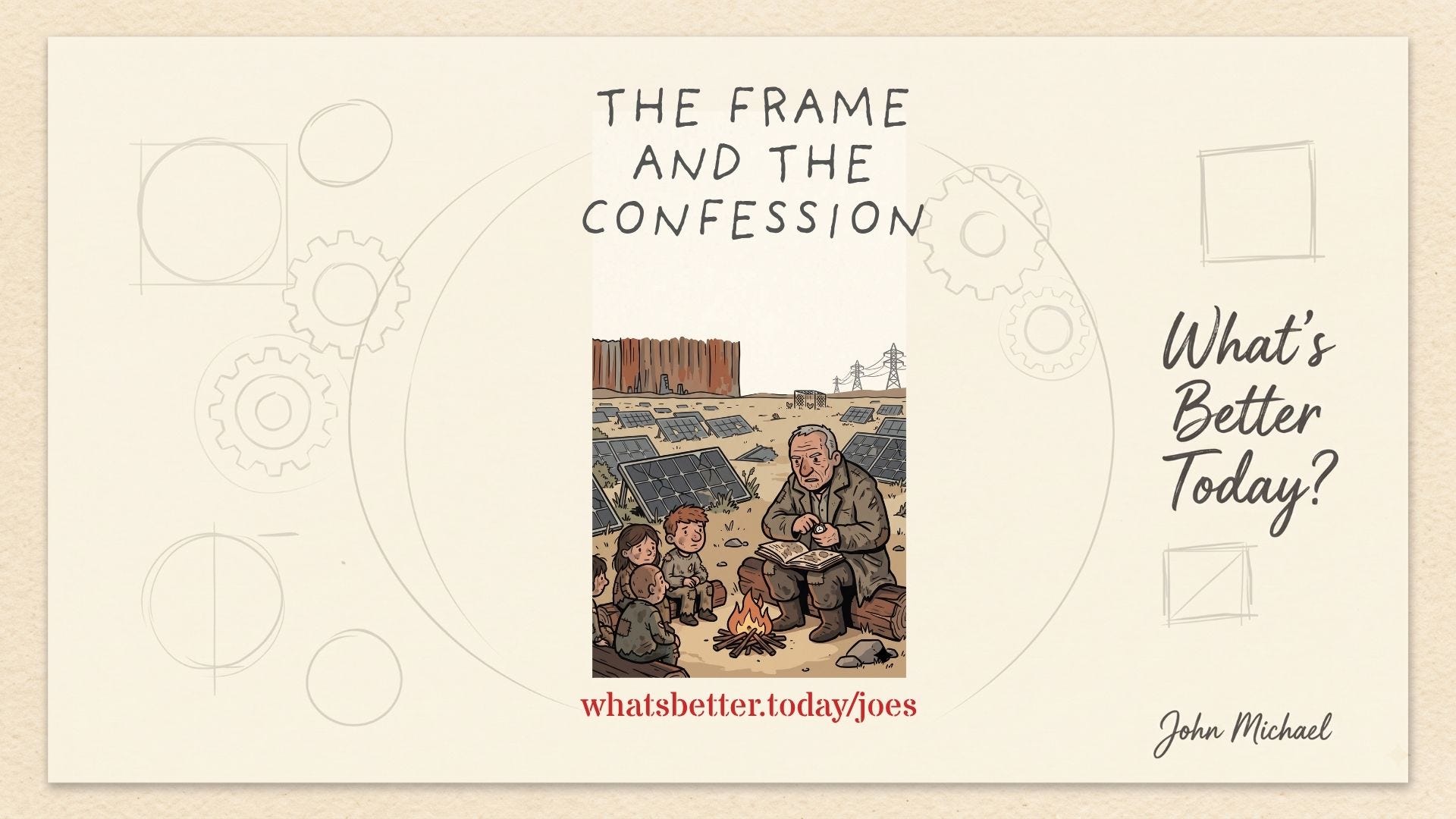
Book of Joes Chapter 1: The Frame and the Confession
Nov 26, 2026 · 4m
Welcome to Chapter 1 (”The Frame and the Confession”). Sitting by a small campfire in the dark, an old man opens a handwritten journal to read to a group of children. Pull up a log and join the...
Refit: Why I Wrote This
Nov 12, 2026 · 4m
It was November when I made the decision that sent my life into a tailspin.I’d been a leadership coach for 33 years. Qualifications piled up. Clients spanning the globe. A moderately successful...
Refit Introduction: What This Is and How to Use It
Nov 5, 2026 · 9m
Read this after you have read the guides.If you are reading it now, before you have read anything else, that is useful information about yourself. Note it. Come back here when you have finished...
Book of Joes Chapter 0: Welcome to the AIrmageddon
Nov 2, 2026 · 5m
Welcome to The Book of Joes: Tales from the AIrmageddon. Read to you by the author, John Michael, and some friends.We live in a world that worships metrics, reach, and algorithmic leverage. The Book...
Refit Epilogue: A Fellow Traveller
Oct 29, 2026 · 12m
From The Refit: Come to Me, Leave the Lies BehindI need to tell you something about where I started.My father was a lay preacher. A good man. A genuinely good man who loved his family and loved his...
Refit Guide 06: The Sustained Choice
Oct 22, 2026 · 14m
From The Refit: Come to Me, Leave the Lies BehindThree weeks in, Sarah had a crisis.She yelled at Jake. She scrolled for 40 minutes on a Wednesday afternoon when she had real work to do. She missed...
Take these sermons with you.
Follow What's Better Today? in the Getsermons app to get every new sermon, build playlists, and pick up right where you left off.

