
What's Better Today?
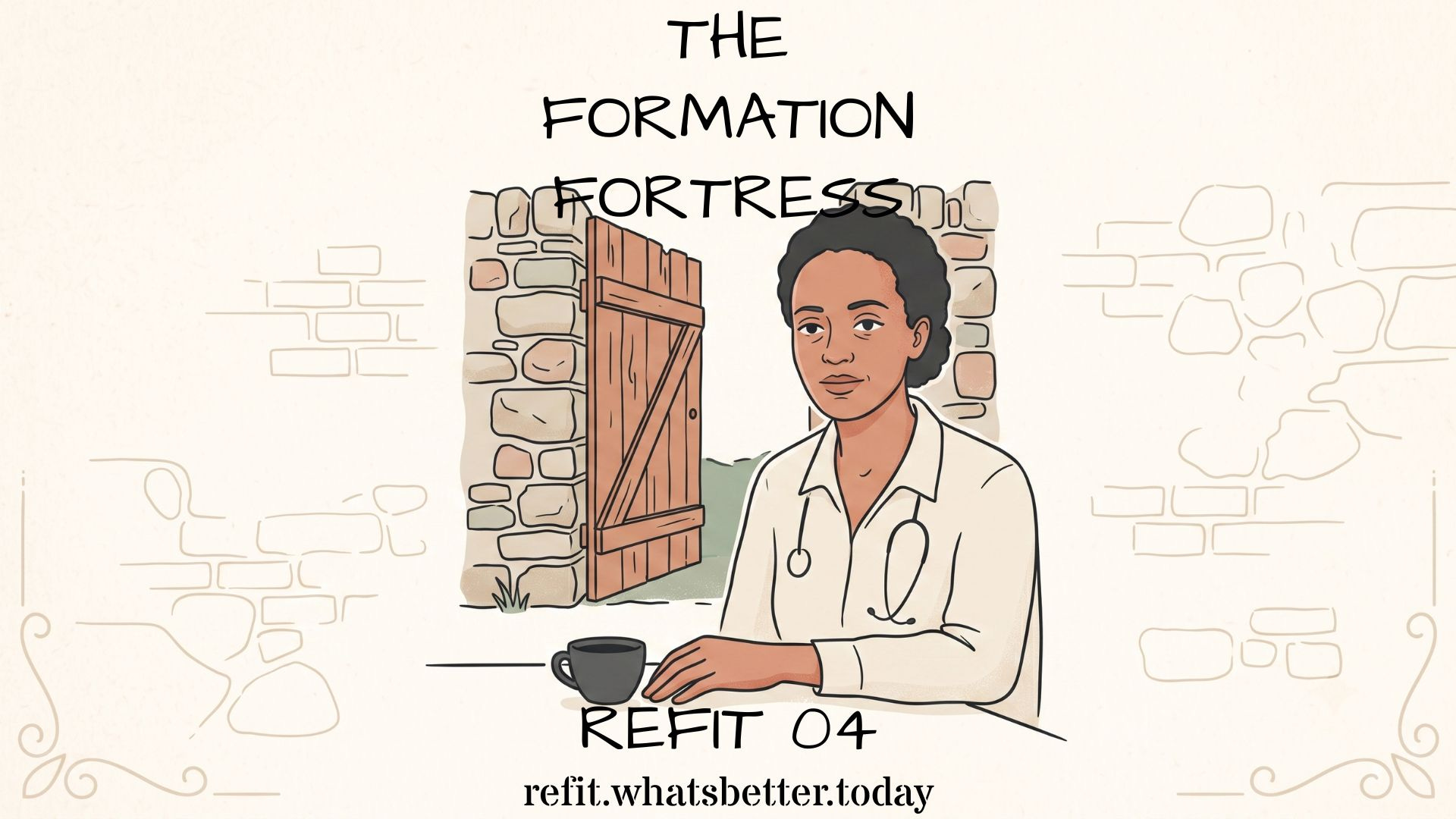
Refit Guide 04: The Formation Fortress
Oct 8, 2026 · 11m
Prefer sermons downloaded automatically?
About this sermon
From The Refit: Come to Me, Leave the Lies Behind
Amara said it quietly, almost to herself
“I thought I was maintaining excellence. I was actually just building a cage.”
Sherman didn’t feel the need to jump in and fill the lull. Bruiser had found a nice shady spot by the door and was being his usual unconcerned self.
“Tell me about the cage,” said Sherman.
What Protection Becomes
For every wall there is a reason. Some are built in response to a legitimate threat. You learned early on that there were standards, that excellence was expected and that there were a particular set of failures that would have repercussions far beyond the failure itself. You built the wall, stone by stone, standard by standard. It served its purpose… for a while.
The problem with walls is that they don’t discriminate. They keep out the threat, yes, but also everything else; the friend who might see the wall, the colleague who might genuinely help and the grace that might come in if only you could admit that you needed it. Job 5:7 is surprisingly practical concerning trouble. It does not come “up from the dust” but “like sparks” and you cannot build a wall high enough to keep sparks at bay. What you can do is build a gate. Not a weakness in the wall but the most masterful part of the whole construction, a gate is not operated by fear but by wisdom.
Most of us have built a fortress without a gate and have slowly starved to death within it.
Amara’s Story
Amara Tadesse, growing up as an Ethiopian-British girl in Birmingham, knew about walls. She knew she would have to build one to get by. Perfection was the price of entry. It is not that there was any specific policy but rather that she learned to internalise the extra scrutiny, the extra correction and the extra silence as an unavoidable cost if she wanted to get ahead.
She paid the cost exceptionally well, as she became a doctor, an excellent doctor at that. By the age of thirty she had not only graduated but was respected and recognised for her skills. And she was finickity enough to turn down coffee with a colleague if their shirt was wrinkled. She told Sherman this last part without any shame, having apparently moved on from the need to feel shame about it
“I realised the fortress wasn’t built from pride but from fear that if I wasn’t twice as good I wouldn’t be respected or welcome”
The wall had made sense to her when she built it but it had failed her since it was completed. It could not distinguish between friends and threats. Sherman floated the idea that she consider lowering her standards in some areas…
“No,” she replied instantly, “You don’t understand, I’m a doctor, if I lower my standards I risk patients lives and my career, the entire industry is built on people trusting that doctors are never wrong.”
“I’m not talking about lowering your clinical standards,” replied Sherman. “Whatever is stopping you is not in your professional competence. That’s not what’s isolating you.”
She let that thought hang in the air.
“The standard that is getting you is the one that says nobody should see you struggle with your professional competence,” he continued. “The performance of never needing help. That’s where the wall goes up.”
She paused, considering.
“So not the standard but the silence around it.”
“The gate,” said Sherman. “Not a smaller fortress but a gate.”
That night she sent a text to her colleague Hanan saying “I’m a bit of a mess”. It was the first time she had ever willingly taken a stone out of her wall. Hanan arrived not long after and the two spent three hours talking, about nothing in particular. Amara later told Sherman that she had forgotten what it was like to let someone in.
What’s Actually Happening
Genesis 3:6 tells us what went wrong in the garden, and it’s worth asking ourselves this diagnostic question: what did Eve see in the fruit that made her pick it? It appears that she found three things appealing; that it looked good, that it would taste nice and that it would make her wise. In other words, appearance, appetite and ambition.
Not one of these things is relational. None of them asked “how will this affect the people I care about?” Perfectionism is the same. It is motivated by appearance (how will I look?), appetite (will this do?) and ambition (how will this make me look?) and cares little for the people you actually care about. Not that there is anything wrong with appearance, appetite or ambition. It is the relational neglect that comes with choosing them that is a problem. The repair is not in abandoning them but in asking how they affect the people you care about. Christ is not here to take the wall away from you and leave you vulnerable but to show you the gate so that you can build it.
There is a you that is excellent and genuine that is competent and connected that is bounded and open that is capable of holding the gate without losing the wall. That is not the you that needs to be alone. That is not the you that needs to be invisible. The image of God is not a solo performance.
Moving from self-protective isolation to safe, honest connection.
The PCPCR Walk-Through
Think of a relationship or a repeated area of interaction where your standard has turned into a wall. This is not about professional competency but about presentation, that is, the demand to always look better than you are.
Pause. Before you defend the wall, pause and consider that Christ is not asking you to lower your professional competency. He is asking you to evaluate if the presentation of your performance is costing you more than it is serving you.
Cause. Two questions. First, ask what good things is the wall keeping out. Not the threats but the colleagues, the help and the grace that can only come in if you let someone see the cracks. The second question relates to who taught you that being seen to struggle was a bad thing. The answer is rarely recent.
Pray. This is the prayer of the gate. Not the prayer of tearing down the wall, not the prayer of becoming “less picky” about who sees you but a more honest prayer that simply asks where the gate goes. Where in your relationships is there space to lower one stone so that someone can come in? Perfectionism is a spiritual condition before it is a behavioural one and the root of it is the assumption of conditional love. Ask God to reveal it to you, and expose it for what it is; a lie that has existed long before you were born and has nothing to do with loving people better than you love yourself.
Choose. One honest sentence. Said to one person who has earned it, about something that is not going perfectly. The goal is not to become more vulnerable but to become more honest. Amara’s “I’m a bit of a mess” was not a vulnerable statement it was an honest assessment of the situation. The standard of her work did not change, only the silence around it. Lowering the wall is not about lowering your expectations but about building a gate. You are not asking permission to fail but rather the opportunity to let someone see you.
Review. Tonight. As you go to sleep ask yourself this question: did I choose connection over perfection today? Not in terms of performance but in terms of choice. Did I let someone in? Either answer is a good one. You are not grading yourself. You are learning to read the gate.
The Kingdom Lens
The world tells us to be flawless or be forgotten. The world tells us that the fortress is the safest place and that the gate is the most dangerous thing you can build. The Kingdom tells us that trouble stirs like sparks, uninvited, unwanted and unstoppable. The peace that passes understanding is not behind a wall but in the middle of the trouble, held by someone who can carry you through it. When you stop building your own fortress and start using the resources of the Kingdom you are protected not by the wall but by the presence of God, and the wall that you had erected for your own protection becomes the very thing that …
This is a public episode. If you would like to discuss this with other subscribers or get access to bonus episodes, visit whatsbettertoday.substack.com
More from What's Better Today?
Book of Joes Chapter 1: The Frame and the Confession
Nov 26, 2026 · 4m
Welcome to Chapter 1 (”The Frame and the Confession”). Sitting by a small campfire in the dark, an old man opens a handwritten journal to read to a group of children. Pull up a log and join the...

Refit: Why I Wrote This
Nov 12, 2026 · 4m
It was November when I made the decision that sent my life into a tailspin.I’d been a leadership coach for 33 years. Qualifications piled up. Clients spanning the globe. A moderately successful...
Refit Introduction: What This Is and How to Use It
Nov 5, 2026 · 9m
Read this after you have read the guides.If you are reading it now, before you have read anything else, that is useful information about yourself. Note it. Come back here when you have finished...

Book of Joes Chapter 0: Welcome to the AIrmageddon
Nov 2, 2026 · 5m
Welcome to The Book of Joes: Tales from the AIrmageddon. Read to you by the author, John Michael, and some friends.We live in a world that worships metrics, reach, and algorithmic leverage. The Book...

Refit Epilogue: A Fellow Traveller
Oct 29, 2026 · 12m
From The Refit: Come to Me, Leave the Lies BehindI need to tell you something about where I started.My father was a lay preacher. A good man. A genuinely good man who loved his family and loved his...
Refit Guide 06: The Sustained Choice
Oct 22, 2026 · 14m
From The Refit: Come to Me, Leave the Lies BehindThree weeks in, Sarah had a crisis.She yelled at Jake. She scrolled for 40 minutes on a Wednesday afternoon when she had real work to do. She missed...
Take these sermons with you.
Follow What's Better Today? in the Getsermons app to get every new sermon, build playlists, and pick up right where you left off.

