
What's Better Today?
Refit Guide 05: The Choice Point
Oct 15, 2026 · 12m
Prefer sermons downloaded automatically?
About this sermon
From The Refit: Come to Me, Leave the Lies Behind
It was 02:47.
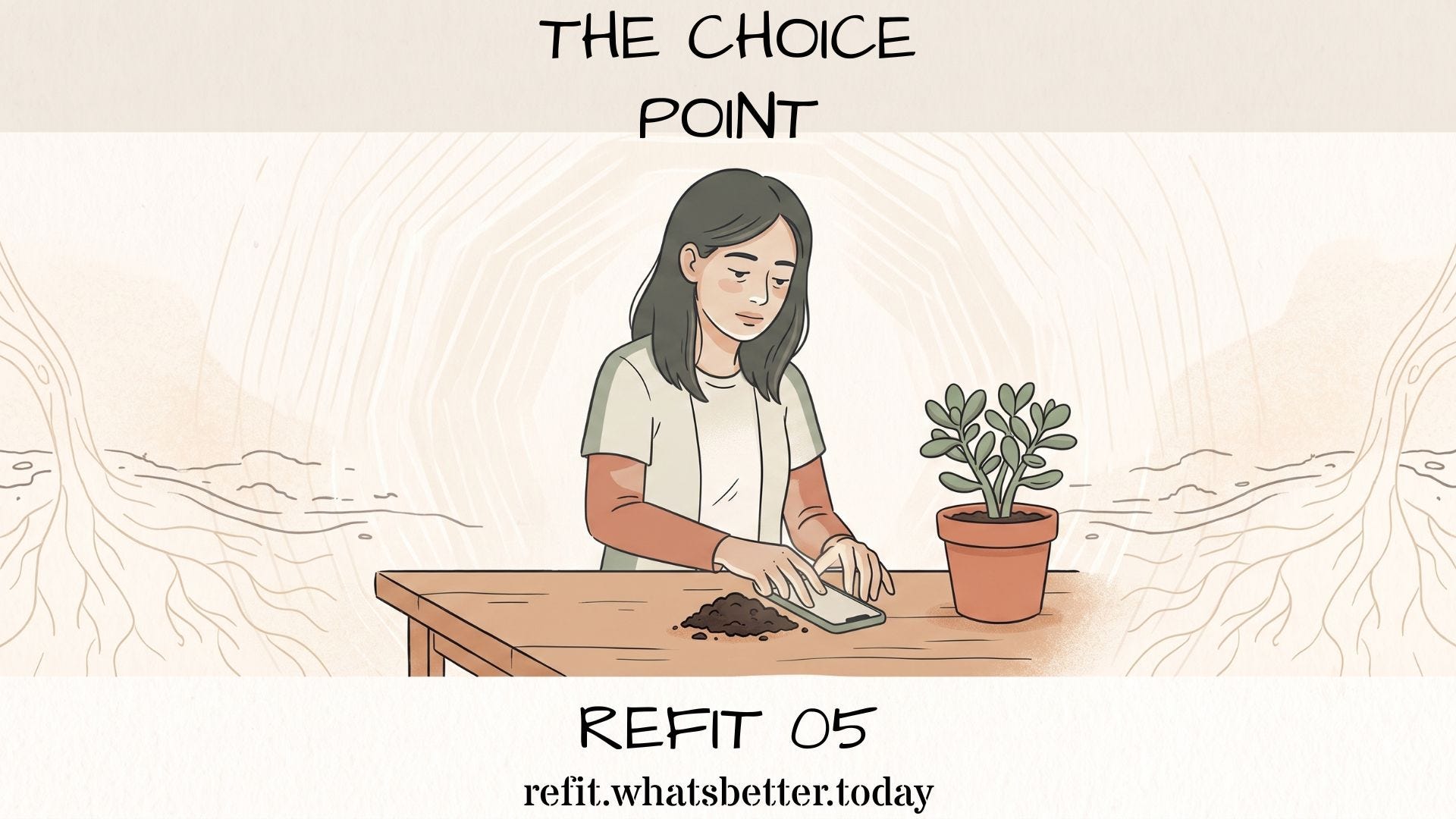
Sarah knew the time because she had checked it three times in the last hour, each time telling herself that she would put the phone down after the next check.
She was twenty-three posts deep in someone else’s feed. Melissa’s promotion, Emma’s apparently perfect weekend.
Jake was fast asleep in the next room, and she’d snapped at him for something she could barely remember doing, and the realisation of why she was so irritated at him and this pointless argument was sitting on her lap in her hand.
She wasn’t angry at Melissa, not really, and she certainly wasn’t angry with Jake.
She was losing a fight with an algorithm. And the algorithm didn’t care if she existed.
The Cage You Build Yourself
Romans 12:2 describes two ways we choose to be shaped.
The first is conformation: the pressure we’re always under to fit in, to shape-shift according to the desires of the world around us, and the second is transformation, the renewing of our minds, our pushing against that pressure, the choice to be shaped according to something different.
Most of us miss the fact that conformation is a choice that we make in response to the pressures around us.
Unless we’re making a huge, obvious choice, an outright battle between good and evil, we find ourselves conforming to the expectations around us without consciously choosing to do so. We’re simply reacting, and the tiny, habitual decisions we make in reaction add up to a person we never decided to become. The important thing to understand is that failing to make a conscious, deliberate choice is itself a choice.
It’s a cage you build yourself, one scroll at a time.
But, there is good news: the cage you build, you can also demolish. One bar at a time. And we begin with the half-second gap between the trigger and the response. Everything is in that half-second.
Sarah’s Story.
She saw Emma’s post at 02:51.
It said something about choosing to focus on what she could control instead of what she couldn’t, her responses and not what other people did, and Sarah immediately put her phone down in the kitchen.
She wasn’t particularly dramatic about it. Just put the phone down, face down, on the kitchen counter, and walked back to the bedroom.
She spent some time lying in the dark, thinking about the last hour, and not really realising that during that time she had not been resting, she’d been giving her peace away to people who didn’t actually care either way and didn’t even notice the loss.
She thought about Jake, the thing that had provoked her, the look on his face that came after she’d shouted at him, the way he’d taken it in and moved on without complaint or defensiveness, and she hated it almost as much as she hated what it meant about her.
She did not pick up her phone. That was all she did that night… stopped.
That was all she had to do, in that moment, to unbuild the cage, and it was hardly a victory at all.
It’s also the reason she fell asleep that night having deliberately chosen to do something - anything, rather than simply finding herself somewhere else.
She told Sherman about it the week afterwards.
He listened to the whole story, and finally said, “Well?
What was in that three seconds between you putting the phone down and deciding not to pick it up again?”
She thought about it, and said, “Honesty about what I was actually choosing to do.”
“That’s where everything happens.
That’s the gap, most people never find it.”
What’s Actually Happening
Proverbs 14:12 talks about paths that look good but turn out to lead to death, because they’re built on lies.
The path looks good as you walk down it. It doesn’t look destructive. The words that sneak out of your mouth that felt justified until you heard them out loud. The instinctive swipe right that seemed harmless enough. It’s as if you’d have no reason to choose it or not choose it… unless you knew what was waiting at the end.
But it’s not often the path that leads to death we choose knowingly. You won’t really know that death lurks at the end until you experience it. And then it’s too late. Far too late.
The neuroscience and theology both agree on this one, insofar as it’s not the lying path we take that’s most damaging - it’s the path we stop questioning once we’ve been on it a while, the one we take on autopilot, the one we don’t have to consciously choose each day because it’s beaten a groove into us by repetition.
Viktor Frankl, writing from direct experience in the holocaust, put it like this: “Between stimulus and response there is a space.
In that space is our power to choose.
In that choice is our freedom.”
He was referring to the space between something happening to us, and us responding, and our ability to stop and think about whether we want to respond that way or not, rather than simply reacting.
It’s not easy to put that into practice, but it’s not an unreachable ideal either - the formation work requires that we learn to observe that space between whatever has happened to us and whatever response we’ve been programmed to give, and notice what choices are built into that response.
That’s not a choice between doing the right thing or doing the wrong thing.
It’s a choice between doing the right thing and doing the easy thing.
PCPCR Walk-Through
Pick your trigger - whatever most consistently causes you to react in a way you don’t consciously choose and you don’t like. For example, the person who’s name on a message makes something tighten before you’ve even read the message. Or the situation you instantaneously snap or scroll or withdraw. That’s the one to choose for this guide.
Pause: For three seconds this time. This is the practice in miniature. This is not a pause to work out what to say or do, but simply to acknowledge that you’re at a choice point, and you’re making a choice in response to something rather than simply reacting to it. One second might suffice, the length of the pause is less important. That you pause is what matters.
Cause: Two questions. The first is simply to name the automated response you’re making. For example: withdraw, scroll, swipe, sarcasm, shout.
The pause is the action that makes your choice possible, but the cause is the reason for making it.
Ask yourself, what am I reacting to?
Name it - the provocation, the script, the programmed response.
The second question is to think about the cost.
Mostly, you want to avoid the temptation to assign this cost to someone else.
The cost of reacting the way you usually do at this point in these circumstances is a cost to you, not a cost to them, and you should be thinking about what that actually means.
What choices are you forgoing by simply defaulting to your old patterns?
What are you saying about your version of Jake, the team, the other person in the room?
Pray: The agency prayer. In this prayer you aren’t asking to take the trigger away. Neither are you asking God to “fix” the other person. Instead, you ask Him to show you the gap. The space between what happens and how you react. To help you notice that you are at a choice point. This is a prayer for agency not control.
Choose: A specific micro-action you can take to introduce the break and interrupt your default pattern.
Sarah’s choice was to physically put the phone in the kitchen, face down, and leave it there.
That was all she had to do, and it was entirely up to her to decide what that would look like.
You might decide to stand up before you reply, or walk to the window before you open the app, or say the other person’s name before you say the next sentence.
Something small and repeatable. This action, repeated often, becomes your new pathway. It doesn’t have to be dramatic, it just has to be real.
Review: Tonight, when you’re reviewing your day, a…
This is a public episode. If you would like to discuss this with other subscribers or get access to bonus episodes, visit whatsbettertoday.substack.com
More from What's Better Today?
Book of Joes Chapter 1: The Frame and the Confession
Nov 26, 2026 · 4m
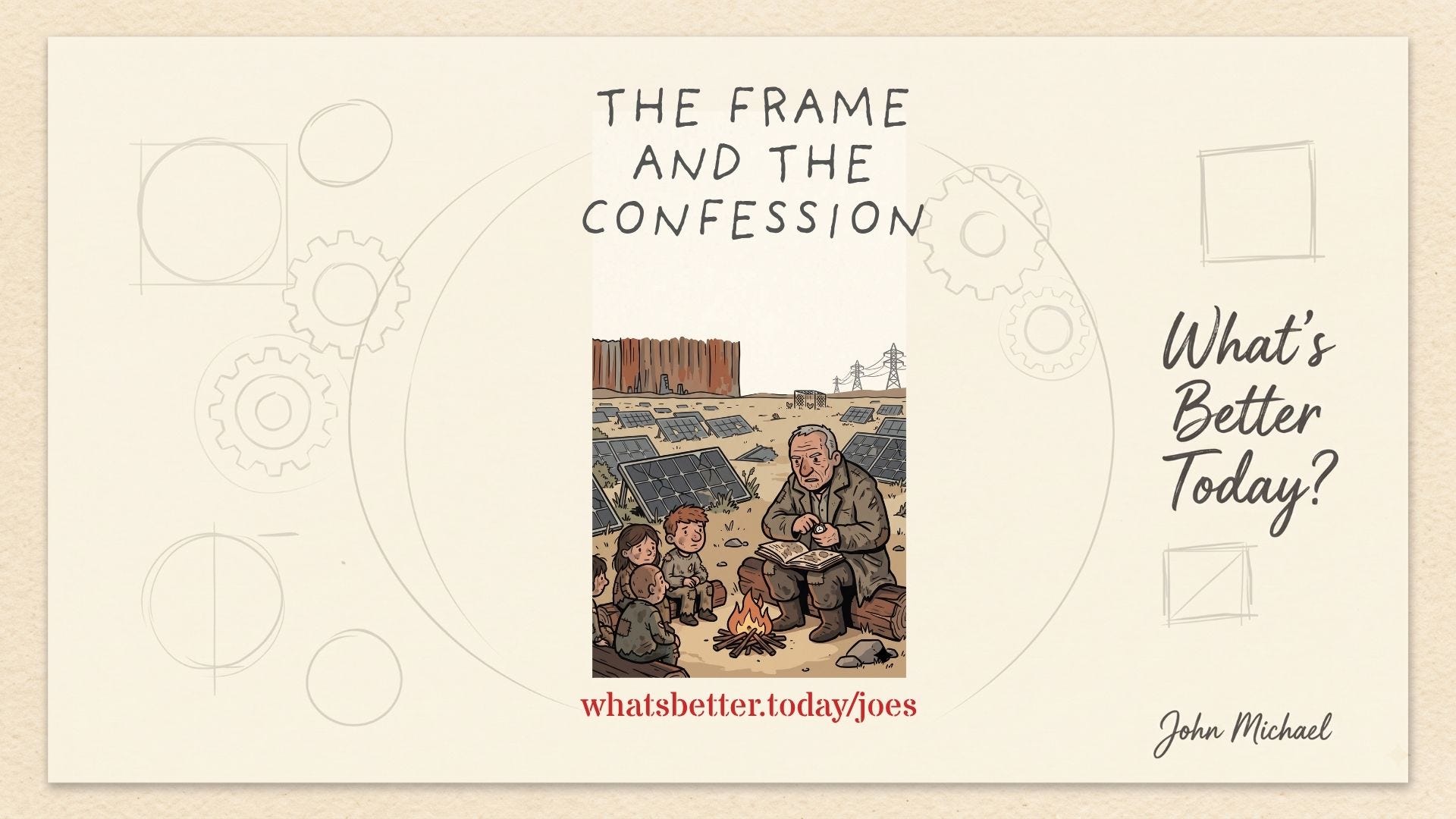
Welcome to Chapter 1 (”The Frame and the Confession”). Sitting by a small campfire in the dark, an old man opens a handwritten journal to read to a group of children. Pull up a log and join the...
Refit: Why I Wrote This
Nov 12, 2026 · 4m
It was November when I made the decision that sent my life into a tailspin.I’d been a leadership coach for 33 years. Qualifications piled up. Clients spanning the globe. A moderately successful...
Refit Introduction: What This Is and How to Use It
Nov 5, 2026 · 9m
Read this after you have read the guides.If you are reading it now, before you have read anything else, that is useful information about yourself. Note it. Come back here when you have finished...
Book of Joes Chapter 0: Welcome to the AIrmageddon
Nov 2, 2026 · 5m
Welcome to The Book of Joes: Tales from the AIrmageddon. Read to you by the author, John Michael, and some friends.We live in a world that worships metrics, reach, and algorithmic leverage. The Book...
Refit Epilogue: A Fellow Traveller
Oct 29, 2026 · 12m
From The Refit: Come to Me, Leave the Lies BehindI need to tell you something about where I started.My father was a lay preacher. A good man. A genuinely good man who loved his family and loved his...
Refit Guide 06: The Sustained Choice
Oct 22, 2026 · 14m
From The Refit: Come to Me, Leave the Lies BehindThree weeks in, Sarah had a crisis.She yelled at Jake. She scrolled for 40 minutes on a Wednesday afternoon when she had real work to do. She missed...
Take these sermons with you.
Follow What's Better Today? in the Getsermons app to get every new sermon, build playlists, and pick up right where you left off.

