
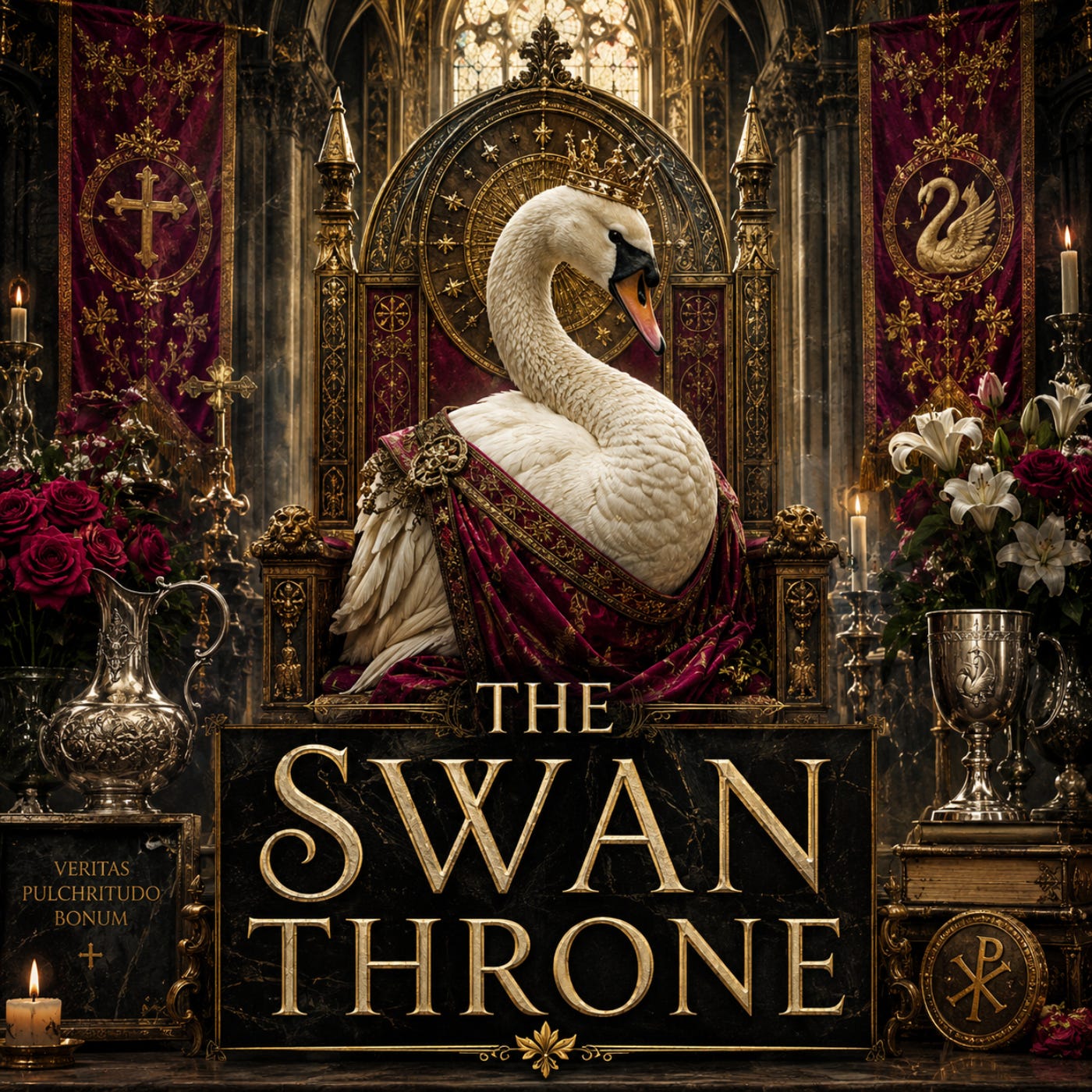
The Swan Throne Podcast
A Devil for Every Revolution
Sep 15, 2026 · 38m
Prefer sermons downloaded automatically?
About this sermon
I. A Revolution That Wins Must Invent Another Enemy
A political order founded upon revolution inherits an uncomfortable problem. Once the revolution succeeds, its victorious leaders become the authorities against whom future rebels can direct the same accusations.
The old king disappears. The throne remains.
Liberalism resolves this contradiction by converting revolution from a historical event into a permanent moral posture. Its public life repeatedly reenacts a foundational confrontation between an innocent population and a corrupt authority.
Each generation receives another version of the original drama.
The supposed oppressor changes according to political circumstances. What remains constant is the assumption that moral legitimacy belongs to whoever can claim the position of rebel.
This gives modern political life its peculiar theatrical quality. A multinational corporation presents itself as resistance. A university administrator describes his office as an insurgent force. A federal agency warns that its critics threaten the freedom of the public it governs.
The powerful become most comfortable when dressed as the persecuted.
The pattern follows the sacred structure of liberal political belief. Liberalism begins with a story about emancipation from inherited authority. It renews its moral energy by identifying some remaining obstruction against which emancipation must continue.
The identified enemy does not need to possess actual power. He needs to occupy the correct symbolic position.
A father addressing a school board can become the face of authoritarianism while the superintendent controls the meeting. A local congregation can appear threatening while a global corporation finances the campaign against it.
The imbalance rarely troubles the story.
The drama needs a devil.
Evidence receives a supporting role.
II. The King Became a Devil Before the Crowd Became a People
Revolutionary politics requires a villain whose defeat can give moral unity to an otherwise divided public.
The American Declaration of Independence provides a clear example. Its argument concentrates colonial grievances within the person of George III. The Declaration’s official text characterizes the king’s conduct as a pattern of injury directed toward absolute tyranny.
This was effective political writing. It was also a dramatic simplification.
The National Constitution Center explains that many disputed policies arose from Parliament rather than from the king acting alone. The Declaration nevertheless directs its accusations toward the monarch.
Parliament lacks the dramatic convenience of a single face.
A king can be cursed. A constitutional arrangement requires explanation.
The issue extends beyond whether colonial grievances were legitimate. The deeper question concerns the moral form through which those grievances became politically meaningful.
George III was presented as a concentrated embodiment of oppression. His symbolic function exceeded his actual place within the British constitutional order.
Once the king becomes the villain, rebellion acquires the emotional character of deliverance.
That transformation shaped the American imagination long after independence. The habit of treating founding documents as sacred objects allows the original confrontation to survive as a permanent template for public morality.
Every later dispute can be narrated as another struggle against the crown.
The crown may now belong to a school principal. It may rest upon the head of a county clerk.
Somebody must wear it.
The revolution cannot recognize itself without a tyrant in the room.
III. Liberalism Kept the Sacred Drama and Replaced the Theology
A society does not escape religious structure merely by removing overt references to God.
It continues to explain human suffering through a story about moral disorder. It identifies agents of corruption and offers a path toward collective redemption.
Liberalism organizes that story around emancipation.
The individual begins under the weight of inherited authority. Moral awakening reveals that authority as domination. Freedom arrives through resistance against whatever prevents the individual from becoming fully self-directed.
The particular political issue changes. The religious architecture endures.
The religious form of modern liberal belief becomes visible whenever an ordinary disagreement is translated into a confrontation between moral innocence and contaminating evil.
A parent objects to a school policy. The disagreement could be handled through public deliberation. Instead, the parent becomes evidence that dangerous forces threaten vulnerable children.
The policy acquires sacred status because opposition to it must be classified as moral pollution.
This resembles the treatment of symbolic objects within any sacred order. As visible forms acquire meaning beyond their material function, ordinary disputes become charged with larger claims about the condition of society.
The school board meeting becomes a small apocalypse.
The person at the microphone becomes a demon with a three-minute time limit.
The system cannot easily recognize permanent settlement because its moral narrative depends on continuing struggle. A completed emancipation would deprive the governing class of its favorite justification.
No priesthood enjoys announcing that the congregation may leave.
The villain must therefore return.
His identity can be revised whenever the old costume becomes unfashionable.
IV. Yesterday’s Liberator Becomes Tomorrow’s Tyrant
The French Revolution revealed the inner instability of revolutionary moral authority with exceptional clarity.
The monarchy fell. The revolutionary government then discovered that victory did not extinguish its need for enemies.
The Law of 22 Prairial gave the Revolutionary Tribunal authority to punish broadly defined enemies of the people. The statute extended suspicion to those accused of weakening revolutionary commitment or misleading public opinion.
Its prescribed punishment was death.
A government supposedly established through liberation became increasingly dependent upon identifying internal enemies. Former allies could be reclassified as threats when they questioned the direction of the revolution.
The category of enemy expanded because revolutionary purity could never become secure.
A man who helped overthrow the king might later be accused of insufficient enthusiasm for the government that replaced him. His earlier service offered little protection.
The revolution treated yesterday’s credentials as evidence that today’s betrayal was more sophisticated.
Historical scholarship on Robespierre and revolutionary political fear shows how the language of public danger intensified alongside efforts to consolidate revolutionary authority.
The permanent emergency became a method of government.
Modern political systems rarely reproduce the guillotine. They retain the underlying pattern whenever former allies become intolerable after failing to endorse the newest moral demand.
The ritual treatment of heretics and apostates explains why a former believer can become more threatening than an open opponent.
He knows the language.
He also proves that departure remains possible.
A revolution without an endpoint eventually interprets moderation as treason.
V. The Oppressor Must Exist Even When He Must Be Manufactured
A political order organized around liberation cannot admit that its preferred enemy has disappeared.
Doing so would weaken the moral justification for continued mobilization.
When obvious legal restrictions are removed, the definition of oppression shifts toward hidden social structures. These structures may describe real patterns of unfairness. Their political usefulness increases when they can also be invoked without establishing personal responsibility.
Consider the modern workplace training session.
An employee who exercises little control over corporate policy is informed that his background places him within a system of inherited advantage. He is asked to acknowledge that …
Get full access to The Swan Throne at swanthrone.substack.com/subscribe
More from The Swan Throne Podcast
Tolkien Taught Modern Christians to Love Creation Again
Nov 24, 2026 · 37m
There is something peculiar about the emotional power of the Shire.Very little happens there, at least by the standards of fantasy. Hobbits eat. They garden. They walk to one another’s houses. They...
Pacifism Is a Luxury Purchased with Violence
Nov 3, 2026 · 35m
The pacifist sleeps peacefully because someone else remains awake.He locks his door at night without expecting an armed gang to enter. He walks through a public park with little fear that a private...
The Christian Influencer Problem
Oct 27, 2026 · 18m
There is something deeply peculiar about a Christian influencer who spends his career defending apostolic authority, only to denounce his bishop whenever that bishop exercises it.For months, perhaps...
The Modern Heretic Questions the Sovereignty of Individual Choice
Oct 20, 2026 · 30m
“Who are you to judge?” is a peculiar question. It usually arrives with a judgment already attached.Consider a disagreement about marriage, religious upbringing, or the obligations of adult children...
The Parish Should Know When Families Cannot Afford Children
Oct 13, 2026 · 29m
A couple can want a child and still dread opening the household budget.Consider an illustrative household: both spouses work, their rent leaves little room for saving, and their relatives live several...
Baptism Before Consent: Why Christians Give Their Children a Faith
Oct 6, 2026 · 28m
At an Orthodox infant baptism, someone else answers.The child cannot recite the Creed, explain the Trinity, or announce his intention to renounce Satan. A sponsor speaks on his behalf. Adults bring...
Take these sermons with you.
Follow The Swan Throne Podcast in the Getsermons app to get every new sermon, build playlists, and pick up right where you left off.

