
Trinity and Christian Life
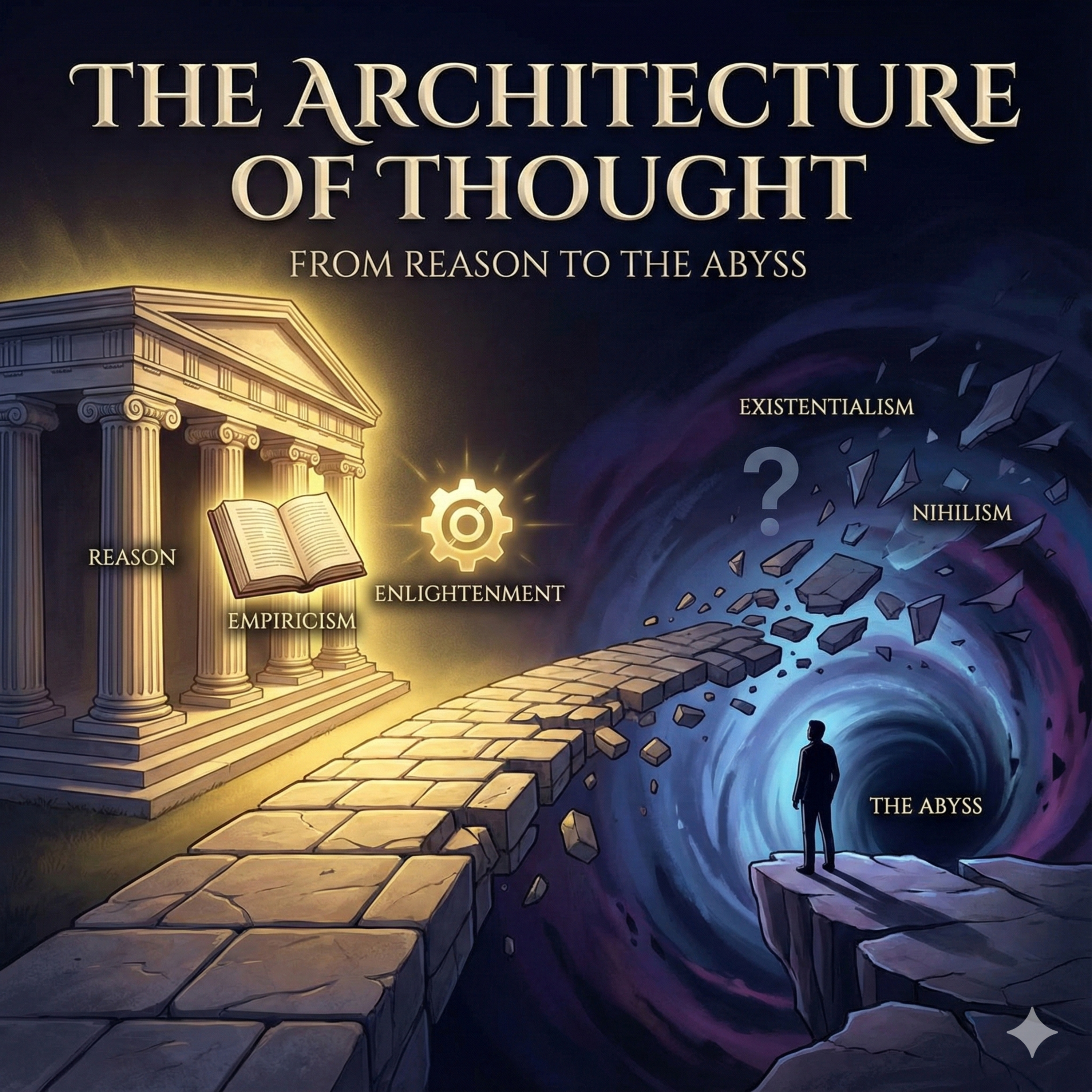
The Architecture of Thought: From Reason to the Abyss
Dec 31, 2025 · 34m
Prefer sermons downloaded automatically?
About this sermon
Join us on an intellectual journey through the five pivotal movements that have defined the trajectory of the Western mind: Rationalism, Empiricism, the Enlightenment, Existentialism, and Nihilism. We explore how the history of philosophy is a "grand narrative of construction and deconstruction," moving from the search for a stable centre of authority to the confrontation with the void.
In this episode, we examine how the 17th century sought certainty through two competing epistemologies: Rationalism, which looked inward to the architecture of the mind, and Empiricism, which looked outward to the evidence of the senses. We discuss the Enlightenment's optimistic synthesis of these views before turning to the Existential revolt of the 19th century and the terrifying descent into Nihilism in the 20th.
Key Topics Covered:
1. Rationalism: The Citadel of Reason Discover the "Continental Rationalism" of the 17th century, where reason was viewed as the supreme arbiter of truth. We discuss René Descartes, the "Architect of Modernity," who stripped away all beliefs to find certainty in the cogito—"I think, therefore I am". We also explore Baruch Spinoza’s use of the "Geometric Method" to deduce metaphysical truths, arguing that freedom is simply the rational understanding of necessity.
2. Empiricism: The Tabula Rasa Contrast Rationalism with the British Empiricists, who argued that the mind is a blank page (tabula rasa) waiting to be written upon by experience. Learn about Francis Bacon’s "New Organon," which championed the inductive method to overcome the "Idols of the Mind," and John Locke’s mechanical explanation of how simple sensory ideas combine to form complex thoughts.
3. The Enlightenment: The Age of Autonomy Explore the 18th-century "Age of Light," which synthesised induction and deduction into the "Analytical Method"—the heart of modern science. We examine the era's moral core: a radical belief in human autonomy that rejected the dogma of original sin in favour of progress through human effort.
4. Existentialism: The Anti-System Witness the 19th-century revolt against abstract systems, where the "Many" (unique individuals) conquered the "One" (universal truth). We discuss how thinkers like Kierkegaard, Nietzsche, and Sartre "eliminated the middleman" by fusing philosophy with art to address the subjective experience of anxiety and freedom. Learn why Sartre declared that "existence precedes essence" and how this places the total weight of responsibility on the individual.
5. Nihilism: The Void Finally, we confront the spectre of Nihilism—the total rejection of established laws and the denial of objective meaning. We trace its roots from the 19th-century Russian revolutionary movement to the "power-mad nihilism" of the 20th century, exemplified by the absolute destructiveness of the collapsing Third Reich.
Conclusion: The challenge of the modern age remains the reconciliation of these forces: maintaining the Rationalist respect for truth and the Enlightenment’s hope for progress, while honouring the Existentialist insight into freedom without falling into the abyss.
More from Trinity and Christian Life
What Makes Preaching Faithful? Exegesis, Christology & Pastoral Relevance
Nov 26, 2026 · 1h 1m
What actually happens when a preacher steps into the pulpit with an open Bible? Is preaching merely a lecture on ancient history, a masterclass in communication, or a genuine encounter with the living...
Why Honor–Shame Theology Backfires | Evaluating the Honor–Shame Paradigm in Biblical Theology
Nov 26, 2026 · 57m
Over the past three decades, the honor–shame movement has reshaped evangelical missiology by challenging Western individualistic blind spots and recovering neglected biblical themes of kinship,...
Why Churches Fail Disabled Families: Moving from Accommodation to Belonging
Nov 14, 2026 · 54m
Why do local churches—which readily profess the God-given dignity of all people—so often struggle to include disabled individuals and their families? In this episode, we examine the painful gap...
D.A. Carson's Battle for the Center | 1 Corinthians 15 & The Gospel
Nov 9, 2026 · 1h 8m
It is remarkably easy to sound prophetic from the margins; what is urgently needed is the courage to be prophetic from the centerIn this episode, we dive into D. A. Carson’s defining exposition of 1...
Eden Was Never the Final Destination: Adam’s Pre-Fall Eschatological Vocation
Nov 1, 2026 · 51m
Was the Garden of Eden meant to be humanity’s permanent paradise, or was it merely the starting line? In this episode, we explore the deep biblical theology behind Adam’s original commission before...
Is Salvation a Contract or Covenant? | Free Grace vs. Lordship Salvation
Oct 23, 2026 · 45m
Is salvation a commercial contract or a conjugal covenant? In this episode, we unpack the late 20th-century controversy between Free Grace Theology (Zane Hodges, Charles Ryrie) and Lordship...
Take these sermons with you.
Follow Trinity and Christian Life in the Getsermons app to get every new sermon, build playlists, and pick up right where you left off.

