
About this sermon
A couple of posts ago, I talked about whether church should be thought of more as a family (or community) or as a society (or enterprise). I ended up arguing that both were important, and needed to be held together.
And this got me thinking.
Have you ever pondered just how many different aspects of Christian teaching are exactly like this—consisting of two truths that need to be held together at the same time?
Always two there are
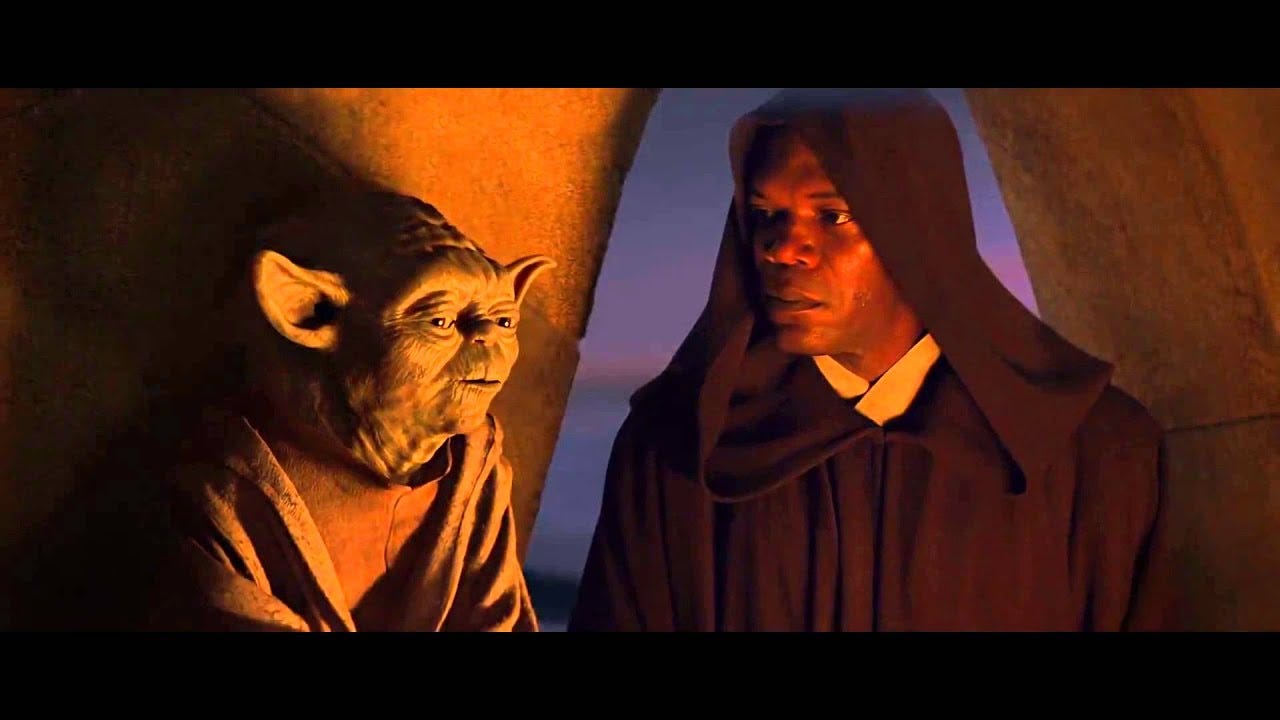
At the risk of opening a can of bantha fodder with all you Star Wars nerds out there, one of the very few interesting things to emerge from the otherwise execrable Episode I: The Phantom Menace was the elucidation of the ‘rule of two’. The evil Sith lords, it seems, were very much into ‘two’ as a number.
‘Always two there are’, croaks Yoda, ‘no more, no less; a master and an apprentice’.
Which is a tad ironic coming from Yoda, because it’s not just the Sith. The whole ridiculous philosophical mashup of the Star Wars universe (of which Yoda is the main spokes-jedi) also depends on a basic dualistic fight between two—between the good side and the dark side of the Force.
But how are those two related?
In Star Wars (as in its ancient real world ancestor, Manichaeism), the two are in constant tension and war, striving for supremacy.
In other philosophies (like Buddhism and Gnosticism and all forms of mysticism), the basic two-ness of the world is resolved by downplaying, denying or demonising one side of it—the physical world and its suffering is bad, nasty and not quite real; only the spiritual, non-physical realm is real and good and worth pursuing.
And in modern rational humanism (following Hegel) we are confident that we can think the two antithetical sides together, and by so doing come to some new and greater synthesis. To which I would say—two world wars, and 100 million killed in genocides? Synthesize that!
However, the biblical universe has its own distinctive approach to the ‘twoness’ of reality. Think, for example, about the following pairs of theological truths:
* God’s sovereignty and human responsibility, in our conversion and in the rest of our Christian lives;
* God’s providential upholding of the creation at every moment, and the rational, cause-and-effect functioning of the world day by day;
* the divine authorship and human authorship of Scripture;
* the full divinity of Jesus Christ and his full humanity;
* God’s immanent, close presence with all of us and his holy transcendent otherness, far above all of us;
* the ‘vertical’ element of our church gatherings (our engagement with God himself) and the ‘horizontal’ element (our engagement with each other);
* the fact that we are fully and completely justified by Christ’s blood, and yet at the same time remain sinful in our character and behaviour (simul justus et peccator as Luther put it; ‘at the same time justified and a sinner’);
* the reality of of being seated at God’s right hand now, and yet remaining fully here in this present evil age—our eschatology is now but not yet;
* we stand before God as individuals and grow as individuals; and yet we are unavoidably part of a corporate body as well (whether that is all of humanity in Adam, or the body of Christ).
Perhaps you can think of others.
It is very striking how many of the great truths of Christian revelation consist of two truths held together at the same time—neither denying one side nor the other, nor seeking to resolve the apparent tension between them.
In fact, the history of Christian heresy and error could be told as the failure to hold two truths fully together, either by downplaying one truth or the other, or by thinking that the way to hold them together was by balancing them in some sort of proportion.
The Christological heresies of the early church, for example, almost all ended up choosing a side—Christ’s divinity or his humanity—and failed to hold both together fully, as the orthodox creeds insisted that we must.
The Pelagian and Semi-Pelagian heretics (who believed in salvation by works or partly by works) couldn’t bring themselves to say that salvation was through faith alone by grace alone, because they felt that to do so was to sideline or eliminate human responsibility.
In much the same way, Arminianism can’t cope with saying that humans are fully responsible and culpable, while at the same time affirming that God is utterly sovereign in election.
Likewise with eschatology—if we lean too hard on the ‘not yet’ we lapse into an other-worldly quietism (there’s no point doing much now, because everything is future); but if we lean too hard on the present blessings of salvation, we find ourselves on the road to the prosperity gospel, or to its less aspirational twin, the social gospel.
And we could go on.
In each case, the answer is not to deny one side or the other, nor to sit on the fence in between, nor to seek to balance the two sides in a certain proportion, as if God were 73% sovereign and we were 27% responsible. In each case, it’s a matter of giving full weight at the same time to two propositions that are both in themselves demonstrably true, even though from some perspectives they appear to be paradoxical or even contradictory.
I can’t help wondering why.
Why, of all the religions and philosophies of the world, does Christianity uniquely and consistently strike this note. Why does it hold together so many apparent paradoxes, and precisely by doing so, explain and account for the reality of the world in such a beautiful and compelling way?
My hunch is that somewhere down deep, it goes back to the doctrine of creation—and in particular creation ex nihilo.
When God made the universe, he made something that was completely distinct from himself. The creation wasn’t an emanation of his own being, nor did he make himself part of the creation. The world was made from nothing, as a reality that was both completely distinct from God, and yet also completely contingent upon him for its existence and life. The world only exists because God wanted it to, and wants it to. And yet it is not part of him; it has a life that is absolutely its own.
I wonder if this first and most basic duality creates a kind of pattern that is expressed in all the others. We exist in this creation, and only know God because he reveals himself to us in the creation. And in every aspect of that revelation and at every point of it—past, present and future—God acts as he did at the beginning when he made everything. He remains transcendently separate, holy and sovereign over his creation, even as he is closely, lovingly and mightily active within it. And it all climaxes in the revelation of his Son, for whom and to whom the whole creation was made—the incarnate, crucified, resurrected Son who embodies in his own person not only the transcendent holy God, but the humanity that he has chosen to draw into fellowship with himself.
Well, these are very deep waters, and although (as in all things) God hovers them, and brings order and life to them, I think that the only thing left to say has already been said by the apostle Paul:
Oh, the depth of the riches and wisdom and knowledge of God! How unsearchable are his judgments and how inscrutable his ways!
“For who has known the mind of the Lord, or who has been his counsellor? Or who has given a gift to him that he might be repaid?”
For from him and through him and to him are all things. To him be glory forever. Amen. (Rom 11:33-36)
PS
Thanks for the ongoing correspondence about church as ‘family’ and as ‘enterprise’. It seems to have struck a chord with a number of people, especially in relation to the struggles of their own church to be the kind of family that is also outward-looking and evangelistic in character. I wrote this back to one correspondent, and I think it captures the heart of the issue:
A healthy church has the gospel of Jesus Christ (i.e. Jesus himself) as the binding, nourishing centre of the family life, and as the motivation and basis for co-ordinated action together to bring his gospe…
This is a public episode. If you'd like to discuss this with other subscribers or get access to bonus episodes, visit www.twoways.news/subscribe
More from Two Ways News
Sense and Sensibility
Nov 23, 2026 · 27m
Dear friends,Last week, Peter answered the question of why he is still a Christian, in terms of the arguments for Christianity found in the person and work of the Lord Jesus Christ. This week, in part...

Persuasion
Nov 16, 2026 · 33m
Dear friends,When Peter and I became Christians in the middle of the 20th century, the great atheist mathematician and philosopher of the time was Bertrand Russell. He produced a book of great...

Always Let Your Conscience Be Your Guide?
Nov 9, 2026 · 23m
Dear friends,Some topics are such a universal way of thinking that it is surprising to see how rarely they are mentioned in the Bible. Conscience is such a topic that is critical to our behaviour...
Blessed Assurance
Nov 2, 2026 · 26m
Dear friends,As Peter and I turn to different topics of Christian concern, it is sad to see how often old problems keep on being recycled through our churches. One such issue is that of assurance....
Institutional Captivity
Oct 26, 2026 · 35m
Dear friends,In this second episode of our series of topics, Peter and I are discussing institutional captivity. Christians, especially evangelical Christians, have been very enterprising and...
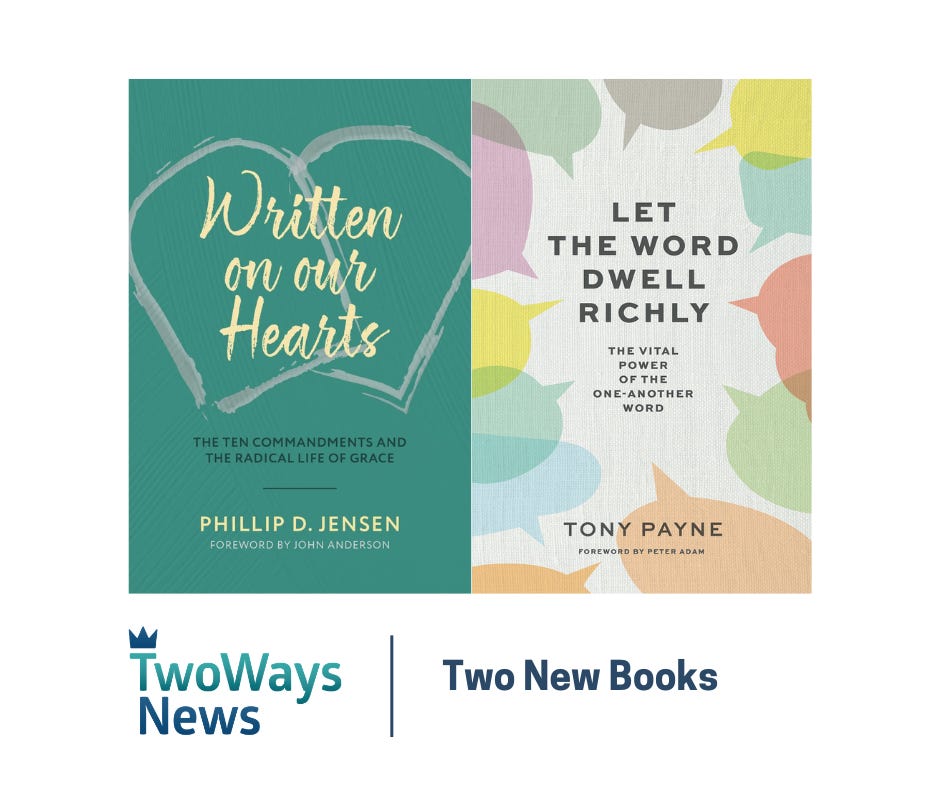
Two New Books
Oct 19, 2026 · 31m
Dear friends,In this episode of Two Ways News, we welcome back Tony Payne, because each of us has published a new book this year. Tony’s book entitled Let The Word Dwell Richly helps us understand the...
Take these sermons with you.
Follow Two Ways News in the Getsermons app to get every new sermon, build playlists, and pick up right where you left off.

