
About this sermon
[Listen to the audio version, or read on … Up to you!]
In this week’s Payneful Truth, a slight divergence from my normal practice, which is to avoid writing about anything newsworthy or topical. Some recent sad accusations against a prominent Christian leader caught my eye this past week, and prompted the following reflections.
Conspicuous sins
It’s happened again.
A much-loved, high-profile evangelical leader is being accused of sexual impropriety. I won’t mention his name, not only because I have no way of knowing whether the accusations are true or not, but because his particular name and his particular case is not the reason for this week’s Payneful Truth.
I’m writing because I wonder whether you get the same sick feeling in your guts as I do when you hear about these things. Is there no-one with integrity, not even one? Can’t these people just keep their pants on? And where on earth do they find the time?
Why is it that these high profile Christian leaders—the mega-church pastors, the denominational head honchos, the international speaker-circuit guys—seem so regularly to have their feet of clay exposed and smashed?
At one level, I suppose it is because of their very prominence. The sins of some men are conspicuous, going before them to judgement (says Paul); but the sins of others appear later (1 Tim 5:24).
The sins of famous pastors are news. The sins of ordinary pastors are known only by a very few.
But although the sins themselves might be different in character and appearance, they are sins nevertheless. Like loving God, sin is a single, unitary phenomenon, with one object and one goal. Sin is the proud rejection of God and his ways, and the exalting of ourselves and our purposes above all others. And just as the love of God manifests itself in multiple virtues, so sin reveals itself in multiple vices.
What, for example, would we say are the common but less conspicuous vices of the ordinary pastor—say, the pastor of a smallish, just-viable church of 80 adults that potters along and makes do from year to year? Despair perhaps, or laziness? Self-pity or blame-shifting or resentment of others’ success? A persecution complex? Comfort-gluttony or alcohol abuse? An unwillingness to take a risk in case it fails (again) and my battered self-image takes another blow?
A lack of outward success hurts our pride, and wounded pride looks for relief wherever it can find it. The mega-church leader, by contrast, has a surfeit of outward success, and faces a different set of temptations.
I was chatting not long ago with a prominent US-based Christian author, and he asked me what I thought was the besetting problem of the mega-church. I fumbled around and said something about a lack of personal relationship among the members.
“No”, he said. “It’s corruption.”
The truth of this observation hit home immediately.
Imagine how difficult it must be to become a beloved and powerful leader within such a massive group of people without it inflating your pride and corrupting your integrity. The high profile church leader begins to believe that he must indeed be worthy of all the admiration and acclaim he so regularly receives; that he has a special place in the church and in God’s purposes; that the little embellishments and exaggerations he starts to make to burnish his image are helpful for the church, because they provide an inspiring example; that his sins and weaknesses are understandable and forgivable, given the extraordinary pressure he is under, and how lonely and hunted he often feels; that he deserves the expensive toys he indulges himself with; that any problems that do emerge are less important than the continued growth and success of the ministry, and so can be rationalised away; that his poor (even abusive) treatment of church employees is the cracking of a few eggs in order to make God’s omelette.
He begins genuinely to believe, in other words, that he really is the most important person in the room, which is the essence of pride, which (according to Augustine) is the essence of sin. And so a double-life develops, with a public church persona on one side and the various compromises and sins of a private existence on the other.
It all comes out eventually, and we shake our heads.
But it leaves us wondering: how would our integrity hold up, if we were the leader of a 10,000-strong church? Would we also be very capable of compartmentalizing the dysfunctional and sinful habits that were emerging in our lives, and maintaining (and even believing in) the image that everyone else saw, of the godly, inspiring pastor?
Personally, I wouldn’t like to find out.
None of this is to say that large churches are a bad idea because their leadership can breed corruption, any more than it is to say that small churches are a bad idea because their leadership can breed complacency or inwardness. It does say, however, that in each case, godly character is more important in a leader than gifting or results.
We should know this anyway from how the Pastoral Epistles describe what’s important in an elder or overseer. Certain gifts are necessary (e.g., ability to teach, ability to manage a household), but these are lodged within a list of character traits dominated by a faithfulness to the true deposit of the gospel, and a life of godliness, self-control and sobriety that has been shaped by that gospel. Tellingly, in 1 Tim 4—just after the discussion of what makes for a good overseer or deacon—Timothy is urged to persist and grow in this gospel-shaped character. “Keep a close watch on yourself, and on the teaching. Persist in this, for by so doing you will save both yourself and your hearers” (1 Tim 4:15-16).
After this latest apparent failure by one of the Great Ones, we might allow ourselves a few moments of sadness and head-shaking. But let it remind us to renew a close watch on ourselves, and on the teaching. Whatever our circumstances—small church or large—let us discipline our bodies and keep them under control, lest after preaching to others we ourselves should be disqualified (1 Cor 9:27).
New to The Payneful Truth and want to get it regularly in your inbox?
PS
Thanks for the encouraging comments and feedback about last week’s ‘Book Talk’ episode. I’ve got some more in the pipeline.
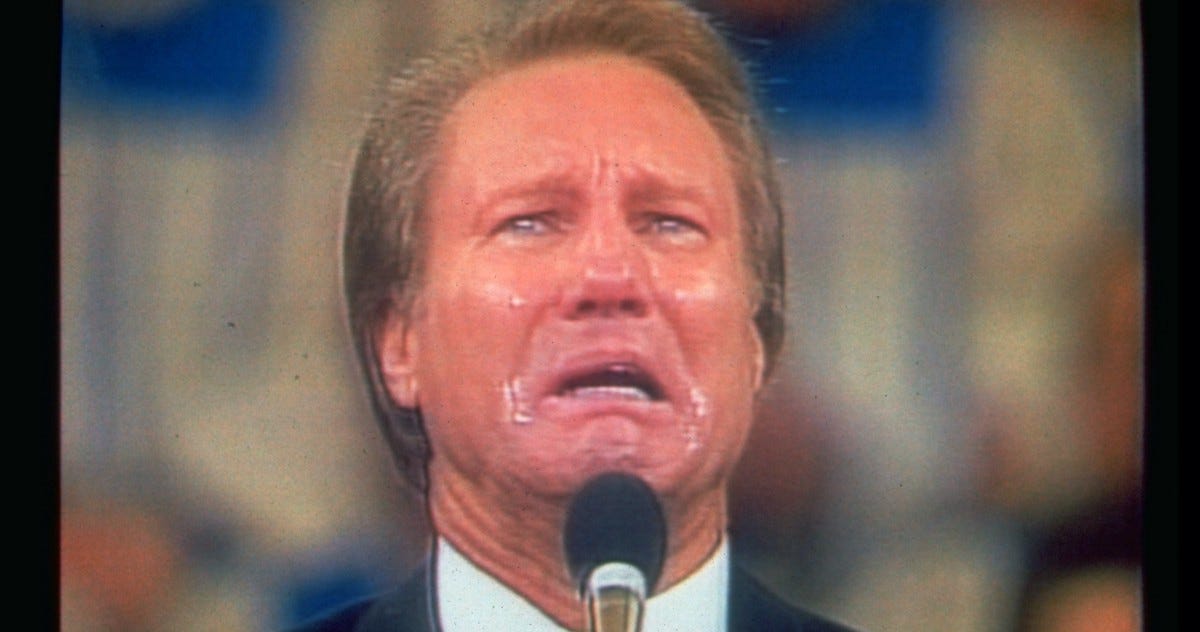
This week’s cover image is a blast from the past. The very first edition of The Briefing in 1988 featured an article about ministerial sin, called ‘The Sins of Jimmy Swaggart’—about a US televangelist who had spectacularly fallen from grace not long before. Astonishingly, Jimmy is still on TV doing his thing (so I noticed the other day). Here’s the iconic picture of Jimmy Swaggart tearfully confessing his sin to his televised congregation back in the late 80s.
This is a public episode. If you'd like to discuss this with other subscribers or get access to bonus episodes, visit www.twoways.news/subscribe
More from Two Ways News

Sense and Sensibility
Nov 23, 2026 · 27m
Dear friends,Last week, Peter answered the question of why he is still a Christian, in terms of the arguments for Christianity found in the person and work of the Lord Jesus Christ. This week, in part...

Persuasion
Nov 16, 2026 · 33m
Dear friends,When Peter and I became Christians in the middle of the 20th century, the great atheist mathematician and philosopher of the time was Bertrand Russell. He produced a book of great...

Always Let Your Conscience Be Your Guide?
Nov 9, 2026 · 23m
Dear friends,Some topics are such a universal way of thinking that it is surprising to see how rarely they are mentioned in the Bible. Conscience is such a topic that is critical to our behaviour...

Blessed Assurance
Nov 2, 2026 · 26m
Dear friends,As Peter and I turn to different topics of Christian concern, it is sad to see how often old problems keep on being recycled through our churches. One such issue is that of assurance....

Institutional Captivity
Oct 26, 2026 · 35m
Dear friends,In this second episode of our series of topics, Peter and I are discussing institutional captivity. Christians, especially evangelical Christians, have been very enterprising and...

Two New Books
Oct 19, 2026 · 31m
Dear friends,In this episode of Two Ways News, we welcome back Tony Payne, because each of us has published a new book this year. Tony’s book entitled Let The Word Dwell Richly helps us understand the...
Take these sermons with you.
Follow Two Ways News in the Getsermons app to get every new sermon, build playlists, and pick up right where you left off.

