
Two Ways News
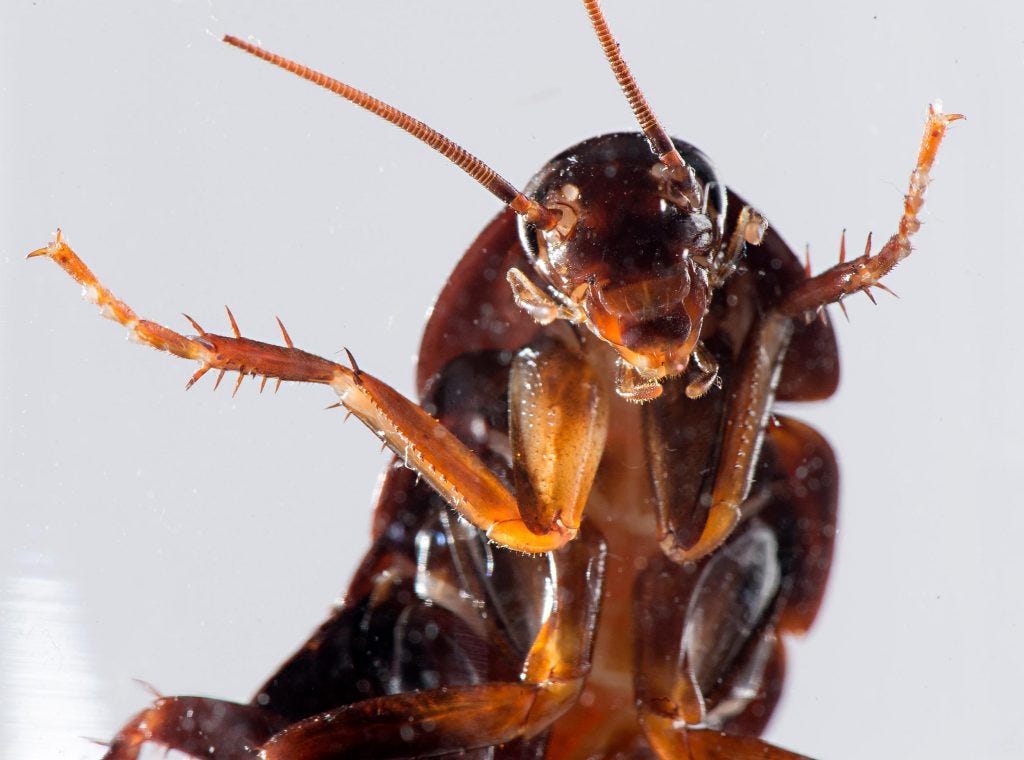
Dear Worthless Cockroach
May 25, 2020 · 13m
Prefer sermons downloaded automatically?
About this sermon
[Click on the play button above to listen, or read on … up to you.]
Dear Worthless Cockroach
I hope you don’t mind me following up our conversation with an open letter like this, but I’m sure you’re not the only one who feels like you do.
Let me see if I’m capturing your question. I think what you’re saying is this:
* I know I’m a sinner through and through; that’s true because the Bible says so, but also in my experience;
* I also know that God has loved me and saved me, not because of anything I have done, or because I am worthy of his love, but purely by his sovereign, wonderful grace;
* But is there anything about me (as myself, as the person I am apart from God's saving grace) that is actually worthwhile or lovable? Am I just a worthless, sinful cockroach that God has chosen to love? And if so, am I wrong to feel bad or uneasy about this? To feel (as I sometimes do) that underneath everything, I really am pretty worthless and unlovable?
Is that right?
If so, let’s see if I can say something useful without it becoming one of my usual long and boring lectures.
I could start by saying that you are certainly worth much more than a cockroach, on the basis of Matthew 10:29-31. If I can slightly paraphrase Jesus’ words: “Are not 50 cockroaches sold for $5? And yet not one of them will be eaten by someone’s pet reptile apart from the will of my Father … Fear not, therefore; you are of more value than many cockroaches!”
So that’s already a small improvement. You’re worth more than a whole intrusion of cockroaches (the collective noun for cockroaches).
Jokes aside, this is actually the beginning of an answer to your question.
Because although sparrows (or cockroaches) aren’t worth very much to us, it’s clear that they are valued by God, and are encompassed in his sovereign fatherly care. And of course, so are we, only much more so (which is Jesus’ point). It’s the same lesson as in Matthew 6—God’s generous fatherly provision for the birds of the air should reassure us that he will most certainly provide for us as well (‘Are you not of more value than they?’).
But why do flowers, sparrows, cockroaches and humans have value in God’s eyes? Is there a sparrowy kind of goodness that God sees in that little bird, that he wants to protect and nurture and provide for, and see flourish? Or is the sparrow actually worthless in itself, and only made valuable because God arbitrarily chooses to love and care for it, for his own sovereign reasons?
This is actually a much-debated question in moral philosophy. (Oh great, I hear you say.) But the simple biblical answer is that the sparrow is indeed good and valuable in itself, because it is one small but wonderful part of God’s good creation. It is good, valuable and lovable, because God made it good, in his own infinite goodness.
And so are you.
Everything God created is good and is to be received with thanksgiving, says Paul to Timothy (1 Tim 4:4), and that includes the extraordinary created gift that is you—with all the attributes that God’s providence has brought forth in you. Everything that God has done for and in you over the years—the provision of food, drink, clothing and learning, the maturation of intelligence, the development of personal qualities, talents, relational gifts, and so on—all of these, he has nurtured and grown in you, just like he dresses the flowers of the field in their unmatched finery.
This is one reason that you have value and are lovable in and of yourself. Because the infinitely good God made you, and has nurtured you in his providence to be the lovely creature you are.
In fact, this is one way of understanding what ‘love’ really is. It’s an affectionate knowledge or perception that something is good, with the accompanying desire to participate in that good and to see it grow and flourish. God’s loving providence for the sparrow and you corresponds to the goodness that you and the sparrow share—because God made both of you with your own kind of sparrowy and human goodness.
We see this in all human relationships. When we love someone—whether or not we or they are Christian—we are responding to a good that is really there; a good that attracts us, that we want to be part of and enjoy, and that we’d like to see continue and flourish.
So there really is something good and valuable about you, whether you a Christian, a non-Christian, a sparrow, or even (yes) a cockroach—because all God’s works are fearfully and wonderfully made.
But of course there is a but.
There is something profoundly not good about you as well (and me too, if I’m honest). Our stupid, sinful rejection of God throws a giant spanner into the goodness we were created to enjoy and become. It alienates us from our creator, and introduces corruption and death into every part of our lives. In fact, this is what the classic Reformed doctrine of ‘total depravity’ means—that our sinfulness penetrates into every part of us; into our hearts and wills and minds and desires and actions. It doesn’t mean that we are all as totally evil as we ever possibly could be, but that depravity has overtaken us totally, in every part of our personalities, so that we cannot escape its influence and consequences.
This means that our actions before God are profoundly un-good. Although we have goodness and value as one of God’s creatures, we have turned aside from him, and fallen far short of his glory. We don’t seek him, can’t know him, can’t please him—and all because we have taken his good creational gifts and run off to a far country to spend them on ourselves, prodigal son style. This is the sense in which we have become ‘worthless’, as Rom 3:11 says. We have corrupted the good gifts he has given us, and ruined any chance we had of becoming the kind of creature he made us to be.
It is in this state that we experience from God a special form of love—a love that we call ‘gracious’ or ‘unconditional’, and that we regard as the highest form of love. It’s a love that seeks the good or benefit of someone regardless of anything they have done or any quality that they have. God’s love for us in Christ is supremely like this—he loved us even when we were his enemies, not because of any goodness in us or in our works.
This kind of unconditional love still seeks and longs for something good—but it is a good that love creates or restores, not a good that already exists. Grace wants to bestow goodness on its object; to bring a goodness into existence that wasn’t there before.
This is what God’s gracious, unconditional, sovereign love does for us in salvation. It redeems the ruin that we have become in our sinfulness, and puts in its place a whole new ‘goodness’ in Christ—a goodness or righteousness that is a gift. We are ‘all good’ now, as the young people say, because God has cleansed us, and given us the goodness of Christ. And even more, he now enables us to put off the old ways of selfishness, lies and malice, and put on instead a new character of goodness, that is being ‘renewed in knowledge after the image of its creator’ (Col 3:10).
This unconditional love of God still bears a relation to the good. It desires and seeks out something very, very good—but it is the good that we are in Christ, and will become in Christ, because of his loving action.
Does that make sense?
I hope so, because this letter is fast approaching ‘lecture’ length, and it’s time to stop. I’ll try to summarise.
Underneath it all, even apart from God’s saving grace, you are indeed very lovable and valuable, because God made you, and all his works are wonderful. God sees that when he sees you, and continues to provide for you in his love, just as he does for the sparrows—in fact, even more so than the sparrows!
But God also sees the fallen creature that you became in your sin and rebellion against him, with all the self-inflicted layers of dirt and grime and damage that resulted. And in his unfathomable, unconditional love, he redeemed and renewed you, because he could also see the good redeemed…
This is a public episode. If you'd like to discuss this with other subscribers or get access to bonus episodes, visit www.twoways.news/subscribe
More from Two Ways News
Sense and Sensibility
Nov 23, 2026 · 27m
Dear friends,Last week, Peter answered the question of why he is still a Christian, in terms of the arguments for Christianity found in the person and work of the Lord Jesus Christ. This week, in part...

Persuasion
Nov 16, 2026 · 33m
Dear friends,When Peter and I became Christians in the middle of the 20th century, the great atheist mathematician and philosopher of the time was Bertrand Russell. He produced a book of great...

Always Let Your Conscience Be Your Guide?
Nov 9, 2026 · 23m
Dear friends,Some topics are such a universal way of thinking that it is surprising to see how rarely they are mentioned in the Bible. Conscience is such a topic that is critical to our behaviour...
Blessed Assurance
Nov 2, 2026 · 26m
Dear friends,As Peter and I turn to different topics of Christian concern, it is sad to see how often old problems keep on being recycled through our churches. One such issue is that of assurance....

Institutional Captivity
Oct 26, 2026 · 35m
Dear friends,In this second episode of our series of topics, Peter and I are discussing institutional captivity. Christians, especially evangelical Christians, have been very enterprising and...

Two New Books
Oct 19, 2026 · 31m
Dear friends,In this episode of Two Ways News, we welcome back Tony Payne, because each of us has published a new book this year. Tony’s book entitled Let The Word Dwell Richly helps us understand the...
Take these sermons with you.
Follow Two Ways News in the Getsermons app to get every new sermon, build playlists, and pick up right where you left off.

