

Two Ways News
Facilitators or teachers?
Mar 30, 2022 · 17m
Prefer sermons downloaded automatically?
About this sermon
Before we get started, some news to share: you can now read The Payneful Truth in the new Substack app for iPhone.
With the app, you’ll have a dedicated Inbox for my newsletter and any others you subscribe to. New posts will never get lost in your email filters, or stuck in spam. Longer posts will never be cut-off by your email app. Comments and rich media will all work seamlessly. Overall, it’s an upgrade to the reading experience I think.
The Substack app is currently available for iOS. If you don’t have an Apple device, you can join the Android waitlist here.
Anyway, on to this week’s subject.
Facilitators or teachers?
Is a small group leader a facilitator? Or more of a teacher?
It’s funny how the answer to that question seems to go in cycles.
In the 1980s, most people in my part of the world would have leaned towards ‘facilitator’. The job of the small group leader was not to deliver a mini-sermon or be a ‘teacher’, but to stimulate some discussion around a Bible passage. Get things moving, try to keep it vaguely on track, but don’t feel it’s your responsibility to impose a conclusion or ‘lesson’ on the group.
In the 90s, there was a pendulum swing away from this thinking, as captured in Col Marshall’s classic book Growth Groups. Col argued explicitly against the concept of ‘facilitator’, and trained a generation of small group leaders to think of themselves more as teachers and leaders—as small-p ‘pastors’ who took a measure of responsibility for the spiritual health of the group members. The leader’s job was to help the group learn what the Bible was teaching, not just share opinions with each other. And this required the leader to do sufficient preparation to understand the passage, and to be able to lead a Bible discussion that revealed and applied the passage’s main points.
In the heyday of Growth Groups, it was assumed that most leaders would prepare and write their own Bible studies most of the time.
Was this a high bar for many leaders and churches? No doubt. And perhaps this is why the pendulum has swung back towards ‘facilitation’ in recent years.
The increasingly common pattern today is for small groups either to do some version of the Swedish method together, or to use pre-written studies, often prepared by the church staff in line with the current sermon series. Leaders see themselves more as a chairperson than a teacher. And if there is a conclusion or landing point to get to, it’s the one that’s been given to them by the pre-written study. Small group leaders writing their own Bible studies from scratch now seems to be a rarity.
I am tempted at this point to do a not-in-my-day rant about falling standards.
But perhaps there is something more helpful to say. Let’s think afresh about the pros and cons of each swing of this pendulum.
On the ‘teacher-leader’ side, the main weakness is simply the high expectations it places on the average group leader. This not only makes it harder to find suitable leaders willing and able to embrace the responsibility, but also means that their training takes longer, and that they are more likely to burn out after a few years. Many churches have found that trying to train all their leaders to this level is unrealistic, and places a cap on how many groups can actually be run. How many churches can find space in their program to run the full 10-week Growth Groups training course for their would-be leaders? Not very many.
Then again, the strength of the ‘teacher-leader’ model is its realism about the ineffectiveness of loosey-goosey, facilitator-type discussions run by inadequately trained leaders. If sermonettes produce Christianettes (as the old saying goes) then meandering group discussions without a landing point produce meandering Christians without a landing point.
The strength of the ‘teacher-leader’ approach is that it recognizes the weakness and potential danger of poorly led opinion sharing, and does something about it. The goal (after all) is not to have a discussion, but to ‘let the word dwell among us richly’ (as Col 3:16 says); to teach and encourage and edify one another in, with and by the Word. This is the goal of all Christian fellowship, of which the small group is one particular type. It’s hard to see why leadership and purposefulness wouldn’t be needed in this context as much as in any other. To think that it will all just happen without well-trained, good quality leadership is a touch naive.
Then again, a well-intended swing towards ‘teaching’ can prompt a teacher-leader to exert too much control over the group, and to squelch or crowd out another theologically vital facet of small group life—the opportunity for members to speak the word to each other for mutual instruction and encouragement. This is the key strength of a ‘facilitated’ group. The facilitator’s whole aim is to stimulate one-another speech, to let the conversation flow freely and go where it will. There is maximum opportunity for mutual encouragement, even if there is also maximum opportunity for missing what the passage is actually about.
So where does that all leave us?
Can we stop this pendulum swinging somehow? Is there a Goldilocks solution?
“Yes!” I hear you pastors say who write Bible studies for their leaders. “That’s why we write these studies. It allows us to exert some direction and quality control over the group discussions, but not place too heavy a burden on our leaders’ shoulders.”
Well, perhaps. Except that pre-written studies can be the worst of both worlds. There is not the freedom of undirected exploration and discovery—since there’s a list of seven questions we all know we have to get through. And unless the studies are very well done, and the leader is experienced, maintaining a natural flow and momentum to the discussion is difficult. It feels clunky, like we’re reading someone else’s lines (because we are). A question seems to be driving at something, but none of us can figure out what it is.
Leading a genuine discussion towards a conclusion is not an easy thing to do. You need to know where you’re going, and to have identified some key milestones along the way. This is impossible without training and preparation. The kind of leader who can make good use of pre-written studies is usually the kind of leader who doesn’t need pre-written studies.
So what is the solution?
Before I say anything else, I have a confession to make.
I reached this point in the first draft of this article, and began to outline a way to think about small group leadership that preserved the key strengths of the ‘teacher-leader’ model of Growth Groups but at a more achievable level for the average or beginner leader in most churches.
And it was only at that point that I remembered that I’d written and published a training course a few years ago that did precisely that. (That’s what comes of churning out too much stuff over too many years I suppose.)
So this nice little article that I was quite enjoying writing suddenly changed into a thinly-disguised promotional piece to get you to buy one of my training courses—which as an Australian is embarrassing.
If you’re prepared to believe me (thousands wouldn’t, as my mother used to say), I’ll leave further mention of the training course to the end, and continue with what I was about to say.
A useful way to think about the leader of a small group Bible study is that he is neither a full-on teacher, nor merely a chairperson or facilitator. He is a tour guide. His role is to lead the group into the Word so that they arrive at the major landmark that every Bible tourist needs to see—that is the main points of this passage, and what they mean for our lives. There is almost always more than one route that will get you there. There may be side-streets and other attractions to view along the way. And occasionally, you may spend so long stopping to look at something really interesting that you don’t get to the major landmark.
But the key point is this: the small group tour guide can only lead and nudge and direct his…
This is a public episode. If you'd like to discuss this with other subscribers or get access to bonus episodes, visit www.twoways.news/subscribe
More from Two Ways News

Sense and Sensibility
Nov 23, 2026 · 27m
Dear friends,Last week, Peter answered the question of why he is still a Christian, in terms of the arguments for Christianity found in the person and work of the Lord Jesus Christ. This week, in part...

Persuasion
Nov 16, 2026 · 33m
Dear friends,When Peter and I became Christians in the middle of the 20th century, the great atheist mathematician and philosopher of the time was Bertrand Russell. He produced a book of great...

Always Let Your Conscience Be Your Guide?
Nov 9, 2026 · 23m
Dear friends,Some topics are such a universal way of thinking that it is surprising to see how rarely they are mentioned in the Bible. Conscience is such a topic that is critical to our behaviour...
Blessed Assurance
Nov 2, 2026 · 26m
Dear friends,As Peter and I turn to different topics of Christian concern, it is sad to see how often old problems keep on being recycled through our churches. One such issue is that of assurance....

Institutional Captivity
Oct 26, 2026 · 35m
Dear friends,In this second episode of our series of topics, Peter and I are discussing institutional captivity. Christians, especially evangelical Christians, have been very enterprising and...
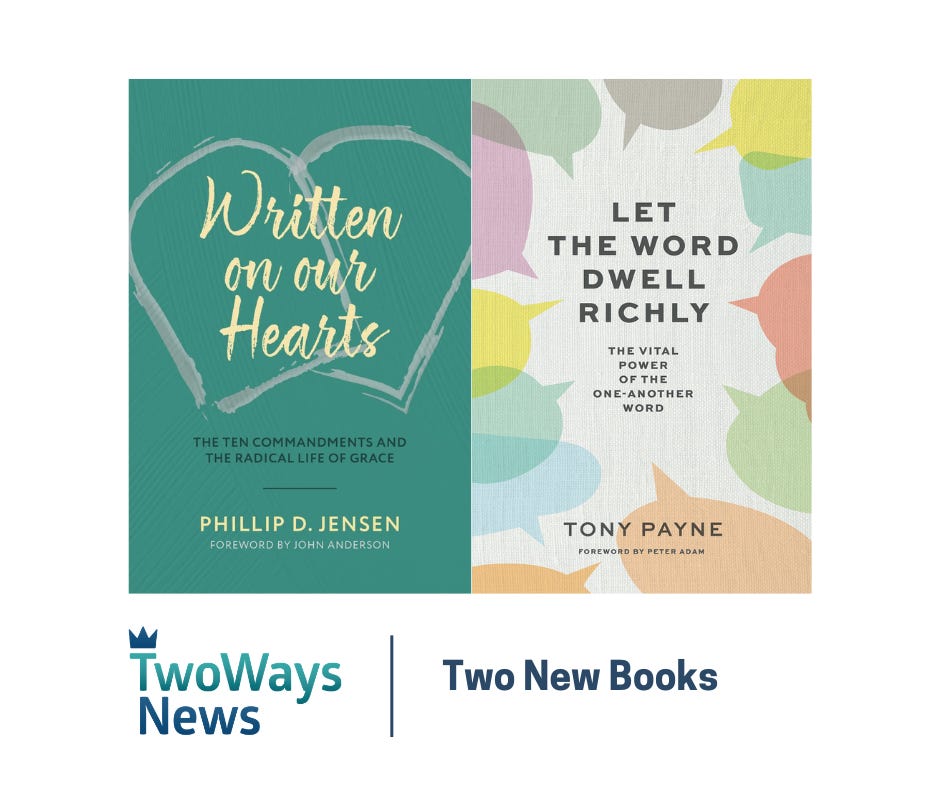
Two New Books
Oct 19, 2026 · 31m
Dear friends,In this episode of Two Ways News, we welcome back Tony Payne, because each of us has published a new book this year. Tony’s book entitled Let The Word Dwell Richly helps us understand the...
Take these sermons with you.
Follow Two Ways News in the Getsermons app to get every new sermon, build playlists, and pick up right where you left off.

