

About this sermon
I was doing some teaching on apologetics recently on Campus, and as we milled around outside afterwards, one of the students asked a thoughtful question.
Why is it that contemporary apologetics mostly focuses on the two approaches that enjoy the least biblical support and have the most risks attached?
To understand the question, some background.
My presentation had been based on the ‘Seven types of apologetics’ essay that I rolled out on The Payneful Truth last year (pt 1, pt 2). As a refresher (or to save you reading from scratch), I argued that in the varied world of contemporary apologetics and evangelistic persuasion, the word ‘apologetics’ gets thrown around pretty loosely—so much so that it’s possible to identify seven different kinds of persuasion or argument that might have the label ‘apologetics’ slapped on them these days. They were:
* Gospel persuasion: the arguments and evidence and reasoning that we employ when actually explaining the gospel of Jesus’ death and resurrection (e.g. evidence that Jesus did indeed rise from the dead).
* Gospel objections: having explained the gospel, we answer the various questions and objections that people raise against it (e.g. “Did Jesus really rise from the dead?”; “I don’t believe that we are all sinners and rebels”; and so on).
* Pre-emptive objections: before we get to talking about the gospel itself, we might address the general objections people have to God and Christianity (e.g. “Why does God allow suffering?”; “Hasn’t science disproved Christianity?”; “Why is Christianity so anti-women and anti-gay?” etc.)
* Building Christian confidence: one function or type of apologetics is bolstering the confidence of Christians by providing answers and reasons for their doubts, and for the common objections that society throws at us.
* God talk and life: way back at the ‘engage’ or pre-evangelistic end of the spectrum, the way we talk and behave in everyday life can open up and commend the subject of the gospel, in a Colossians 4:5-6 kind of way.
* Positive reasons: These are positive arguments we put forward for the truth or attractiveness of the Christian faith. They might be some version of the classic proofs of the existence of God; they might be arguments that start with the people’s inherent desires and aspirations and show that Christianity fulfills them; they might seek to present the positive goodness of Christianity in the most reasonable and attractive way, to get some traction with the modern, secular person.
* Critique (kategoria): Rather than provide a defense or ‘apologia’, this form of persuasion points out the inconsistencies and dysfunctions in the non-Christian worldview. It critiques the world, rather than answering the critiques of the world. (Paul’s speech in Acts 17 is a classic case in point.)
I argued that we find types 1, 2, 4, 5, and 7 in the example and instructions of the apostles, and suggested that these were the ones we should also focus on in our own evangelism and persuasion. Types 3 and 6—‘Pre-emptive objections’ and ‘Positive reasons’—are not only difficult to find in the New Testament but have considerable risks attached. The ‘pre-emptive objections’ approach puts us on the backfoot, and often gives too much credence to the validity or genuineness of the objection; the ‘positive reasons’ strategy often seeks to frame Christianity in terms that are attractive to the prevailing secular mind, thereby risking a distortion of the counter-intuitive, offensive nature of the gospel.
Unfortunately, it is precisely these two latter types (3 and 6) that tend to dominate the field of contemporary apologetics and persuasion.
Hence the question I was asked: How has this come to be the case? Why do we end up focusing on the two apologetic approaches that have least to commend them?
In answer, I made a few vague, stuttering remarks about the trends of modern thought, and our temptation to give the world too much credit, and our lack of belief in the power of the gospel itself, and how everything had gone to pot since the Enlightenment, and so on. All no doubt true, but a bit incoherent.
But then a few days later, in the slow process of moving some books around at home—slow because I keep stopping to browse through old favourites—I came across Graeme Goldsworthy’s underappreciated Gospel-centred Hermeneutics. Not a light read but full of gold. And I remembered and found again this section on page 60:
Sinful thinking is ‘snake-think’, the kind of noetic rebellion proposed by the serpent in Eden. It is diametrically opposed to the mind renewed by the gospel … At this point we can say that the godless presuppositions underlying the temptation and fall in Genesis 3 include the following:
* If God is there, he does not communicate the truth.
* We do not need God to reveal the rational framework for understanding reality;
* Human reason is autonomous, and the ultimate arbiter of truth and falsity, right and wrong.
In essence, these presuppositions are those of the secular mind that were given such sophisticated expression in the philosophies of the Enlightenment.
‘Noetic rebellion’—there’s a phrase you would only hear spoken in the halls of academe. ‘Noetic’ means ‘to do with the mind’ (from the Greek word nous, ‘mind’, ‘understanding’, ‘intellectual perception’). Why we can’t just say ‘mental rebellion’ I’m not sure, but I digress.
At one level, Goldsworthy’s point is one that you’ve heard in a thousand sermons on Genesis 3—that the fall involved a false set of assumptions and beliefs about God: that even if he is there, we can’t trust him and don’t need him; that we can gain wisdom and truth on our own terms; that we can become like God ourselves, as self-legislating judges of what is true and good.
Goldsworthy’s insight, however, is that this primal ‘snake-think’ is precisely the program of the Enlightenment, and the foundation of modern thought. The Enlightenment was the humanistic project beginning in the late 17th century that sought to cast off the dark, dim understanding of our forebears, who relied on God and his revelation to understand the world. The Enlightenment thinkers wanted to see if we could figure it all out for ourselves, without an answer coming to us ‘from outside’. Could knowledge and truth and morality be found by following our own reason and instincts and experience? Surely yes, said the Enlightenment, and tried to do so.
Fast forward to today, and we are the inheritors of several centuries of what amounts to very sophisticated snake-think. The progress of the Enlightenment has been anything but smooth. In fact, the ‘post-modern’ movement was basically the realization that the assumptions of the Enlightenment were overly optimistic and self-defeating.
All the same, even if post-modern thinkers are a tad less confident about our ability to figure it all out ourselves, the basic serpentine assumption remains. It’s as old as Adam. If there is any rationality or truth or goodness or morality to be found, it will only be discovered or created by us, on our own terms, through our own reason and experience.
Any proposal, therefore, that is put forward—whether Christian or otherwise—needs to accept these ground rules. The truth or falsity of something, its rightness or wrongness, its goodness or badness, its usefulness or otherwise, can only be established on terms decided by us.
In our noetically rebellious world, human reason and experience occupy the bench as Judge. If Christianity wishes to argue for itself, it needs to take its place in the dock, like everything else, and defend itself. It needs to answer the Judge’s objections and questions. It needs to show itself good and reasonable according to our current, autonomous standards of reason and experience.
This is where Goldsworthy’s insight helps answer my student’s question about the focus of much contemporary apologetics.
We find it very easy to focus on apologetic strategy number 3 (pre-emptive objections) and number 6 (positive reasons) because they fit withi…
This is a public episode. If you'd like to discuss this with other subscribers or get access to bonus episodes, visit www.twoways.news/subscribe
More from Two Ways News
Sense and Sensibility
Nov 23, 2026 · 27m
Dear friends,Last week, Peter answered the question of why he is still a Christian, in terms of the arguments for Christianity found in the person and work of the Lord Jesus Christ. This week, in part...

Persuasion
Nov 16, 2026 · 33m
Dear friends,When Peter and I became Christians in the middle of the 20th century, the great atheist mathematician and philosopher of the time was Bertrand Russell. He produced a book of great...
Always Let Your Conscience Be Your Guide?
Nov 9, 2026 · 23m
Dear friends,Some topics are such a universal way of thinking that it is surprising to see how rarely they are mentioned in the Bible. Conscience is such a topic that is critical to our behaviour...
Blessed Assurance
Nov 2, 2026 · 26m
Dear friends,As Peter and I turn to different topics of Christian concern, it is sad to see how often old problems keep on being recycled through our churches. One such issue is that of assurance....

Institutional Captivity
Oct 26, 2026 · 35m
Dear friends,In this second episode of our series of topics, Peter and I are discussing institutional captivity. Christians, especially evangelical Christians, have been very enterprising and...
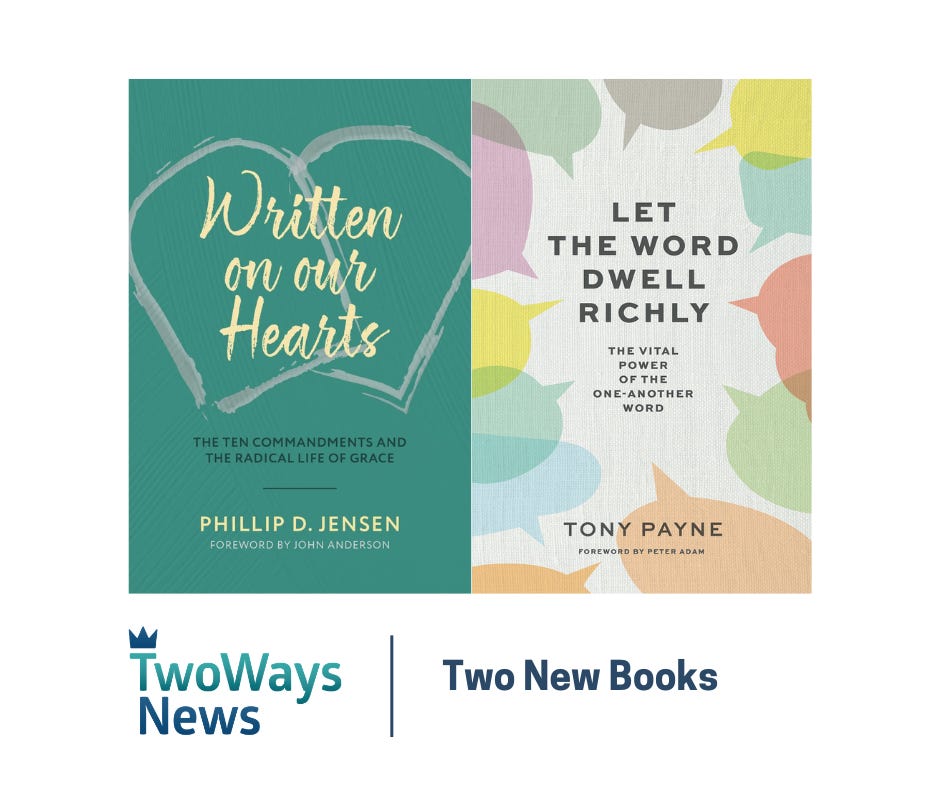
Two New Books
Oct 19, 2026 · 31m
Dear friends,In this episode of Two Ways News, we welcome back Tony Payne, because each of us has published a new book this year. Tony’s book entitled Let The Word Dwell Richly helps us understand the...
Take these sermons with you.
Follow Two Ways News in the Getsermons app to get every new sermon, build playlists, and pick up right where you left off.

