
Your Bible Uncovered Podcast
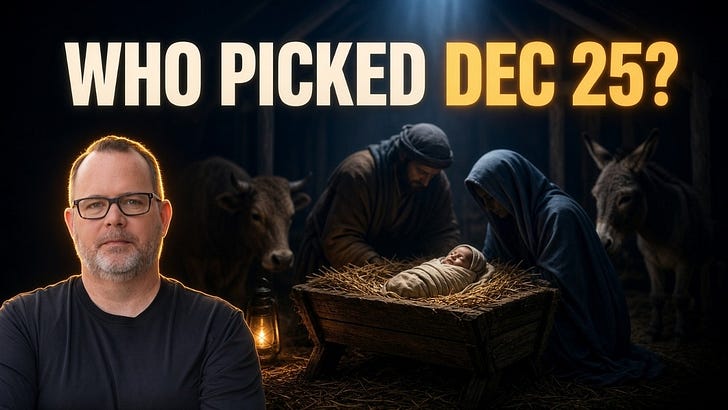
Is Christmas Pagan?
Nov 19, 2026 · 10m
Prefer sermons downloaded automatically?
About this sermon
Every December the same claims come around. Christmas is a pagan holiday with Jesus painted on top. The date was stolen from a Roman sun god. The parties came from Saturnalia. And the Christmas tree is condemned right there in Jeremiah 10.
Some sincere believers hear that and feel guilty for putting up a tree. Others roll their eyes. Neither is the best response. The best response is to check, so let’s check.
What the Bible actually says about the date
Nothing. Luke gives us the setting, not the day:
And there were shepherds living out in the fields nearby, keeping watch over their flocks at night. (Luke 2:8)
You’ll hear that shepherds couldn’t have been outside in December. But Bethlehem’s winters are mild, and an old Jewish source, the Mishnah, assumes flocks were kept in the fields near Jerusalem well before Passover. So the shepherds don’t prove December, and they don’t rule it out.
We know the rough year, about 6 to 4 BC, because Herod the Great was still alive. The day, God didn’t tell us. And the earliest Christians didn’t agree on it either. Around AD 200, Clement of Alexandria listed several dates believers in Egypt had proposed. None was December 25. By the 300s, the churches of the East kept January 6 while the West kept December 25. The Armenian church still keeps January 6.
Did Christians steal a sun god’s birthday?
Here’s the popular version: in AD 274 the emperor Aurelian promoted the Unconquered Sun, Sol Invictus, and Christians later took over his December 25 birthday to win pagans over.
Here’s what usually gets left out. The earliest record of a sun festival on December 25 is a Roman calendar book from AD 354, often called the Chronograph of 354. That same book also contains our earliest firm record of Christmas on December 25, in a list compiled around 336. The two show up together, in the same book.
There’s also a Christian writer, Hippolytus of Rome, whose commentary on Daniel, written around AD 204, gives December 25 as the date of Jesus’ birth. Scholars debate whether that line is original. If it is, Christians had the date seventy years before Aurelian.
So where would a Christian date come from? Many historians, including Andrew McGowan, point to a calculation. Early Christians dated Jesus’ death to March 25, and there was an old idea, found in Jewish tradition as well, that great men of God died on the same date they were conceived. Conceived March 25, born nine months later: December 25.
That doesn’t prove Jesus was born on December 25. It does mean “they stole it from the pagans” is a lot weaker than it sounds.
Saturnalia
Saturnalia was real, and it was rowdy. But it began on December 17 and, at its longest, ended on December 23. It never fell on December 25. Did some winter customs drift between holidays over the centuries? Probably. Customs always mix. But a shared season isn’t a shared god.
The tree in Jeremiah 10
This is the one that troubles people most, so here’s the passage:
For the practices of the peoples are worthless; they cut a tree out of the forest, and a craftsman shapes it with his chisel. They adorn it with silver and gold; they fasten it with hammer and nails so it will not totter. (Jeremiah 10:3–4)
Now read the next verse. Jeremiah says these things are “like a scarecrow in a cucumber field” and cannot speak. He’s describing a carved idol. The tree is the lumber.
And Christmas trees don’t go back to ancient pagans. The earliest detailed description we have comes from Strasbourg in 1605: a fir in a family parlor hung with paper roses, apples and wafers. (The story that Martin Luther started it is a legend.) The custom grew in Christian homes in Germany, not in a pagan temple.
So should Christians celebrate Christmas?
Some sincere Christians have said no. The Puritans in Massachusetts banned Christmas from 1659 to 1681, with a five-shilling fine. They weren’t against Jesus. They said Scripture never commands the holiday, and they hated the drunken excess that came with it.
Paul addresses this kind of disagreement directly:
One person considers one day more sacred than another; another considers every day alike. Each of them should be fully convinced in their own mind. Whoever regards one day as special does so to the Lord. (Romans 14:5–6)
You don’t have to celebrate Christmas to be faithful. And you don’t have to feel guilty if you celebrate it for the Lord. Around AD 400, Augustine told his congregation to keep the day holy, not as unbelievers do because of the sun, but because of the one who made the sun.
What matters more than the date
But when the set time had fully come, God sent his Son, born of a woman, born under the law, to redeem those under the law, that we might receive adoption to sonship. (Galatians 4:4–5)
We don’t know the date. God did, and Paul says it came exactly on time. John puts it this way:
The Word became flesh and made his dwelling among us. We have seen his glory, the glory of the one and only Son, who came from the Father, full of grace and truth. (John 1:14)
That’s worth celebrating any day of the year. And if you choose December 25, you can do it with a clear conscience.
A free guide if you want to go deeper
I put together a free seven-day study guide called The Fullness of Time. It walks through the birth of Jesus from the prophets to Luke 2, one day at a time, and then lays out the real history of Christmas with the sources: the early dates, the Chronograph of 354, Hippolytus, Saturnalia, Jeremiah 10 and Romans 14. Each day has the NIV text, background, questions for your family or group and a short prayer.
👉 Download The Fullness of Time, free →
The video is here:
Your turn
Which claim have you heard most: the sun god, Saturnalia, or the tree? And how does your family keep Christmas, or not? Tell me in the comments. I read every one.
Scripture quotations taken from The Holy Bible, New International Version® NIV®. Copyright © 1973, 1978, 1984, 2011 by Biblica, Inc.™ Used by permission. All rights reserved worldwide.
This is a public episode. If you would like to discuss this with other subscribers or get access to bonus episodes, visit yourbibleuncovered.substack.com
More from Your Bible Uncovered Podcast
The Devil Came for the Pope
Nov 28, 2026 · 10m
Have you ever had a week that felt like it had a target painted on it?Not just a hard week. A week where the bad news came from three directions at once, right after something good happened, and...
The Storehouse Was Full of Grain
Nov 27, 2026 · 9m
Somewhere in your church history there is probably a Sunday you remember. The offering plate is coming down the row, the pastor has just read Malachi 3, and you are doing quiet math in your head about...
Every Good Gift
Nov 25, 2026 · 10m
Every December, somewhere between the cookies and the wrapping paper, a kid asks the question: “Was Santa real?”The honest answer is yes and no. The man in the red suit with the reindeer was...
Follow the Star
Nov 24, 2026 · 10m
Every December my nativity set goes on the same shelf: Mary, Joseph, the baby, a shepherd with a chipped arm, and three kings in gold crowns kneeling at the manger.It’s a lovely scene. It’s also wrong...
The Night They Ran
Nov 20, 2026 · 9m
Then everyone deserted him and fled." Mark 14:50 covers all eleven disciples in six words. Every one of them had promised to die with Jesus a few hours earlier.This episode walks through that night:...

Under His Wings
Nov 20, 2026 · 10m
Does Psalm 91 mean nothing bad can happen to you?It’s a fair question, and a lot of people are asking it. YouVersion’s 2026 report says “Psalm 91” was the single most-searched term in its Bible app...
Take these sermons with you.
Follow Your Bible Uncovered Podcast in the Getsermons app to get every new sermon, build playlists, and pick up right where you left off.

