
A Fisherman's Faith
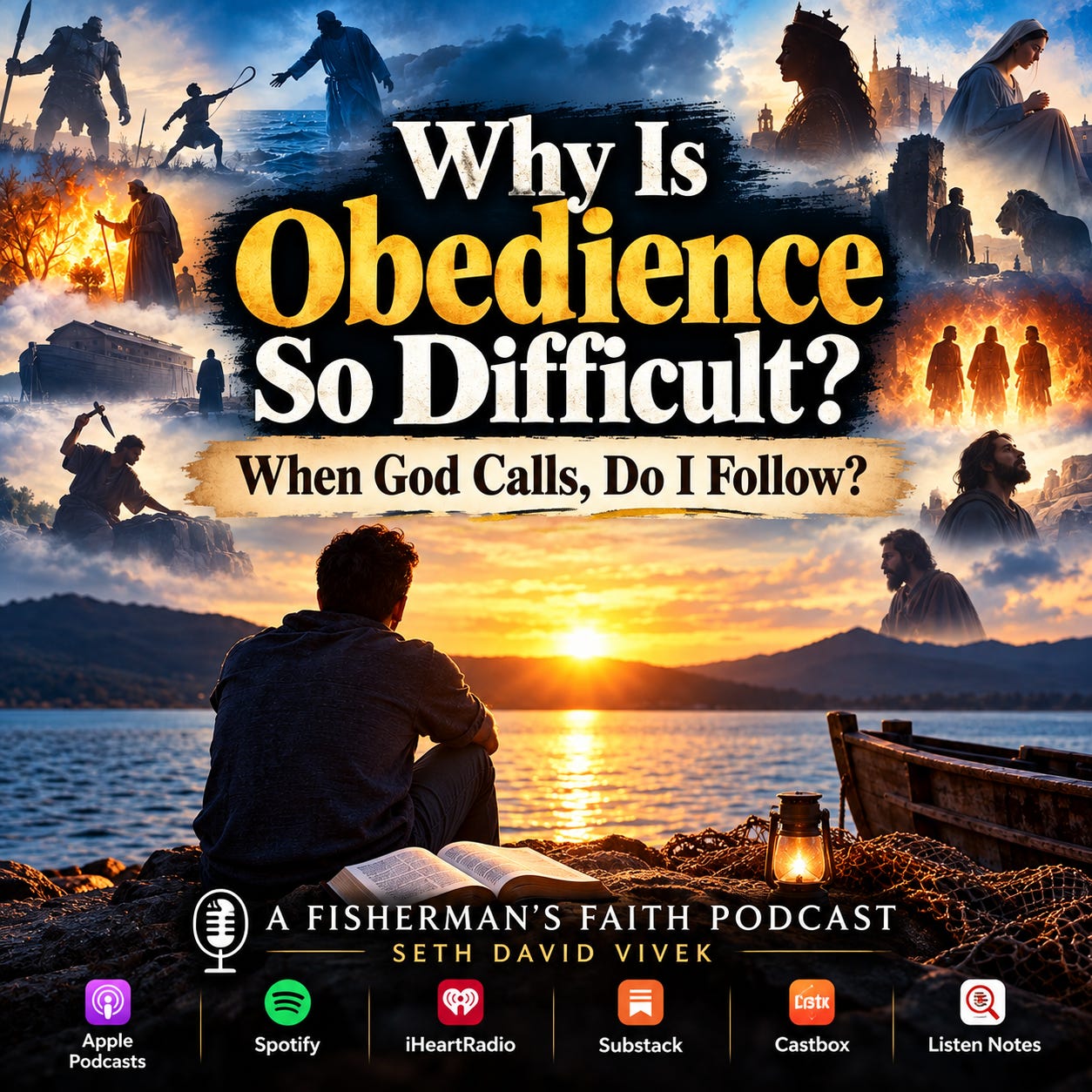
Why Is Obedience So Difficult? When God Calls, Do I Follow?
Oct 19, 2026 · 9m
Prefer sermons downloaded automatically?
About this sermon
Welcome back to A Fisherman’s Faith Podcast.
Welcome back to A Fisherman's Faith Podcast. Yesterday morning, during our morning walk, my wife and I were listening to Gospel music. One of the songs was about obedience, and it stirred something in my heart . It brought me back to a question I have struggled with for a long time: Why is obedience so difficult?
We read God’s Word, hear His teachings, and sometimes know exactly what we need to do. Yet, when the moment comes to obey, we hesitate. We question, delay, or convince ourselves that perhaps this is not the right time. I have experienced this in my own life, and I believe many of us have too. So today, I want us to reflect on this question: When God calls, do I follow?
As I thought about obedience, another question came to mind. What would the Bible look like if the people God called had consistently chosen not to obey? What if Noah had refused to build the ark because there was no rain? What if Abraham had refused to leave his homeland because he wanted to know exactly where he was going? What if Moses had told God at the burning bush, “Lord, please find somebody else”? What if David had looked at Goliath and decided the risk was simply too great? What if Esther had remained silent because she was afraid? And what if Mary had decided that the cost of carrying out God’s plan was too much?
Their stories remind us that God’s purposes unfolded through people who responded to His calling without knowing every detail of what lay ahead. Obedience often begins before we have all the answers.
But there is another side to obedience that I find especially challenging. Sometimes God uses people to confront us, correct us, guide us, and help us understand how His Word should shape our lives.
Think about David. After David sinned, God sent the prophet Nathan to confront him. David was the king. He had power and position, and he could have used his authority to silence Nathan. But instead, when Nathan exposed his sin, David acknowledged, “I have sinned against the LORD.”
David did not allow his position to place him above God’s correction. He recognized the truth of the message and humbled himself before God. Imagine how differently his story might have unfolded if he had defended himself, blamed others, or silenced Nathan.
David’s response challenges me to ask: When someone brings correction into my life, am I willing to examine my heart, or do I immediately defend myself?
Of course, not everyone who claims spiritual authority speaks for God, and not every correction is right. Spiritual leadership must remain accountable to Scripture. But when godly people correct us in truth and love, we must be careful not to reject their counsel simply because it challenges our pride.
So what is obedience? Obedience is responding to God’s Word with trust and action, choosing His direction over our own preferences when the two are in conflict. James 1:22 tells us to be doers of the Word, not hearers only. We can know Scripture and encourage others to obey God while still resisting His Word in our own lives.
Sometimes obedience means taking a step of faith when we cannot see the outcome. At other times, it means apologizing when we are wrong, accepting correction, forgiving someone who hurt us, or receiving wisdom from a godly leader. Obedience is not merely an idea we admire. It is a response we live out.
And this brings me to Jesus, our greatest example of obedience. In the Garden of Gethsemane, knowing the suffering that lay ahead, Jesus prayed, “Not as I will, but as thou wilt.” Jesus did not pretend that suffering was easy. Yet He surrendered Himself to the Father’s will. His obedience led Him to the cross, and through His death and resurrection, we have the hope of salvation.
Jesus also said in John 14:15, “If ye love me, keep my commandments.” We do not obey God to earn His love or prove that we deserve His grace. We respond because He has loved us first. Obedience is an expression of love, gratitude, and trust.
As I reflect on these truths, I keep coming back to one question: What about me?
When I look back on my own life, I can honestly say that much of my obedience has come through brokenness and the lessons I have learned along the way. For someone as strong-headed as I can be, God has often used difficult seasons to teach me what I could not learn any other way. And for that, I am genuinely grateful. The Lord is still teaching me that obedience is not simply about surrendering when I have no other choice. It is about learning to trust Him willingly, even when I do not fully understand what lies ahead.
There is another practical aspect of obedience that the Lord has been teaching me. Christ continues to work in my heart, teaching me to honor spiritual authority, embrace godly counsel, and receive discipleship within a Christ-centered community of believers.
For about 25 years, I was part of church life on the East Coast, and I also served in church leadership. Looking back, I realize that I did not always place myself in situations where I had to receive spiritual guidance, correction, and accountability from others. There was a certain distance between leaders and members, and I had become accustomed to a way of church life that did not necessarily challenge me to examine my own understanding of spiritual authority.
If I am honest, part of the struggle was within me. I was more comfortable making my own decisions and relying on my own understanding than allowing others to speak into my life. It is one thing to teach God’s Word or encourage others in their walk with the Lord; it is another thing to humble yourself and allow that same Word to correct you through someone else.
But in the last few years, the Lord has brought me into a deeper experience of Christian community. Through relationships with brothers in Christ whom I have come to respect and trust, I have been learning what it means to receive godly counsel, submit to discipleship, and embrace accountability.
I am beginning to understand that spiritual authority is not about someone controlling my life or demanding unquestioning obedience. It is about recognizing the spiritual gifts, wisdom, character, and fruit God develops in others, and being humble enough to learn from them.
Acts 17:11 has become especially meaningful to me. The Bereans received the message eagerly, but they also examined the Scriptures daily to see whether what they were hearing was true. That is the balance I am learning to embrace: a heart humble enough to receive instruction, but grounded enough in God’s Word to examine what I am taught.
As I have begun to let go of my pride and become more willing to receive guidance and correction, I have experienced something beautiful. I have gained wisdom, grown through discipleship, experienced deeper relationships, and learned more about the love of Christ. The Lord has been using these relationships to expose areas in my heart that still need to change and to help me understand His truth in a deeper, more practical way.
I am still learning, and I have a long way to go. But I can testify that God has been teaching me something important: I cannot grow fully as a disciple of Christ while insisting on doing everything on my own terms. Obedience means more than knowing God’s Word; it means being willing to live it, even when that requires me to set aside my pride, receive correction, and learn from others.
I believe this is essential to serving the Lord faithfully. We need God’s Word, the guidance of the Holy Spirit, and the encouragement and correction of mature believers. God has given us one another so that we can grow together into the likeness of Jesus. Sometimes, one of the most important steps of obedience is not taking charge, but humbling ourselves enough to be taught.
So let me leave you with this question: Is there something God has already shown you that you know you need to do, but you have been putting it off? Perhaps it is a step of faith, a conversati…
This is a public episode. If you would like to discuss this with other subscribers or get access to bonus episodes, visit sethdavidvivek.substack.com
More from A Fisherman's Faith
Discipline Is Not Punishment, Without Discipline, There Is No Discipleship.
Nov 18, 2026 · 12m
A Fisherman’s Faith Podcast by Seth David VivekFor most of my Christian life, I wanted to be loved, encouraged, prayed for, and supported by my church and small group. I wanted brothers and sisters...

My Flesh Sees Only the Eye of the Needle, Yet Faith Sees the Beautiful Gate.
Nov 10, 2026 · 7m
For the last couple of weeks, I have been struggling with a decision I need to make concerning one of my sons. Deep down, I know it is God’s will. I also know it is one of the crucial steps my son...
Lord, I Don’t Want to Fight a Battle That Hasn’t Even Begun - A Prayer for Faith When Fear Remembers.
Nov 3, 2026 · 6m
There are moments in life when you hear something, and suddenly, your heart takes you somewhere you never wanted to go again. Something happens. Someone says something. You hear something that touches...
Self-Pity Makes Us Spectators of Our Own Suffering Rather Than Participants in God’s Work.
Oct 31, 2026 · 8m
Have you ever wondered how much of our lives we spend feeling sorry for ourselves? I mean, really think about it. How often do we replay the things people said to us, the disappointments we...
A Fisherman’s Battle Within - Can Repentance Transform My Heart ?
Oct 12, 2026 · 14m
For most of this week, my wife and I have been going through Romans chapters 6 through 8 during our morning devotions. As we have been reading and reflecting on these chapters, one thing has continued...

Rusted Shears, a Trimmed Bush, and an Unfinished Story.
Sep 29, 2026 · 9m
Hello, everyone. This is Seth David Vivek, and welcome back to another episode of “A Fisherman’s Faith” Podcast.Have you ever looked at someone you love and quietly thought, “I just don’t see how this...
Take these sermons with you.
Follow A Fisherman's Faith in the Getsermons app to get every new sermon, build playlists, and pick up right where you left off.

