

crumbs from His table fellowship podcast
Book Review: The War for Middle-Earth
Feb 13, 2026 · 24m
Prefer sermons downloaded automatically?
About this sermon
In The War for Middle-Earth, historian Joseph Loconte has provided an exhaustively researched and insightful examination of the lives and works of C. S. Lewis and J. R. R. Tolkien in the context of World War II and the decade preceding it. He discussed the ideological water in which Lewis and Tolkien swam and worked, the interbellum and World War II history of Great Britain, the friendship and writerly encouragement between Lewis and Tolkien (and the other Inklings, but these two centrally), and the way the world events from the First World War through the rise of totalitarianism and the Second World War shaped their imaginations and work. To borrow Barbara Tuchman’s phrase, gazing in the “distant mirror” of history through this book felt both emotionally moving and ideologically important. It helped me see my own time more clearly and charted a course for thoughtful, creative Christians living in another tumultuous age. I would shelve it between the works of the Inklings and the works of Francis Schaeffer. It built on the foundation Loconte laid in New York Times best-seller A Hobbit, a Wardrobe, and the Great War.
The best-known fictional works of Lewis and Tolkien bore the mark of the wars on the authors. Lord of the Rings was substantially written during World War II, and the fellowship—like the British, especially from Dunkirk on—fought valiantly against an evil existential threat with no certainty of victory. The British fought on against Italian and German fascism, even with a very real risk of obliteration from the air, of invasion by sea, and of mass starvation on an island suddenly cut off from the resources of her allies and Commonwealth. Like the fellowship, they fought on because they believed they fought a wickedness so great that it must be resisted, even if they died in the attempt. It is easy today, especially from North America, to underestimate that mortal peril to civilians and British civilization when looking back, already knowing the outcome.
The literary epics Lewis and Tolkien loved, the tales like Beowulf which forged their own moral imaginations, convinced them that modern Christian myth-making (“mythopoeia”) could kindle courage in a disillusioned and hopeless generation. From their own experiences of transformation through beloved stories, from Norse legend to the Aeneid to Beowulf to Paradise Lost to George Macdonald, they knew that great stories could be levers with which to shift imaginations and affections. After all, conversations with Tolkien and Hugo Dyson about the supreme Myth to which all lesser stories point proved crucial in C. S. Lewis’s conversion to faith in Christ. This is not to say that they made stories intended primarily for moral instruction; rather, the underlying values the stories embodied portrayed the good and true as beautiful and desirable and unmasked the bad and false as ugly and repellent.
Into the prevailing climate of materialism, they unflinchingly insisted on an unseen reality greater and more important than what can be seen, felt, and measured.
Into the climate of religious doubt, they pointed to the Creator as the source of hope, goodness, and rescue for our bent and broken humanity.
Into a climate of eugenics, they portrayed a world where survival depended on the least and littlest of the peoples of Middle Earth and even the brutal and treacherous Gollum deserved life and compassion, whereas genetic optimization produced the monstrous super-orcs of Saruman, and only the worst villains of the National Institute of Co-ordinated Experiments (NICE) gave support to eugenic experiments. In That Hideous Strength, the corrupt Lord Feverstone, one of the architects of NICE’s planned society, echoed real-world eugenicists when he advocated for “‘sterilisation of the unfit, liquidation of backward races (we don’t want any dead weights), selective breeding. Then real education, including pre-natal education. By real education I mean one that has no ‘take-it-or-leave-it’ nonsense. A real education makes the patient what it wants infallibly: whatever he or his parents try to do about it’” (C.S. Lewis, The Space Trilogy, 473). Bucking the trend, even among public-facing Christians, Lewis critiqued this more directly in The Abolition of Man.
Into a climate of racism, they offered the beauty of reconciliation and deep friendship between a dwarf and an elf in The Lord of the Rings, and the harmonious cooperation between the three primary sentient life forms on Malacandra in Out of the Silent Planet.
Into a climate of totalitarianism, they presented the wonder of humble, sacrificial leadership in Aragorn and Ransom and the need of diverse gifts, united in one purpose, if good were to triumph. Sauron, Weston the Un-Man, the White Witch of Narnia, and NICE, on the other hand, showed the will to power in all its ugly, soul-destroying evil.
Into a climate of atheistic evolution, they painted pictures of a radiant, flourishing, personal creation filled with song and color.
Into a climate of peace-at-any-price isolationism and appeasement, they upheld the old beliefs in a true moral good worth defending, even at the cost of life itself, and true moral evil so grave that it must be opposed, though one should die in the attempt.
Into a climate of disillusion and dissolution, they held out hope like starlight captured in a glass and displayed the beauty of lives lived in honor, humility, courage, and sacrificial service. They pointed us toward faith that eucatastrophe is possible, even when hope seems lost, even if death itself must work backward to bring about that sudden, joyful turn of events.
Lewis’s space trilogy was produced in this furnace of war and the dual totalitarian ideologies of fascism and communism, both based on “the will to power.” Lewis wrote it as a counter-narrative to the atheistic and nihilist science fiction of H. G. Wells. Lewis also mentored and encouraged the evacuees lodging at his home, the same evacuees who provided the germ of the idea of the first Narnian story. Quotes from one evacuee whose career course he redirected and from both dons’ former students brought their teaching work to life in Loconte’s book.
In addition to the imaginative works, Lewis began his Christian apologetic work and honed his ability to communicate to lay persons of varied educational backgrounds as a direct result of World War II. For example, listening to a radio broadcast of a spell-binding speech by Hitler sparked Lewis’s idea for The Screwtape Letters. The essay “Learning in Wartime” began as a sermon to an Oxford congregation and made it clear that war was not the greatest danger they all faced; rather, fear, sinful neglect of duty, and unfaithfulness to God were. The talks which became Mere Christianity were requested by the head of the BBC to fortify the British with the moral courage and eternal hope they needed to resist at great cost instead of surrender. Revisiting that book now surprised me with the frequent use of wartime imagery and mentions. (How had I not noticed that?) The Abolition of Man began as wartime talks for the University of Durham. Lewis also traveled the length of Britain sharing Christian hope with the very young airmen of the Royal Air Force, men whom Lewis knew may not have another opportunity to hear the gospel message before flying into death for King and country. If that were not enough, he also agreed to a student’s request that he preside over the new Oxford Socratic Club.
On the other hand, only Lewis’s enthusiasm and “indefatigable” collegial criticism spurred perfectionist Tolkien to stop revising/rewriting and finish The Hobbit and The Lord of the Rings. Tolkien acknowledged to Walter Hooper, “‘You know, C. S. Lewis was such a boy, he had to have a story. And that story, The Lord of the Rings, was wr…
Get full access to crumbs from His table fellowship at crumbsfromhistable.substack.com/subscribe
More from crumbs from His table fellowship podcast

Not Alone
Nov 26, 2026 · 3m
No locks or bars or gates—No exile, imprisonment,Infirmity, caregiving, alienation—Can exclude the intrusionOf the Father of mercies,The Man of Sorrows,The Comforter into lonelySolitude,...

Evening Prayer and Philippians 2
Nov 23, 2026 · 19m
This is the second post in our Philippians series. To hear or read the first post, visit this page:Call to Worship:“Blessed is the God and Father of our Lord Jesus Christ, the Father of mercies and...
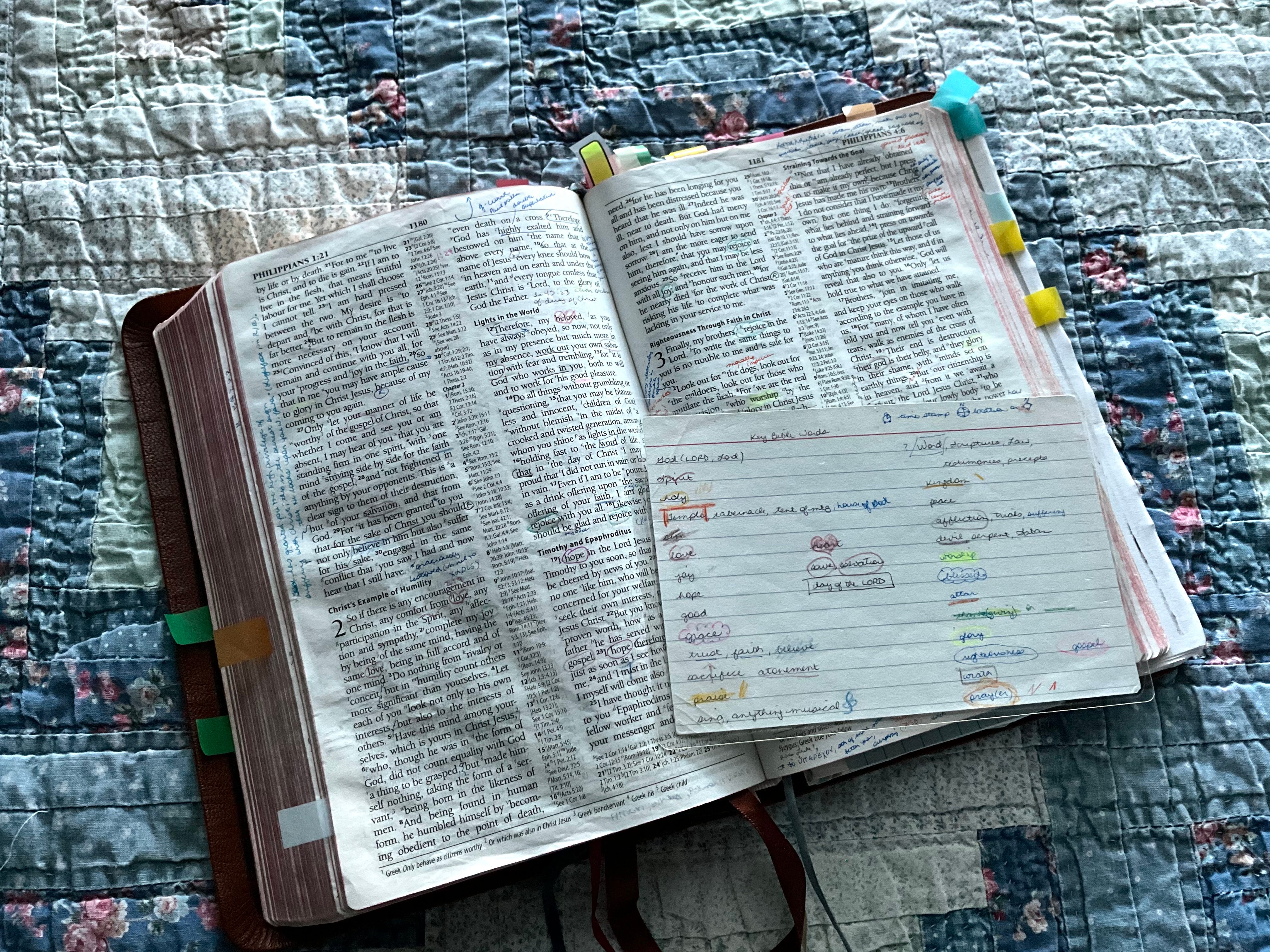
Bird’s Eye Overview of Bible Study Methods
Nov 14, 2026 · 11m
Ever-speaking God,Who spoke the world into being,Who sustains it by Your all-powerful word,Who breathed out the Scripture we approach today:In coming to Your Word,We come to You Yourself.Open our eyes...

Morning Prayer and Philippians 1
Nov 9, 2026 · 28m
Starting today, we are prayerfully reading Philippians together. If you are able, please read and pray along with me.If you would like to study this passage for yourself, please keep listening after...

Reaching
Oct 27, 2026 · 4m
My roots are in Zion;My home is not here.This groaning life is pilgrimage, a tortuous,Path winding where the wind blows.All my stability is in heaven,In the trustworthy promises of God,In the...

Parable of the Waiting Room
Oct 6, 2026 · 15m
A peek into our time capsule…The sparsely adorned walls, uncomfortable chairs, and odd assortment of magazines scattered on the various tables confirmed that the woman was in the right place. She...
Take these sermons with you.
Follow crumbs from His table fellowship podcast in the Getsermons app to get every new sermon, build playlists, and pick up right where you left off.

