

Michael J. Lilly Podcast
Selective Silence
Apr 10, 2026 · 11m
Prefer sermons downloaded automatically?
About this sermon
If you’ve spent any significant time in the pews of a traditional Church of Christ (COC), you know the rhythm of the calendar. Every December and every April, like clockwork, a familiar and predictable cadence echoes from the pulpit. It’s the season of the “anti-holiday” sermon.
These sermons are built upon a specific, rigid interpretive framework historically championed by the COC: CENI (Command, Example, Necessary Inference) and a strict view of the Regulative Principle of Worship. The overarching motto of this hermeneutic is famous: “Speak where the Bible speaks, be silent where the Bible is silent.” In theory, this sounds like a noble pursuit of biblical purity. However, a glaring problem emerges when we see how this standard is applied in practice. This strict framework is aggressively applied to condemn the celebration of Easter and Christmas. Yet it’s completely abandoned when it comes to actual, explicit biblical commands that are culturally inconvenient for the modern church.
While many COC preachers vehemently condemn the religious observance of Christmas and Easter based on the “silence” of scripture, their simultaneous dismissal of explicit commands (such as women’s headcoverings) alongside their ignorance of historical context exposes a deep hermeneutical hypocrisy and an inconsistent application of their own rules.
The “Unspeakable” Holidays
The traditional arguments against Christmas and Easter are well-worn. Preachers will argue that no specific day is authorized in scripture for celebrating Christ’s birth. They’ll insist that the Lord’s Supper, observed every Sunday, is the only authorized memorial of His death and resurrection. Therefore, observing a yearly religious holiday like Easter or Christmas is deemed a “sin,” a “tradition of men,” or “adding to the scripture.”
This argument rests entirely on a demand for proof. “Give me book, chapter, and verse,” the preacher challenges. The logic dictates that if there’s no explicit command authorizing a practice, the practice is inherently forbidden by God’s silence.
Yet, in their zeal to police the calendar, these same preachers routinely shirk the plain reading of the Apostle Paul’s instructions on Christian liberty regarding days. In Romans 14:5, Paul writes: “One person esteems one day above another; another esteems every day alike. Let each be fully convinced in his own mind.”
There’s a staggering irony here. COC preachers will frequently (and often quite harshly) accuse other denominations of “ignoring the plain reading of the text” regarding topics like baptism or instrumental music. Yet, when faced with the plain, literal reading of Romans 14, which explicitly grants individual believers the liberty to observe special days to the Lord, they suddenly find ways to creatively explain it away or ignore it entirely.
The Irony of Ignorance
Compounding this scriptural blind spot is a frequent, glaring lack of historical education. Condemning these holidays often reveals just how uninformed many of these preachers are regarding the actual history of the Christian calendar.
Instead of engaging with legitimate church history, pulpits are often used to attack straw men, repeating debunked internet myths about the pagan origins of these days, such as falsely linking Easter to the goddess Ishtar or Christmas to Nimrod.
The core issue isn’t simply that they misjudge modern believers’ “intent” in celebrating. The issue is a fundamental lack of understanding of the historical reasons for the dates of these holidays and the actual reasons they’re celebrated. Many are entirely unaware of complex ancient historical realities, such as the early church’s nuanced methods for calculating the date of Pascha (Easter) alongside the Jewish Passover, or the early theological and historical reasoning early Christians utilized to date the incarnation and birth of Christ. Because they don’t know the actual historical facts behind the calendar, they substitute real church history with empty rhetoric and uncharitable assumptions.
It’s perfectly acceptable for a preacher not to know everything about historical theology, the ancient Christian calendar, or Byzantine dating calculations. However, as the old adage goes: “It is better to remain silent and be thought a fool than to speak and to remove all doubt.” If one is factually uninformed about the actual origins and historical reasoning behind these holidays, they should refrain from commenting on them from the pulpit rather than aggressively condemning what they don’t understand.
1 Corinthians 11 and Headcoverings
The hypocrisy of the anti-holiday sermon comes into sharpest relief when contrasted with the deafening silence regarding explicit commands that the modern church simply ignores.
Consider the Apostle Paul’s instructions regarding women’s headcoverings. Contrary to what some would have you believe, this isn’t some obscure reference to a strange cultural practice; it’s a sustained argument spanning multiple verses. Paul writes:
“But every woman who prays or prophesies with her head uncovered dishonors her head, for that is one and the same as if her head were shaved. For if a woman is not covered, let her also be shorn. But if it is shameful for a woman to be shorn or shaved, let her be covered” (1 Corinthians 11:5-6).
Notice how Paul justifies this command. He doesn’t root it in 1st-century Corinthian culture. Instead, he roots it in the created order of Adam and Eve (v. 8-9), the presence of the angels (v. 10), and the universal practice of the churches of God (v. 16).
Despite this being a direct, multi-verse command backed by profound theological justification, the vast majority of COC preachers don’t bind it upon their congregations today. The reality in the pews is a sea of uncovered heads—and a pulpit that’s perfectly fine with it.
Selective Contextualization
This reveals a staggering double standard in how the Bible is read and applied.
When dealing with holidays, preachers utilize a rigid, literalistic, “silence means forbidden” approach. Cultural context is entirely irrelevant; only the exact, literal text and the lack of a direct command matter.
But when it comes to headcoverings, these same preachers suddenly become cultural scholars. They argue that the command was “just for that time,” that it was “based on local customs regarding temple prostitutes,” or that the veil merely “represented submission in that specific era,” and therefore, we don’t need to do it today.
We must ask the core question: Why is the hermeneutic of cultural contextualization allowed to completely neutralize a direct, explicit command, but forbidden when considering the early church’s silence on annual festivals?
And headcoverings are merely the tip of the iceberg. The exact same cultural dismissiveness is routinely applied to other explicit New Testament commands, such as greeting one another with a “holy kiss” (Romans 16:16) or men lifting “holy hands” in prayer (1 Timothy 2:8). We see this same avoidance regarding the commands for the laying on of hands—whether for the anointing of the sick with oil (James 5:14) or the formal ordination of the eldership (1 Timothy 4:14). Despite clear textual mandates, these practices are frequently explained away or quietly shelved.
Why does this selective contextualization exist? It’s difficult to avoid the conclusion that sectarian tradition has been elevated over truth. The anti-holiday stance serves a specific purpose: it maintains the COC’s distinct sectarian identity, separating them from the broader evangelical, Christian world. Conversely, enforcing headcoverings, holy kisses, or ceremonial anointing would make them look “weird” to modern society. The hermeneutic bends to serve the tradition and remain “palatable” to culture rather than accomplishing the stated goal of “doing Bible things in Bible ways.”
Re-evaluating the Framework
This inconsistent policing of the text perfectly mirrors the paradigm Jesus warned against when He rebuked the religious…
Get full access to Test Everything at testeverything.substack.com/subscribe
More from Michael J. Lilly Podcast

The Triune God and His Divine Council
Jun 11, 2026 · 15m
If you were to sit down with a modern Christian, hand them a Bible, and ask them where the story begins, almost all of them would immediately turn to Genesis 1:1. We tend to open the book, look at the...

The House Church Myth Revisited
May 30, 2026 · 24m
In their video response to my article, “The House Church Myth,” Matt Dabbs and Tom Wadsworth attempt to defend the modern “organic” house church movement. They argue that the first-century church...

A Supernatural Worldview for a Supernatural Book
May 25, 2026 · 11m
We like to think we read the Bible exactly as it was written. We open the text, read the words, and assume our modern brains are perfectly capturing the original intent of the authors. But the truth...

Preachers for Hire
May 12, 2026 · 10m
Today’s church pulpits often feel more like corporate seminar stages than sacred spaces. Many focus on polish, production, and engaging speakers. We look for someone who can keep an audience’s...

Divine Scales
May 6, 2026 · 10m
It’s incredibly common in modern church culture to hear people say that “all sin is the same to God” or “sin is just sin.” It usually comes from the good intention of emphasizing that everyone needs...
Oral Tradition and the Synoptic Problem
Apr 29, 2026 · 8m
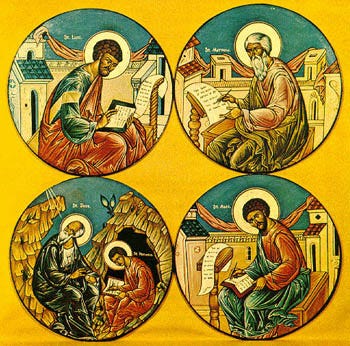
Have you ever noticed how similar Matthew, Mark, and Luke are? They share a tremendous amount of material, often word-for-word. Scholars call this the “Synoptic Problem,” and they have debated for...
Take these sermons with you.
Follow Michael J. Lilly Podcast in the Getsermons app to get every new sermon, build playlists, and pick up right where you left off.

