

Michael J. Lilly Podcast
The Adulterous Union
Jan 29, 2026 · 37m
Prefer sermons downloaded automatically?
About this sermon
A few months ago, I was asked as part of a group to study the topic of marriage, divorce, and remarriage, especially as it concerns the debate mentioned in the essay here. The original form of this essay was a much longer work (30-some-odd pages) defending a much different position. At a certain point, I had to stop and ask myself, “Why am I trying to jump through so many hoops to defend this position?”
Ultimately, through much more prayer and study, I began to see the original position as untenable and un-Christ-like.
This is a heavily revised version with a much different focus, parsed down for readability and directness. I was asked by a few people to share my thoughts and make them public.
Few moral and pastoral questions have proven as enduringly complex, or as deeply divisive, as marriage, divorce, and remarriage. In the landscape of modern Christian ethics, there is a tension that exists between two fundamental biblical imperatives: the prophetic demand for moral purity and the pastoral mandate to shepherd broken souls toward salvation. This intersection is perhaps most strongly felt in the issue of the “alien sinner”—an individual outside the covenant of Christ—who seeks baptism while living in a marriage contracted after an unscriptural divorce.
Does the Gospel demand the dissolution of this family unit as a condition of repentance and salvation, or does it offer a mechanism for such a relationship to be redeemed? Is the “adulterous” nature of the union an ontological shackle that persists through the waters of baptism, or is it a moral debt that is paid and transformed by the stewardship of grace?
To answer, one must navigate the tension between akribeia (exactness) and oikonomia (economy)—principles that have defined Christian jurisprudence for two millennia.
A definitive modern expression of this controversy occurred in January 2003, during the Satterfield–Evans Debate on Marriage, Divorce, and Remarriage held in Marietta, Georgia. The debate featured Phillip Satterfield, representing the “Strict” or “Dissolution” view, and Dr. Jack Evans Sr., a towering figure in the African American Churches of Christ, representing the “Pastoral” or “Redemptive” view.
The debate centered on a specific doctrinal proposition, affirmed by Evans and denied by Satterfield:
“The Holy Bible teaches that an alien sinner in an adulterous marriage may repent of sins, including adultery, be baptized for the forgiveness of sins, including adultery, without dissolving his or her last marriage contracted before baptism, and be saved eternally.”
Satterfield’s argument was rooted in a strict reading of the “creation ordinance” and the present-tense grammar of Matthew 19:9. He argued that if a relationship is defined as “adultery” by Jesus, it remains adultery until it ceases. Baptism, in this view, forgives the guilt of past acts but does not legitimize an ongoing state of sin. To remain in the marriage is to remain in the sin. Therefore, repentance requires the cessation of the sexual relationship, effectively mandating a second divorce or celibacy within the home.
Evans, however, argued from the standpoint of the “alien sinner’s” status. He contended that the “old man” of sin is crucified in baptism (Romans 6:6). If the convert is truly a “new creation” (2 Corinthians 5:17), then the pre-baptismal liabilities, including the irregularity of their marriage covenants, are washed away. For Evans, demanding the breakup of a family was not “repentance” but a new tragedy that violated the spirit of the Gospel. While he did not use the term “Economy” (oikonomia), his argument served as a plea for the church’s authority to declare a sinner “clean” based on Christ’s blood, prioritizing the salvation of the person over the strict enforcement of the marital statute.
This debate functions as a theological fulcrum for the Churches of Christ and the broader Restoration Movement. Historically, this movement has sought to “speak where the Bible speaks and be silent where the Bible is silent.” However, the text of Scripture is often silent on the specific procedural remedy for an unscripturally remarried convert.
Strict interpretative models like those of Gordon Wenhamand Thomas Schreiner emphasize the permanence of the creation ordinance, arguing that an “adulterous” union is an ongoing state of sin that baptism cannot erase without cessation. This view fears that allowing the marriage to continue turns grace into a license for immorality (Jude 4). They argue that just as a polygamist must put away his extra wives, the adulterously remarried must put away their current spouse.
Conversely, pastoral models like those of Rubel Shelly and John Meyendorff argue that the Cross redeems states of being and that the church is entrusted with the “stewardship” (economy) of grace to manage these complexities. They fear that the strict view turns the Gospel into a system of law more rigid than the Mosaic code, effectively barring the “sick” (Mark 2:17) from the Physician unless they first heal themselves by destroying their families.
This article employs a six-part integrative hermeneutical framework to construct a comprehensive analysis of the issue.
The study begins by establishing the foundational theological tension that frames the entire debate: the relationship between the “Prophetic Standard” of marriage as a creation ordinance and the “Pastoral Application” of the church as the steward of grace. This initial section explores the ontology of marriage and examines the definition of repentance, setting the groundwork for the specific biblical arguments that follow.
Following this theological grounding, the paper proceeds to a grammatical-historical examination of Jesus’ teaching in Matthew 19:1–12. This exegetical analysis focuses on the context of the first-century Hillel-Shammai debate to clarify the intent behind Jesus’ prohibition of divorce. Special attention is given to the semantic range of porneia and the theological implications of the “eunuchs for the Kingdom” saying, arguing that these texts function less as legal statutes and more as a counter-narrative to Pharisaic legalism.
The analysis then shifts to the apostolic application of these ideals in 1 Corinthians 7. By analyzing Paul’s instructions to a complex Gentile community, specifically the “Pauline Privilege” and the command to “remain” in one’s calling, this section argues that Paul provides the essential template for economy. It demonstrates how the apostle applies the absolute ideal of Jesus to the messy realities of Corinthian life without compromising the Gospel’s transformative power.
To broaden the perspective beyond purely textual analysis, the study also incorporates a historical-theological framework. This section contrasts the akribeia (strictness) characteristic of the early Latin canons (exemplified by Tertullian and the Council of Elvira) with the developing theology of oikonomia (economy) in the Byzantine East, particularly in the canons of St. Basil. This historical survey provides a crucial precedent for the thesis that the church has long recognized a distinction between the ideal of marriage and the pastoral management of human brokenness.
Moving to the specific context of the Restoration Movement, the essay examines the doctrine of Congregational Autonomy. By empowering local elders to make binding judgments on “matters of opinion” regarding the reception of converts, autonomy allows for the exercise of pastoral discretion in cases where a universal strict rule might obscure the mercy of Christ.
Finally, the study synthesizes these exegetical, historical, and ecclesiological threads to articulate a theology of “Redemptive Economy.” This conclusion argues that the locus of authority for determining the status of a convert’s marriage rests within church leadership, distinct from the individual conscience, ultimately affirming the redemptive capacity of the Gospel to sanctify broken structures.
Ultimately, this paper argues t…
Get full access to Test Everything at testeverything.substack.com/subscribe
More from Michael J. Lilly Podcast
The Triune God and His Divine Council
Jun 11, 2026 · 15m
If you were to sit down with a modern Christian, hand them a Bible, and ask them where the story begins, almost all of them would immediately turn to Genesis 1:1. We tend to open the book, look at the...
The House Church Myth Revisited
May 30, 2026 · 24m
In their video response to my article, “The House Church Myth,” Matt Dabbs and Tom Wadsworth attempt to defend the modern “organic” house church movement. They argue that the first-century church...
A Supernatural Worldview for a Supernatural Book
May 25, 2026 · 11m
We like to think we read the Bible exactly as it was written. We open the text, read the words, and assume our modern brains are perfectly capturing the original intent of the authors. But the truth...

Preachers for Hire
May 12, 2026 · 10m
Today’s church pulpits often feel more like corporate seminar stages than sacred spaces. Many focus on polish, production, and engaging speakers. We look for someone who can keep an audience’s...

Divine Scales
May 6, 2026 · 10m
It’s incredibly common in modern church culture to hear people say that “all sin is the same to God” or “sin is just sin.” It usually comes from the good intention of emphasizing that everyone needs...
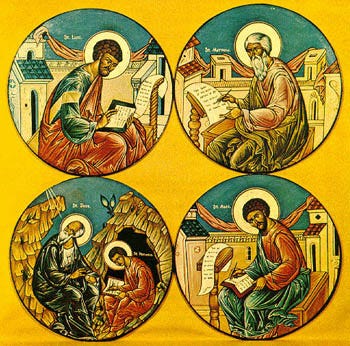
Oral Tradition and the Synoptic Problem
Apr 29, 2026 · 8m
Have you ever noticed how similar Matthew, Mark, and Luke are? They share a tremendous amount of material, often word-for-word. Scholars call this the “Synoptic Problem,” and they have debated for...
Take these sermons with you.
Follow Michael J. Lilly Podcast in the Getsermons app to get every new sermon, build playlists, and pick up right where you left off.

