

Michael J. Lilly Podcast
Why Restoration Still Matters
May 5, 2025 · 10m
Prefer sermons downloaded automatically?
About this sermon
One of the most common critiques of the Restoration Movement is that it’s an attempt to recreate a romanticized version of the early church—an effort to reconstruct a world that no longer exists. Detractors often accuse Churches of Christ of chasing an idealized past, as if we’re trying to relive the first century through sheer force of will. But this criticism misunderstands both our history and our goal.
Restoration, at its core, is a call to return to the revealed foundation of the faith—the apostolic teaching preserved in the New Testament. The desire is not to be primitive for novelty’s sake but to be faithful to the original pattern laid down by Christ. In a religious landscape dominated by tradition on one side and theological amnesia on the other, the Churches of Christ offer another way: a path shaped not by councils, creeds, or cultural trends but by the inspired Scriptures that still guide the people of God today.
This Substack is reader-supported. To receive new posts and support my work, consider becoming a free or paid subscriber.
What Restoration Actually Means
The Restoration Movement didn’t begin as a campaign to recreate the first-century world. It started as a call to return to the faith once for all delivered to the saints. Leaders like Thomas and Alexander Campbell and Barton W. Stone weren’t trying to form a new denomination or develop a distinct brand. They wanted to peel back centuries of human tradition and return to the clear, powerful simplicity of the New Testament church.
Thomas Campbell’s famous plea, “Where the Scriptures speak, we speak; where the Scriptures are silent, we are silent,” reflected a deep commitment to the authority of God’s Word. Their goal wasn’t innovation but restoration—not to invent something new but to recover what had been there from the beginning. Alexander Campbell wrote, “The Bible alone must always decide every question that can come before us in the great business of building up the church.” That conviction of Christ as head and Scripture as the standard remains the foundation of true Restoration today.
And yet, the spirit of the movement was never sectarian. One of the earliest and most important phrases from these leaders still captures the heart of the plea: “We are Christians only, but not the only Christians.” The goal was unity, not uniformity; fellowship built around truth, not tradition. Restoration has always been about finding unity by returning to Christ and His Word, not by building barriers but by tearing them down when they’re not grounded in Scripture.
What the Restoration Doesn’t Mean
It’s important to briefly frame the goal of the Restoration Movement because one of the most common critiques against the Churches of Christ is that we’re trying to recreate the early church without understanding what it was. The accusation is that we’ve built an entire movement on a naïve or incomplete picture, ignoring centuries of theology, archaeology, and patristic insight in favor of a modern invention based on selective proof texts.
However, this critique misunderstands the actual aim of restoration. The goal was never to recreate first-century culture. It was to recover apostolic teaching—what Christ handed to the apostles and what the apostles handed to the church. Restoration is not about pretending we live in the ancient world. It’s about measuring every doctrine, tradition, and practice against the revealed Word of God, which remains authoritative in every generation.
Yes, early Christians lived in a specific time and place. Their cultural expressions were shaped by their world. But what made them the church was not their sandals or house churches; it was their submission to the gospel, their devotion to the apostles’ teaching, and their unity through the Spirit. That’s what we seek to imitate.
We’re not trying to recreate an ancient era. We’re trying to follow an eternal gospel.
What Makes the Churches of Christ Different?
In a religious landscape shaped by oppressive traditions on one side and theological ambiguity on the other, the Churches of Christ stand out as a movement striving to be biblical in a way that is often countercultural in the modern landscape of Christianity.
At the heart of our distinctiveness is the conviction that the church should remain what it was initially—nothing more, nothing less.
We believe the New Testament provides a sufficient and authoritative guide for the faith, worship, doctrine, and structure of the church. The Bible is trustworthy in every generation and fully capable of equipping the church for faithfulness today.
Where many Christian traditions build their theology on creeds, catechisms, or magisterial pronouncements, we insist that the Bible is enough. This is not just another slogan; it’s the governing principle of our doctrine and practice.
We don’t subscribe to human-made confessions of faith, not because all creeds are evil but because they tend to fossilize fallible interpretations into immovable doctrine. Even the best creeds must be judged by Scripture. We aim to speak only where the Bible speaks and remain silent where it is silent.
This Substack is reader-supported. To receive new posts and support my work, consider becoming a free or paid subscriber.
We also believe in unity that goes deeper than surface-level peacekeeping. Jesus prayed that His followers would be one (John 17:20–23), and Paul pleaded for the church to be “perfectly united in mind and thought” (1 Cor 1:10). Unity is not a sentimental ideal; it’s the result of shared submission to the will of Christ.
While much of modern Christianity has traded theological conviction for a lowest-common-denominator kind of unity, the Churches of Christ teach that real unity is only possible when it’s grounded in the truth of God’s Word. This means unity in baptism, worship, leadership, and moral teaching, not just in general agreement about Jesus.
In a world where church traditions often evolve for convenience or preference, we believe that God has already spoken clearly about how His people are to worship, live, and organize themselves as a community of faith. The practices are rooted in the teachings of Christ and carried out under the direction of the Holy Spirit.
That’s why we strive to restore what we see in Scripture, including:
* Baptism by immersion for the forgiveness of sins (Acts 2:38; Rom 6:3–5): Not a symbol or secondary ritual, but the God-ordained moment where faith and obedience meet God’s saving work. We practice baptism as the consistent apostolic practice taught in every corner of the New Testament.
* The weekly observance of the Lord’s Supper (Acts 20:7; 1 Cor 11:23–26): The Eucharist is not a quarterly ritual or optional ceremony. It is the covenant meal of the church, where we proclaim the death of Christ and participate in His body and blood. A weekly observance reflects the rhythm of grace and remembrance that the early church lived by.
* Congregational autonomy and shepherding by elders (Acts 14:23; 1 Pet 5:1–3; Titus 1:5): Rather than a bureaucratic hierarchy or external authority, the New Testament reveals a pattern of locally governed churches led by qualified elders. These men protect the flock, teach sound doctrine, and model godly lives. Each congregation answers directly to Christ, not a central organization.
To restore these things is not to say, “We’ve gotten it perfectly right every time,” but to say, “We trust that God’s Word is sufficient—and we want to be formed by it.” These practices are focused on faithful adherence to what God has revealed, rooted in the belief that Christ, as Head of the church, has already shown us how to be His people.
Finally, we dare not separate grace from discipleship. While salvation is a gift, it is a gift that transforms. We hold that faith must be active, obedience is not optional, and doctrine matters. As Paul says in Galatians 5:6, what counts is “faith working through love.” This sets us apart in a religious climate where obedience is often …
Get full access to Test Everything at testeverything.substack.com/subscribe
More from Michael J. Lilly Podcast

The Triune God and His Divine Council
Jun 11, 2026 · 15m
If you were to sit down with a modern Christian, hand them a Bible, and ask them where the story begins, almost all of them would immediately turn to Genesis 1:1. We tend to open the book, look at the...
The House Church Myth Revisited
May 30, 2026 · 24m
In their video response to my article, “The House Church Myth,” Matt Dabbs and Tom Wadsworth attempt to defend the modern “organic” house church movement. They argue that the first-century church...

A Supernatural Worldview for a Supernatural Book
May 25, 2026 · 11m
We like to think we read the Bible exactly as it was written. We open the text, read the words, and assume our modern brains are perfectly capturing the original intent of the authors. But the truth...

Preachers for Hire
May 12, 2026 · 10m
Today’s church pulpits often feel more like corporate seminar stages than sacred spaces. Many focus on polish, production, and engaging speakers. We look for someone who can keep an audience’s...

Divine Scales
May 6, 2026 · 10m
It’s incredibly common in modern church culture to hear people say that “all sin is the same to God” or “sin is just sin.” It usually comes from the good intention of emphasizing that everyone needs...
Oral Tradition and the Synoptic Problem
Apr 29, 2026 · 8m
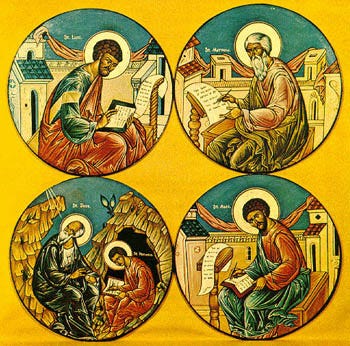
Have you ever noticed how similar Matthew, Mark, and Luke are? They share a tremendous amount of material, often word-for-word. Scholars call this the “Synoptic Problem,” and they have debated for...
Take these sermons with you.
Follow Michael J. Lilly Podcast in the Getsermons app to get every new sermon, build playlists, and pick up right where you left off.

