

Pondering with Purpose Podcast
A Trinity-Shaped Reality
Nov 25, 2025 · 41m
Prefer sermons downloaded automatically?
About this sermon
Image by Zack Gross (2023)
Thanks for reading Pondering with Purpose! Subscribe for free to receive new posts and support my work.
This post is adapted from my teaching at Patmos on Ephesians 1:1–23.
Whenever I introduce a new book to my students at church, I love starting with a visual. So before diving into Ephesians, watch the BibleProject overview video. As it plays,notice the major themes of the letter: What is Paul trying to show us? Why does this letter matter?
The BibleProject makes it clear: Ephesians is about the spiritual realm, the unity of the Church, and the lordship of Christ.
Those three emphases saturate this entire letter.
And as we read our passage, Ephesians 1:1–23, pay attention to what it reveals about the gospel around four anchor points: Father, Son, Spirit, and prayer.
There’s also a refrain that occurs three times in this passage:“to the praise of His glorious grace.”In the live teaching, every time we hit that line, we read it aloud together.
As you read it you might read that part out loud too.
Reading of Scripture: Ephesians 1:1–23
Introduction (vv. 1–2)
Paul opens this letter in a very intentional way. He could have begun with any number of greetings or personal notes, but instead he starts like this:
“Paul, an apostle of Christ Jesus by the will of God… to the saints who are in Ephesus and faithful in Christ Jesus.”
Paul identifies himself first: an apostle: literally, a sent one, an ambassador, an official representative of Jesus Christ, by the will of God.
Right from the start Paul frames reality through the activity of the Triune God. His identity and calling are rooted in what God has done, not what he has chosen.
And that’s not just true for Paul…
“My hope is that each of you could say something similar: Zach, called to Patmos by the will of God… Justin, called to this job or that by the will of God.”
Where you are is not random.Your life is shaped by God’s initiative.
Then Paul identifies his audience:
“The saints in Ephesus, faithful in Christ Jesus.”
He could’ve described them in a dozen ways whether economically, culturally, morally but he chooses this: holy ones.Set-apart people.
Despite their struggles, failures, background, and environment, Paul declares their truest identity: holy people, faithful in Christ.
It’s both a proclamation and a gentle challenge:“You are this; so live like this.”
Knowing the story of the Ephesian church in Acts 19, it’s no surprise Paul begins with identity. He reminds them who they already are:a people set apart for God’s redemptive purposes in the world, in a particular place, at a particular time.
Just like them, you are a people in a place, set apart for God’s purposes.That’s the foundation.
After this opening, Paul launches into one of the most remarkable sentences in Scripture.In Greek, verses 3–14 are one single, rolling, cascading sentence as if Paul cannot contain the overflow of praise in his heart.
Before he even gets to his usual thanksgiving and prayer, he erupts with worship.
Why?
Because when Paul considers what God has done—Father, Son, and Spirit moving with unified purpose toward salvation—he sees the entire universe folding into this reality.This is ground zero for understanding everything else.
This entire opening is structured with a repeated refrain:
“to the praise of His glorious grace.”A refrain signaling transitions from the Father’s work, to the Son’s, to the Spirit’s, and ultimately into Paul’s prayer.
Let’s walk through each movement.
The Reality of the Purposes of the Father (vv. 3–6)
Paul begins:
“Blessed be the God and Father of our Lord Jesus Christ…”
In Scripture, blessing always begins with God.He is the source of life, goodness, and abundance.When God blesses someone, whether Adam and Eve, Abraham, David, His words accomplish what they declare.
When humans bless God, we’re simply acknowledging who He already is.
And Paul does something remarkable here.He doesn’t say, “Blessed be the God of Abraham” or “the God of Moses,” the traditional Jewish formulas.Instead he blesses “the God and Father of our Lord Jesus Christ.”
Paul, steeped his whole life in a Jewish worldview, has had his imagination so reshaped by Jesus that he cannot speak of God without speaking of Him as the Father of Jesus.
Why this blessing?
Paul continues:
“…who has blessed us with every spiritual blessing in the heavenly places in Christ.”
Again, God is always the initiator.As 1 John says,
“We love because He first loved us.”
Likewise, Paul blesses because God first blessed.
Here’s where many of us stumble:When Western Christians hear “in the heavenly places,” we picture clouds, harps, and a distant future location.
But Paul isn’t talking about some far-off realm.In Ephesians, the heavenly places is the unseen spiritual dimension that overlaps our physical reality, God’s space is present and active right now.
This isn’t “future pie in the sky.”It’s the truest layer of reality.
Paul then goes all the way back to the origin of this blessing:
“He chose us in Him before the foundation of the world… in love He predestined us for adoption…”
This isn’t cold calculation.It flows from “the good pleasure of His will.”From love.From grace.
This is the master plan plotted out, rehearsed, perfectly executed. Better than any heist or movie ever.” The Father’s plan is first, ultimate, and overflowing with delight.
And Paul responds with the only fitting refrain:
“…to the praise of His glorious grace.”
This leads naturally to how Jesus Himself lived.Jesus said:
“I do nothing on my own but speak just what the Father has taught me… I always do what pleases Him.” (John 8:28–29)
Jesus lived entirely from the Father’s purposes.And by His Spirit, He gives us the means to do the same.
The Reality of Being in the Son (vv. 7–12)
Paul shifts seamlessly from the Father’s eternal purposes to the Son’s redemptive work. He writes:
“In Him we have redemption through His blood, the forgiveness of sins…”
Notice the phrase “in Him.”Not because of Him.Not as a result of something He once did.But in Him.
Paul is talking about locationm, spiritual reality, and identity.
We think we’re “in El Salvador,” or “in this classroom,” or “in our hometown.” And those things are true.But even more true, at the deepest level of reality, we are in Christ.
There is a dimension of our existence that is unseen but more real than what we touch and feel.Paul keeps lifting the veil so we can see it.
Redemption (v. 7)
In Scripture, redemption always involves two things:
* A price being paid
* A person being set free
In Jesus, both are accomplished. His blood was the price. Our liberation is the result.
Redemption isn’t abstract. It’s bodily, costly, historical. Jesus’ physical life laid down on a cross.
Ryken puts it this way (paraphrased):
In the Exodus, salvation was from Egypt into the promised land.In Christ, salvation is from sin into glory.
It’s always a two-step movement:
Out of bondage and into fullness.
God never simply rescues from.He always rescues into.
This theme frames all of Scripture and Paul sees that movement unfolding in the Ephesians’ own story.
Forgiveness (v. 7)
Forgiveness means release, letting go, cancellation of debt.No longer do we carry the weight of our offenses.No longer do our trespasses define us.
Why?Because of the “riches of His grace.”Grace that overflows, abounds, pours out like a river that cannot be turned off.
Revealed Mystery (vv. 8–10)
Paul says God has:
“made known to us the mystery of His will.”
God wants us on the inside. He wants His people to understand the story they are living in.
In Christ, the divine plan, once hidden, is now revealed:
“…the summing up of all things in Christ, things in heaven and things on earth.”
All of history, all of creation, all spiritual powers, all human destiny —Everything is headed toward unity in Christ.
Inheritance (vv. 11–12)
Paul writes:
“In Him we have obtained an inheritance…”
But the language is intentionally ambiguous.Are we receiving the inheritance?Or are we God’s inheritance?
The answer seems to be:Yes.We get God.And in His love, He desi…
This is a public episode. If you would like to discuss this with other subscribers or get access to bonus episodes, visit zackgross.substack.com
More from Pondering with Purpose Podcast

Testing and Tempting
Oct 21, 2026 · 35m
Introduction:How do you figure out if you have real or fool’s gold? How do you figure out what is inside a wrapped present? How do you figure out if a chair can hold your weight? How do you figure out...

Pointing Out What’s Right in Front of Us
Sep 22, 2026 · 27m
The following is a lightly adapted sermon outline for this talk that I gave to my junior high students on October 10, 2024. IntroductionI am wondering how many of us have ever practiced technique...

Making Sense of Brokenness
Jun 16, 2026 · 26m
IntroductionBrokenness is an expected part of life. If I were to take a quick mental survey of the poeple in my life I could think of people who have had to make hard moves, experienced divorce, the...

The Reality of Dependence in Prayer
Jun 2, 2026 · 40m
The following is an adapted version of my teaching at Patmos Reality Discipleship July 2026 through the letter to the Ephesians.This is the final installation in an eight part series through...

The Reality of Our Preparation
May 5, 2026 · 34m
The following is an adapted version of my teaching at Patmos Reality Discipleship July 2026 through the letter to the Ephesians. IntroductionAs we look at this section of Ephesians, it is helpful...
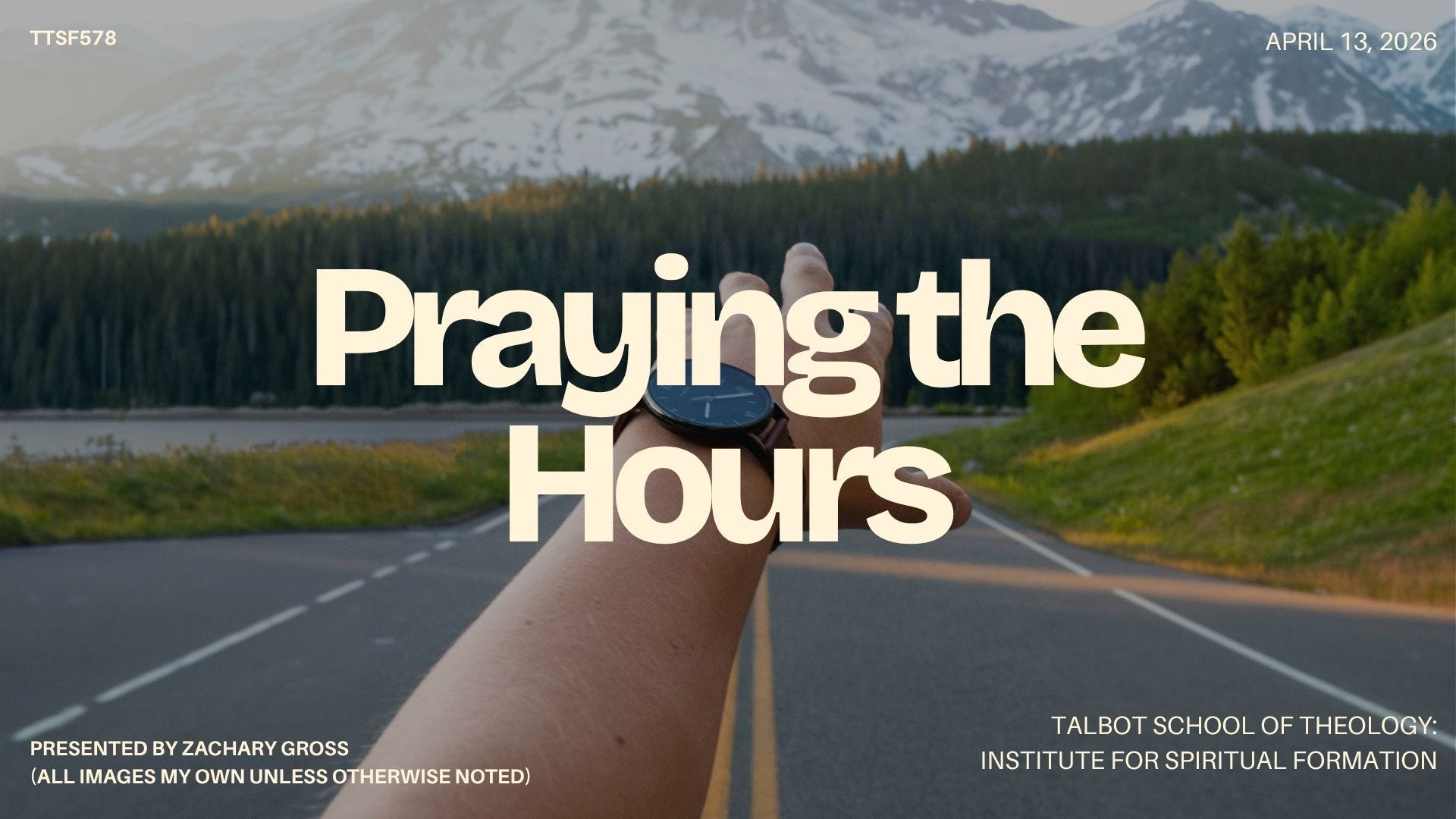
Praying the Hours
Apr 14, 2026 · 22m
This is an adapted version of a presentation I gave in class on April 13, 2026 Thanks for reading Pondering with Purpose! Subscribe for free to receive new posts and support my work.I want you to...
Take these sermons with you.
Follow Pondering with Purpose Podcast in the Getsermons app to get every new sermon, build playlists, and pick up right where you left off.

