
Reflections on the Psalms Podcast
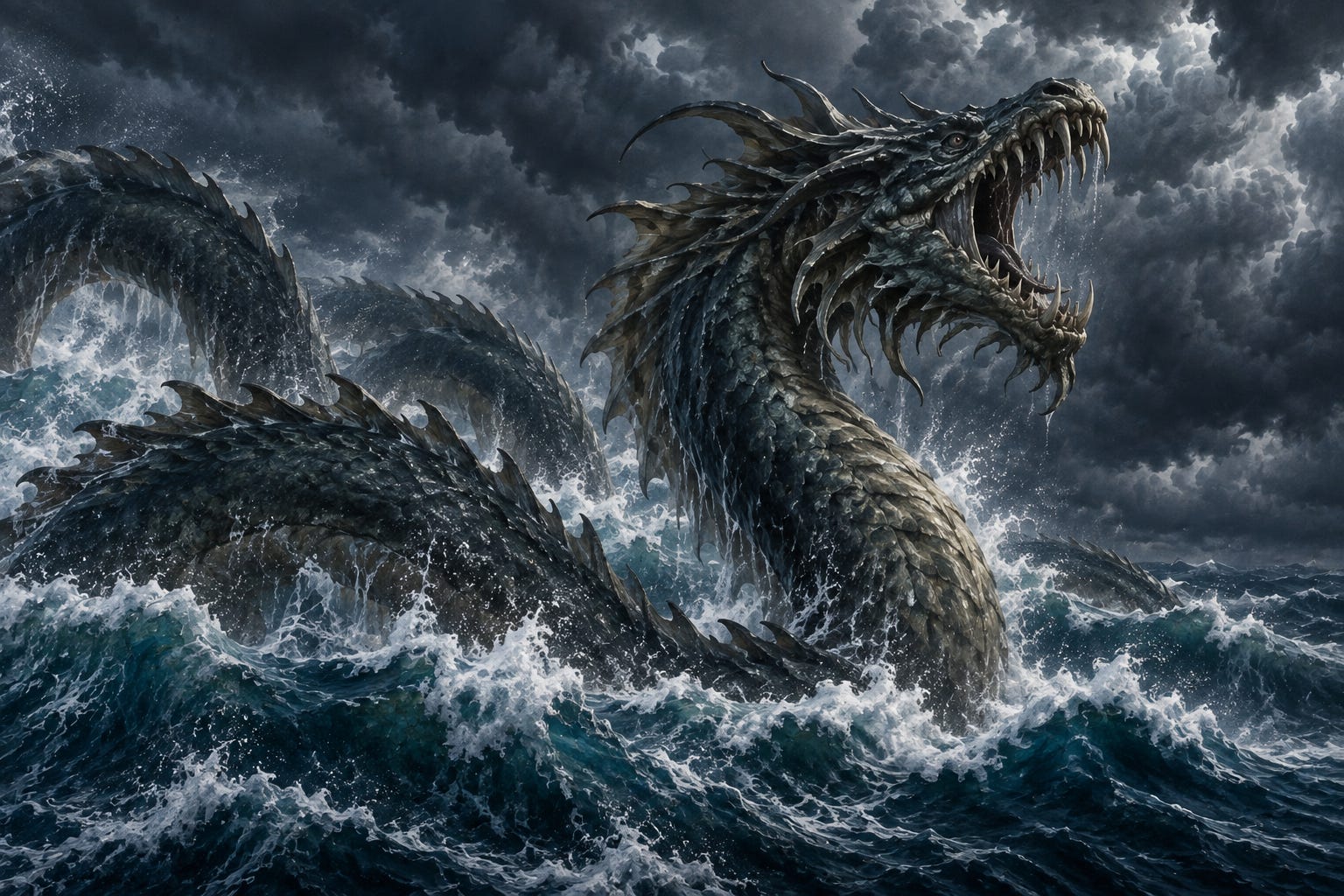
Rahab, the Chaos Sea Monster
Sep 18, 2026 · 8m
Prefer sermons downloaded automatically?
About this sermon
All right, this is the Book of Common Prayer lectionary reading for the 17th. I’m doing this one a little later because I had to think about this one.
And the one I want to talk about is Rahab, the chaos sea monster.
When you come to Psalm 89:9–10, you read:
“You rule the raging of the sea; when its waves rise, you still them. You crushed Rahab like a carcass; you scattered your enemies with your mighty arm.”
You have to ask yourself: Who is this Rahab?
This reference comes up several times in the Bible, and it draws upon the ancient Near Eastern world of creation stories and mythology about where everything came from.
In the Babylonian myth, Marduk defeats Tiamat, the primordial sea, and forms the ordered world from her body. In the Canaanite myth, Baal defeats Yam, the god of the sea, overcoming chaos and establishing his reign and order.
So there is an ancient Near Eastern history here—an ancient understanding of chaos, the sea, and creation.
But this is not the same thing as what you see in Genesis 1.
Some scholars, especially in the critical schools, have argued that Genesis 1 got its creation story from these ancient myths. The Enuma Elish is the Babylonian creation account containing the conflict between Marduk and Tiamat.
But there is a very big difference between these accounts.
Marduk struggles against Tiamat.
Yahweh merely speaks.
Creation does not emerge from divine violence. And when you look at the Genesis account, chaos is not something that stands as a rival to God.
“In the beginning, God created the heavens and the earth.”
The earth was formless and void. There is the chaos. And the Spirit of God was hovering over the waters.
God does not have to fight the chaos. His Spirit is already hovering over it.
But now let’s look at the biblical imagery, because it tells us something more about Rahab.
In Job 26 we read:
“By his power he stilled the sea; by his understanding he shattered Rahab. By his wind the heavens were made fair; his hand pierced the fleeing serpent.”
So here we have the sea, Rahab, and a fleeing serpent all brought together.
Then you come to Psalm 74:13–14:
“You divided the sea by your might; you broke the heads of the sea monsters on the waters. You crushed the heads of Leviathan; you gave him as food for the creatures of the wilderness.”
And this Leviathan reminds us, of course, of the great Leviathan we see in the book of Job.
But Leviathan also shows up again in Psalm 104:
“Here is the sea, great and wide, which teems with creatures innumerable, living things both small and great. There go the ships, and Leviathan, which you formed to play in it.”
Now notice what happens there.
Leviathan is not a rival to God.
He is simply a creature.
He is not threatening God in any way. This is not the Babylonian creation myth where the god has to struggle against the monster. God made Leviathan. He formed him to play in the sea.
Then you come to Isaiah 27:
“In that day the LORD with his hard and great and strong sword will punish Leviathan the fleeing serpent, Leviathan the twisting serpent, and he will slay the dragon that is in the sea.”
Now Leviathan is a serpent and a dragon.
And then Isaiah 30:7 says:
“Egypt’s help is worthless and empty; therefore I have called her ‘Rahab who sits still.’”
It’s mocking this chaos monster.
It takes this ancient Near Eastern imagery and turns it against Egypt. Egypt thinks it is this great power. This great monster. And God says, basically, Rahab just sits there.
Then you get to Isaiah 51:9–10:
“Awake, awake, put on strength, O arm of the LORD; awake, as in days of old, the generations of long ago. Was it not you who cut Rahab in pieces, who pierced the dragon? Was it not you who dried up the sea, the waters of the great deep, who made the depths of the sea a way for the redeemed to pass over?”
And now you start seeing all of this watery imagery coming together.
You have Rahab. You have the dragon. You have the sea. You have the great deep. And then you have the redeemed passing through it.
This takes us back to creation and the waters of chaos. The biblical writers are using imagery that people in the ancient Near Eastern world understood. We can understand some of that imagery better by knowing something about that ancient world.
But the Bible is not saying that God has a rival—that Rahab is actually some divine being that God has to struggle against.
And when Isaiah says that God dried up the sea and made a way for the redeemed to pass through, well, that obviously reminds us of the Red Sea.
God dries up the sea so that his people can walk through it.
So here again you have a division of the waters, and that takes you back to the creation account. God divides the waters. Creation itself is being replayed in redemption.
Then you come to Ezekiel 29:3:
“Thus says the Lord GOD: Behold, I am against you, Pharaoh king of Egypt, the great dragon that lies in the midst of his streams, that says, ‘My Nile is my own; I made it for myself.’”
Now Pharaoh sounds like the dragon. He sounds like Rahab.
And then in Ezekiel 32, God tells Ezekiel to raise a lamentation over Pharaoh:
“You consider yourself a lion of the nations, but you are like a dragon in the seas; you burst forth in your rivers, trouble the waters with your feet, and foul their rivers.”
So we keep seeing this imagery coming back.
And there is almost a mocking quality to it. Pharaoh thinks he is the great dragon. Egypt thinks it is Rahab. These empires imagine themselves as these great powers.
But God is not one among many.
He is supreme over all of these supposed chaos monsters.
And then you get to the book of Revelation.
“Another sign appeared in heaven: behold, a great red dragon, with seven heads and ten horns, and on his heads seven diadems.”
And then Revelation 12:9 tells us exactly who this dragon is:
“The great dragon was thrown down, that ancient serpent, who is called the devil and Satan, the deceiver of the whole world.”
And when you continue into Revelation 13, you see beasts rising out of the sea.
Now all of this imagery starts coming together.
The sea. The serpent. The dragon. The beasts. The chaos monsters.
And God defeats them.
He always defeats them.
And ultimately, I think, we come to see that this chaos-monster imagery points us toward the ultimate enemy of creation: the devil.
The devil is anti-creation.
He is trying to go backwards in the days of creation. He is trying to bring everything back toward chaos.
Now the primordial condition in Genesis 1 was not evil. The formless and void creation was exactly where God intended it to be before he formed it and filled it.
But Satan’s work is different. His work is destructive. He wants to undo what God has made. He wants to take what God has ordered and bring it back toward disorder.
And that is what sin does.
Sin goes backwards.
Sin bends creation in the wrong direction.
God, on the other hand, is bringing creation toward its fullness. He is moving creation toward Sabbath.
If you think of it this way, the chaos monster is anti-Sabbath.
God is bringing creation forward: day one, day two, day three, day four, all the way toward the seventh day, toward rest.
And because of the fall, that movement toward final rest is disrupted. Creation has to be restored. The chaos monster has to be defeated. And in the resurrection we arrive at the eighth day—the first day of the new creation, the Lord’s Day—and the promise of final Sabbath rest.
So these creation-chaos-sea monsters actually have a very biblical-theological connection to our salvation.
We live as Christians fighting against chaos all the time.
Where you see sin, you see disorder. You see strife. You see conflict. War itself is chaos.
But God is not threatened by the chaos.
He is ordering his creation toward its proper end.
Sin is disorder. Sin is chaos. Sin is going backwards in the days of creation.
Fruitfulness and wholeness and shalom move in the other direction. They move forward toward Sabbath.
And that is part of the ebb and flow of biblical history. The chaos monsters rise. The devil, the world, an…
This is a public episode. If you would like to discuss this with other subscribers or get access to bonus episodes, visit william945.substack.com
More from Reflections on the Psalms Podcast
Today, If You Hear His Voice
Nov 19, 2026 · 8m
Psalm 95: Today, If You Hear His VoicePsalm 95 is actually part of the daily prayers in the Book of Common Prayer. It is known as the Venite and is repeated in Anglican churches throughout the...
The Blessed Man and the Shema
Nov 2, 2026 · 3m
One of the things I’ve noticed is the similarities between Psalm 1 and the Shema, which was the great confession of ancient Israel and remains part of the daily prayers of Jews even today.When Jesus...
Glorious Things of Thee Are Spoken
Oct 17, 2026 · 5m
Psalm 87: Glorious Things of Thee Are SpokenThe City of God and the Conversion of the NationsThis is Reflections on the Psalms for October 17, 2026.When we come to Psalm 87, we come to what is...
Psalm 63: Learning to Pray with the Whole Body
Oct 14, 2026 · 6m
Psalm 63: Learning to Pray with the Whole BodyA Psalm of David, when he was in the wilderness of Judah.This psalm is one that I have actually attempted to memorize in a rapid way. I tried to...
Tears in a Bottle
Oct 11, 2026 · 3m
In Psalm 56, David asks God to put his tears in his bottle. David was suffering, even to the point of tears. His suffering was real in this world, and his tears were remembered by God.When we look...
Sometimes You Need a Javelin
Oct 7, 2026 · 4m
Today’s reflection on the Psalms, for the seventh of October, comes from Psalm 35:“Contend, O LORD, with those who contend with me; fight against those who fight against me! Take hold of shield and...
Take these sermons with you.
Follow Reflections on the Psalms Podcast in the Getsermons app to get every new sermon, build playlists, and pick up right where you left off.

