
Reflections on the Psalms Podcast
The Sea Looked and Fled
Sep 24, 2026 · 6m
Prefer sermons downloaded automatically?
About this sermon
Psalm 114 is part of the Egyptian Hallel.
It begins:
When Israel came out of Egypt,Jacob from a people of foreign tongue,Judah became God’s sanctuary,Israel his dominion.
Coming out of Egypt is almost a biblical metaphor for leaving the old fallen world and going into a new one.
And this is actually the language of the Belgic Confession. In Article 34, when it talks about baptism, it says this “is our Red Sea, through which we must pass to escape the tyranny of Pharaoh, who is the devil, and to enter the spiritual land of Canaan.”
That is remarkable.
Egypt is a place of bondage. It is a place of slavery.
And that is what has to happen to us. We have to leave Egypt. We have to leave that slavery—the slavery we were put under by the fall of our representative, Adam. When he fell, we all fell in him.
But when Israel comes out of Egypt, something happens:
Judah became God’s sanctuary,Israel his dominion.
When we are delivered by God, we become a sanctuary for him. There is a restoration of communion.
Then verse 3:
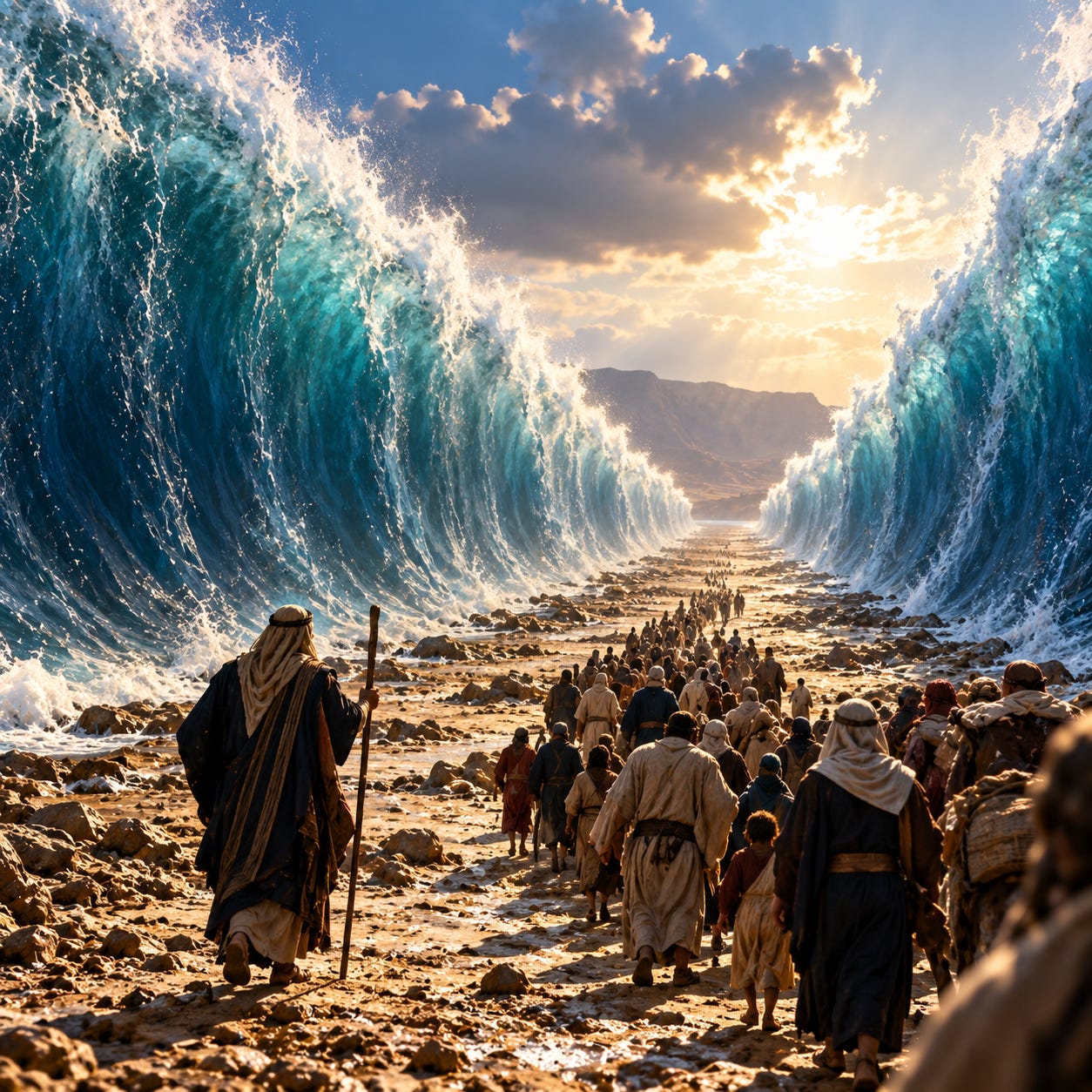
The sea looked and fled,the Jordan turned back.
“The sea looked and fled” is the Red Sea. This is talking about the crossing of the Red Sea.
And if you look at it in creation grammar, this looks like Day Two.
God separates the waters. He breaks the water so that there may be a place of habitation, and the people go through the parted waters.
So this is replaying creation.
The Fall went from order to disorder. It went backwards—what I call backwardation through the days of creation. Now God replays the creation grammar. He begins moving everything back toward fullness and rest.
So here we see the sea look and flee.
And then, forty years later, after the wilderness wanderings:
the Jordan turned back.
The Jordan is another Exodus crossing. Israel passes through the waters again, this time into the Promised Land.
Then:
The mountains leaped like rams,the hills like lambs.
When you start seeing things shaking, remember this in creation grammar: when creation comes into the presence of its Maker, it shakes.
Think about the very beginning:
In the beginning God created the heavens and the earth.
There is darkness, and the Spirit of God hovers over the waters—the waters of chaos, things that are still unformed. It isn’t that they are evil. They simply haven’t yet been formed.
And the Spirit of God moves over them.
That hovering, that movement of the Spirit of God upon the unformed creation, is moving it toward form, toward habitation, toward fullness.
And we see that grammar again.
What happened when God came down on Mount Sinai?
It was loud.
Everything was shaking.
Whenever God comes, creation starts shaking in the presence of its Creator.
And then look at the book of Acts. At Pentecost there is the coming of the Holy Spirit—noise, wind, flame. And later, when the Spirit fills his people, the place itself shakes.
This is God coming and working in his creation.
Then the psalm asks the question:
Why was it, sea, that you fled?Why, Jordan, did you turn back?Why, mountains, did you leap like rams,you hills, like lambs?
Why?
Tremble, earth, at the presence of the Lord,at the presence of the God of Jacob.
When he comes, he breaks things.
He breaks what belongs to the fallen creation so that he can make it anew.
Sometimes something has to be broken in order to be reset. If you’ve ever broken a bone badly enough, sometimes the doctor has to reset it so that it can heal properly.
And there is something like that in the story of redemption.
When Adam and Eve fell, humanity fell into sin. We became fallen creatures. And in order to remake us, God has to break us. He breaks us with his Word so that we may turn and come to him to be healed.
Every story of rebirth involves a breaking.
The Spirit of God moves upon people and brings them to their wits’ end, so that they call upon him.
And then he heals us.
And the psalm ends:
who turned the rock into a pool,the hard rock into springs of water.
Notice what has happened.
First, God separates the waters. Dry land appears. But you cannot simply have dry land without water. The land has to be watered.
So the water comes back—but now it comes back in measured pools and springs, not as the roaring, chaotic waters.
Water is not the enemy.
The Spirit of God moves over the waters and brings order.
And think about these two crossings: the Red Sea and the Jordan.
The old preachers used to talk about crossing the Jordan. You have to come through the waters. And the New Testament picks up this baptismal grammar as well.
And here the Belgic Confession is worth hearing again. Christ is:
“our Red Sea, through which we must pass to escape the tyranny of Pharaoh, who is the devil, and to enter the spiritual land of Canaan.”
And Article 34 goes on to describe what God himself does in baptism’s reality: he washes and cleanses, renews the heart, assures us of his fatherly goodness, and clothes us with the new nature while stripping off the old.
That is the movement from the old creation to the new.
The same God who parts the waters so that his people can pass through them is the God who gives them the water they need to live.
He turns the rock into a pool.
He turns hard rock into springs of water.
He breaks the waters so that his people can pass through.
And then he gives the waters back as life.
That is the movement of Psalm 114:
Out of Egypt.
Through the waters.
The earth shakes.
The dry land appears.
The water returns.
And God dwells with his people.
Creation is happening again.
This is a public episode. If you would like to discuss this with other subscribers or get access to bonus episodes, visit william945.substack.com
More from Reflections on the Psalms Podcast
Today, If You Hear His Voice
Nov 19, 2026 · 8m
Psalm 95: Today, If You Hear His VoicePsalm 95 is actually part of the daily prayers in the Book of Common Prayer. It is known as the Venite and is repeated in Anglican churches throughout the...
The Blessed Man and the Shema
Nov 2, 2026 · 3m
One of the things I’ve noticed is the similarities between Psalm 1 and the Shema, which was the great confession of ancient Israel and remains part of the daily prayers of Jews even today.When Jesus...
Glorious Things of Thee Are Spoken
Oct 17, 2026 · 5m
Psalm 87: Glorious Things of Thee Are SpokenThe City of God and the Conversion of the NationsThis is Reflections on the Psalms for October 17, 2026.When we come to Psalm 87, we come to what is...
Psalm 63: Learning to Pray with the Whole Body
Oct 14, 2026 · 6m
Psalm 63: Learning to Pray with the Whole BodyA Psalm of David, when he was in the wilderness of Judah.This psalm is one that I have actually attempted to memorize in a rapid way. I tried to...
Tears in a Bottle
Oct 11, 2026 · 3m
In Psalm 56, David asks God to put his tears in his bottle. David was suffering, even to the point of tears. His suffering was real in this world, and his tears were remembered by God.When we look...
Sometimes You Need a Javelin
Oct 7, 2026 · 4m
Today’s reflection on the Psalms, for the seventh of October, comes from Psalm 35:“Contend, O LORD, with those who contend with me; fight against those who fight against me! Take hold of shield and...
Take these sermons with you.
Follow Reflections on the Psalms Podcast in the Getsermons app to get every new sermon, build playlists, and pick up right where you left off.

