
The Redemption Project: Redemption Stories
Ashley Cantrell Found Faith in Jail. Getting Clean Took Longer.
Nov 6, 2026 · 17m
Prefer sermons downloaded automatically?
About this sermon
When Ashley Cantrell turned herself in to the Murray County Jail in Georgia, she had spent approximately three months avoiding arrest. She was tired of looking over her shoulder, tired of wondering when the police would catch up with her, and increasingly tired of the life she was living.
She served 15 days in jail for what she recalled as a probation violation. During that time, a group of women visited the jail to talk about Jesus Christ. Something about their presence and the way they spoke caught her attention.
“Man, I want what they have,” Cantrell remembered thinking.
She accepted Jesus Christ into her life during that incarceration. But when she was released, she returned to the same environment and continued using drugs for approximately another year.
That part of her story deserves attention because it challenges one of the assumptions people sometimes make about addiction, faith, and recovery.
Recognizing that your life needs to change is not always the same as knowing how to change it.
For Cantrell, the decision to pursue something better came before she had the circumstances, support, and stability to make that decision a lasting reality.
When addiction becomes normal
Cantrell first experimented with methamphetamine when she was approximately 14 years old, around 2000. At the time, she described it as something she did with friends.
It was not initially something she recognized as the beginning of a long struggle.
She also grew up in a family where drug use was familiar. During our conversation, Cantrell explained that she had used drugs with her parents when she was a teenager.
That detail helps explain the environment in which her addiction developed.
When drug use becomes part of someone’s home life, the distinction between normal behavior and dangerous behavior can become difficult to recognize, particularly for a child.
Cantrell had already begun engaging in theft as a young student, stealing items from school lockers. As she grew older, those behaviors became more serious, and methamphetamine increasingly became part of her daily life.
She also described experiencing periods of depression in which she would sleep for 15 to 20 hours a day. Methamphetamine became a way to stay awake, although its use ultimately contributed to a much larger pattern of instability.
She became a mother at 20 and continued working while using drugs. From the outside, she believed many people could not tell she was using methamphetamine.
But maintaining employment or appearing functional does not necessarily mean an addiction is under control.
By approximately age 23, Cantrell had begun injecting methamphetamine. During one particularly difficult period, while her son was spending the summer with her brother and grandfather, her behavior deteriorated.
She described breaking into homes, stealing, and exchanging sex for money to obtain drugs.
Those decisions carried consequences for other people as well as herself. Cantrell does not attempt to hide that part of her history.
She also encountered the criminal justice system repeatedly, including arrests and periods of probation.
Her experience illustrates something important about addiction: a person can recognize that their behavior is destructive and still struggle to separate themselves from it.
When the lifestyle becomes the prison
After years of methamphetamine use, Cantrell began questioning the life that had become familiar to her.
She recalled sitting with people who were using drugs and wondering why they were spending their time doing something that no longer brought her any satisfaction.
She even remembered dumping methamphetamine onto the floor and telling others that she no longer cared about it.
But she kept returning.
It was not simply a matter of wanting another high. The people she knew, the places she visited, and the routines she followed were closely connected to her addiction.
Eventually, even the prospect of continuing that lifestyle became exhausting.
When she finally turned herself in to the authorities, she was not describing a moment of sudden happiness or confidence. She was describing exhaustion.
She wanted something different, even if she was not yet sure how to obtain it.
Her time in jail brought her into contact with women who shared their Christian faith. Their example offered something she believed was missing from her own life.
But after she was released, she continued to struggle.
That does not necessarily mean her faith was insincere. It means the circumstances that had shaped years of addiction were still present.
The importance of changing your surroundings
One of the most significant moments in Cantrell’s story did not involve an arrest, a courtroom, or a dramatic spiritual experience.
It involved a family member offering her a place to live.
Cantrell explained that someone in her family invited her to move in once that relative had a home of her own. She accepted the opportunity and eventually moved away from the community where she had spent much of her life.
She changed counties, distanced herself from people she associated with drug use, and began rebuilding her routines.
According to Cantrell, that move was a turning point in her recovery.
At the time of our September 2026 interview, she reported approximately 10 years without methamphetamine.
She also described having stopped using marijuana several years earlier and more recently giving up alcohol.
What stands out is how much her recovery depended on changing the daily circumstances of her life.
As a retired detective, I have seen the importance of understanding what happens to people after they leave a jail, complete a program, or decide they want to stop using drugs.
A person can make a sincere commitment to recovery while still returning to a household where drugs are readily available, relationships are unstable, and the same pressures remain.
Personal responsibility is essential, but access to safer housing, healthier relationships, and a supportive community can make it far more practical to act on that responsibility.
Cantrell’s story does not establish that changing environments will work for everyone. Addiction and recovery are more complicated than any single intervention.
But her experience makes the importance of those circumstances difficult to ignore.
Faith became more than a moment
Cantrell’s Christian faith remained central to her life after she left the environment where she had been using drugs.
She described eventually feeling called to be baptized, becoming involved in a local church, and developing a deeper relationship with God.
She also acknowledged that her spiritual growth took time.
Attending church, reading the Bible, and learning to apply her beliefs to everyday decisions were not things she mastered immediately.
Her understanding of faith developed alongside her recovery.
During our conversation, Cantrell described how the people in her church supported her as she worked through painful experiences from her past.
For her, Christianity became something more than the decision she made while sitting in a jail cell.
It became part of how she understood her identity, her responsibilities, and the future she wanted.
That progression is important.
Faith did not remove her need to make difficult decisions. It helped give those decisions meaning.
She still had to change her habits, distance herself from destructive relationships, maintain employment, and take responsibility for her life.
What she describes is not an effortless transformation, but a relationship with Christ that has continued to develop through those choices.
The life she is building today
When I asked Cantrell about her life today, the conversation moved away from the drugs, arrests, and instability of her past.
That was intentional.
I am interested in what people have overcome, but I am equally interested in what they are doing with the opportunities they have now.
Cantrell works for a school system, cleaning and helping maintain a high school. She also cleans houses on weekends and has b…
Get full access to The Redemption Project Newsroom at newsroom.theredemptionproject.news/subscribe
More from The Redemption Project: Redemption Stories

Cameron Arnett: Christ Over Career
Nov 20, 2026 · 37m
What happens after a decision you believe is right costs more than you expected?Cameron Arnett joins Brandon Burley for a conversation about acting, faith, and the long period of rebuilding that...
Rob Decker Survived the Fall. Redemption Took Longer
Nov 13, 2026 · 1h 5m
Content note: This story discusses suicide, childhood abuse, addiction, and allegations of sexual violence.Rob Decker remembers lying on the concrete, looking up at the third-story window he had...
Wm. Paul Young: The Shack and the Work of Redemption
Nov 10, 2026 · 46m
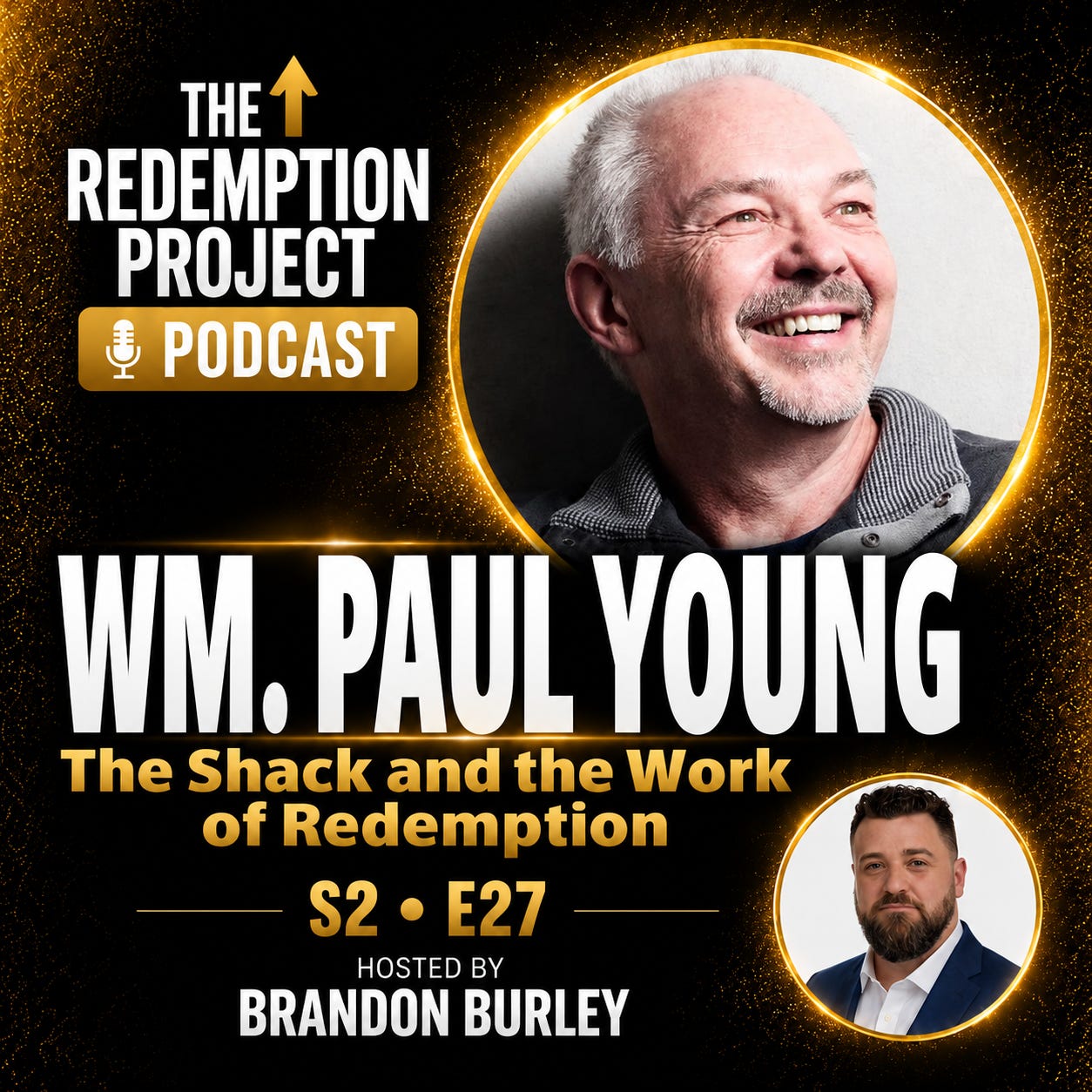
Before The Shack reached strangers, Wm. Paul Young had to face the damage he had caused among the people who knew him best.In our conversation, he describes a crisis at 38, when his wife, Kim,...

Aaron Kinzel: Out of the Convict Closet
Nov 3, 2026 · 53m
What should a second chance ask of someone—and what should it make possible?Aaron Kinzel joins Brandon Burley for a conversation that holds responsibility and rehabilitation together. Kinzel...

Redemption Story of the Week: Scarlett — Her Papaw Showed Up. Then the Rebuilding Began.
Oct 30, 2026 · 37m
She had survived an overdose. She was still weak after a severe health crisis. In our conversation, she described leaning against the hospital building, uncertain what would happen next.Then her papaw...

He Was Arrested for a Murder He Says He Didn't Commit. Then He Believed God Had Another Purpose for His Imprisonment.
Oct 23, 2026 · 33m
Baba had no idea that renting an apartment for a few days would change the direction of his life.In 2021, he needed to conduct business in another part of Lagos, Nigeria. Rather than travel back and...
Take these sermons with you.
Follow The Redemption Project: Redemption Stories in the Getsermons app to get every new sermon, build playlists, and pick up right where you left off.

