
A Fisherman's Faith
The Forgiveness We Often Forget... My 2 Cents
Jul 26, 2026 · 5m
Prefer sermons downloaded automatically?
About this sermon
Alright, let me share something that happened yesterday morning during our devotional time. My wife asked me a simple question: “What is the difference between envy, jealousy, and possessiveness?” Like any good IT husband, I did what came naturally, I asked ChatGPT.
We found some helpful definitions and started talking about how those attitudes show up in our lives and relationships. But you know how it goes, one conversation leads to another. Before we knew it, we weren’t talking about envy or jealousy anymore. We were talking about ourselves.
That took us down memory lane as we reflected on different seasons of our marriage. We remembered times when she was young, innocent, and full of love, while I was ignorant, selfish, and not yet a believer. Looking back wasn’t about reopening old wounds; it was about recognizing God’s grace. Yet our conversation also revealed something else. Both of us realized there were still areas where we hadn’t completely forgiven ourselves for parts of our past. That realization opened the door to a deeper conversation about forgiveness.
As we talked, we realized most Christians understand two parts of forgiveness. First, we receive God’s forgiveness through Christ.
“If we confess our sins, He is faithful and just to forgive us our sins and to cleanse us from all unrighteousness.” 1 John 1:9
Second, we’re called to forgive others.
“Be kind and compassionate to one another, forgiving each other, just as in Christ God forgave you.” Ephesians 4:32
But we also discovered a third struggle many believers quietly carry. Even after receiving God’s forgiveness and forgiving others, we continue condemning ourselves. Sometimes that’s because we’ve never allowed God to bring us to genuine repentance.
The enemy loves to keep us in the place of victimhood. He whispers, “You were the one who was hurt. What do you have to repent of?” As long as we stay there, we remain focused on everyone else’s actions while never allowing God to search our own hearts. True repentance isn’t taking responsibility for another person’s sin. It’s allowing the Holy Spirit to reveal anything in us that doesn’t reflect Christ, whether it’s bitterness, pride, resentment, self-pity, or unforgiveness. Repentance isn’t condemnation; it’s God’s invitation into freedom.
When we revisit the past, we remember what others did to us, but we also replay everything we wish we had done differently. “Why didn’t I speak up? Why did I tolerate that? Why was I so selfish? Why did I keep making the same mistakes?” Whether we were the victim or the one who caused the pain, we become our own harshest judge and slowly begin believing our failures define us instead of seeing them as part of the story God is redeeming.
I believe this is one of the enemy’s greatest lies. Revelation calls Satan “the accuser of our brothers and sisters.” He keeps bringing up a case that Jesus has already settled. We may know Christ has forgiven us and even forgive those who hurt us, yet one memory can pull us back into guilt, shame, blame, or self-pity. If the enemy can’t stop us from receiving forgiveness, he’ll try to stop us from living in its freedom.
But God’s Word says, “There is therefore now no condemnation for those who are in Christ Jesus.” Romans 8:1. Consequences may remain, but consequences are not condemnation. The Holy Spirit brings conviction to draw us back to Christ; the enemy brings condemnation to drive us away from Him.
David reminds us, “As far as the east is from the west, so far has He removed our transgressions from us.” Psalm 103:12
So what does it mean to forgive ourselves? It doesn’t mean excusing our failures. It means agreeing with God’s verdict instead of continuing to argue with it. If Christ has forgiven us, and we’ve honestly repented before Him, we no longer have the right to keep condemning the person He has redeemed.
Maybe you’ve already received God’s forgiveness. Maybe you’ve forgiven those who hurt you. But if your past still puts you back on trial, ask God to search your heart, repent where He leads you, and then leave the verdict with Him. The cross declares that you are forgiven. The empty tomb declares that you are free. Live like both are true.
That’s my two cents. Love you all in our Lord’s love.
This is a public episode. If you would like to discuss this with other subscribers or get access to bonus episodes, visit sethdavidvivek.substack.com
More from A Fisherman's Faith
Discipline Is Not Punishment, Without Discipline, There Is No Discipleship.
Nov 18, 2026 · 12m
A Fisherman’s Faith Podcast by Seth David VivekFor most of my Christian life, I wanted to be loved, encouraged, prayed for, and supported by my church and small group. I wanted brothers and sisters...
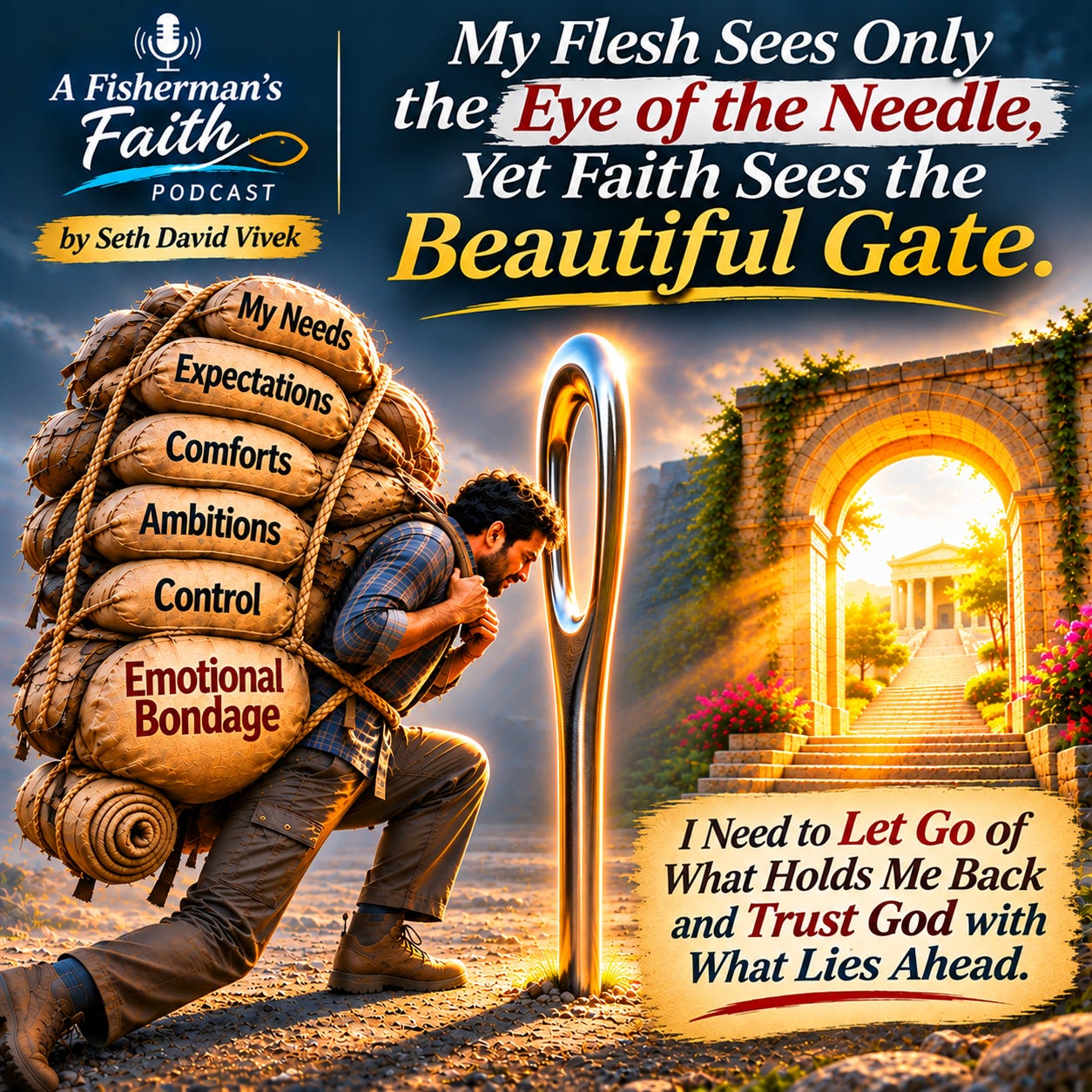
My Flesh Sees Only the Eye of the Needle, Yet Faith Sees the Beautiful Gate.
Nov 10, 2026 · 7m
For the last couple of weeks, I have been struggling with a decision I need to make concerning one of my sons. Deep down, I know it is God’s will. I also know it is one of the crucial steps my son...
Lord, I Don’t Want to Fight a Battle That Hasn’t Even Begun - A Prayer for Faith When Fear Remembers.
Nov 3, 2026 · 6m
There are moments in life when you hear something, and suddenly, your heart takes you somewhere you never wanted to go again. Something happens. Someone says something. You hear something that touches...
Self-Pity Makes Us Spectators of Our Own Suffering Rather Than Participants in God’s Work.
Oct 31, 2026 · 8m
Have you ever wondered how much of our lives we spend feeling sorry for ourselves? I mean, really think about it. How often do we replay the things people said to us, the disappointments we...
Why Is Obedience So Difficult? When God Calls, Do I Follow?
Oct 19, 2026 · 9m
Welcome back to A Fisherman’s Faith Podcast.Welcome back to A Fisherman's Faith Podcast. Yesterday morning, during our morning walk, my wife and I were listening to Gospel music. One of the songs...
A Fisherman’s Battle Within - Can Repentance Transform My Heart ?
Oct 12, 2026 · 14m
For most of this week, my wife and I have been going through Romans chapters 6 through 8 during our morning devotions. As we have been reading and reflecting on these chapters, one thing has continued...
Take these sermons with you.
Follow A Fisherman's Faith in the Getsermons app to get every new sermon, build playlists, and pick up right where you left off.

