
The Second Look
Shiny, Heroic, Leader? | TSL EP# 11
Aug 24, 2026 · 14m
Prefer sermons downloaded automatically?
About this sermon
Description
Nearly everything written about leadership converges on the same list. Character, competence, charisma, communication, care, integrity. This episode does not argue that any of those are unimportant. It argues that the list does not do the job it is being asked to do, because every item on it is something worth wanting from everyone in the building, not just the person at the top.
The test case is personal, and it is a disappointment rather than a scandal. A college student training for ministry attached himself to a well-known leadership author he had never met, read everything the man wrote, and took the framework seriously at an age when he had never led anything of consequence. Years later that author fell. The moral failure was devastating on its own terms and is treated that way here. But it left a narrower question behind, and the narrower question is what the episode is actually about: if character is the baseline you expect from every colleague, what is the thing that only a leader does?
Working toward an answer takes the piece through the gap between Mel Gibson’s William Wallace and the man who actually lost at Falkirk, through a respectful disagreement with one of the most widely read writers in the field, and through a king of Israel who at the decisive moment did not supply his own integrity and had to borrow it from someone standing next to him. The conclusion is not that leaders do not matter. It is that we have made them far too big, and that the real work of the role is smaller, heavier, and considerably less flattering than the heroic version.
What’s inside: the author whose fall changed what one reader wanted in a leader; Braveheart against the historical record; why six admirable virtues fail as a definition; a disagreement with John Maxwell that is not a criticism of the man; Zig Ziglar on wandering generalities; David, Bathsheba, and Nathan; what a room of newly promoted supervisors was told about blame; and a definition of leadership narrow enough to be useful.
Written and read by Kiel F. Harvey. Originally published August 21, 2026. Running time 14:11.
In this episode
* 0:00 Billboard and intro
* 0:58 The leadership author a college student attached himself to
* 1:28 A fall in 2018, and what it changed about what he wanted in a leader
* 2:16 Braveheart, and the kind of leader we all say we want to follow
* 2:48 The real William Wallace, Stirling Bridge, and Falkirk
* 3:52 Training programs that promise to make you the Braveheart of the office
* 4:33 John Maxwell, leadership as influence, and a philosophical difference
* 5:29 Integrity, communication, care: things worth wanting from everyone
* 5:59 Zig Ziglar on wandering generalities and meaningful specifics
* 6:20 Leadership happens in a messy environment, not a vacuum
* 7:09 King David, Bathsheba, and where the integrity actually came from
* 8:04 Leaders as part of an ecosystem rather than self-contained causes
* 8:30 Going hard in the paint against the heroic leader
* 8:49 The definition, narrower and heavier than a list of virtues
* 9:03 What a room of newly promoted supervisors was told
* 9:53 Where the compounding failure actually was
* 10:58 Twenty years later, and the role model that was needed
* 11:32 Outro
The argument, in short
Character is a prerequisite for leadership, not a description of it. Every virtue the standard list names is something worth demanding of everyone in an organization, which means none of them can be what separates a leader from anyone else. A definition that applies equally to the whole company is not a definition. It is a distinction without a difference, and it leaves people who are handed authority with an aspiration instead of a job.
The distinguishing act is narrower. A leader takes responsibility for directing people toward a shared outcome, and the responsibility does not get shared out even though the outcome always is. That is why the newly promoted supervisor in this episode is told he has forfeited the right to blame anyone. It is not a motivational line. It is a description of what he just accepted.
The second half of the argument cuts against the same heroic picture from the other direction. Leaders are not self-contained causes of anything. They sit inside an ecosystem of people who correct, support, challenge and enable them, and the reason David survived his worst moment is that one of those people was willing to walk into the room and say so. Making everyone a leader flatters the org chart and quietly devalues the very people a leader cannot function without.
If you take one thing: owning the outcome is the job, including the outcome that hurts. A leader who will not face what happened has failed at the one thing the role actually required, however impressive the rest of the resume looks.
Referenced in this episode
* Bill Hybels and the 2018 Willow Creek investigation. The leadership author at the center of the opening. An independent investigation later found the allegations against him credible, and church leaders reported that he did not take part in their reconciliation efforts. The episode treats his writing on character, competence and chemistry as work that genuinely formed people, and treats him as a man who fell rather than as a cautionary prop.
* John Maxwell, “leadership is influence.” One of the most widely read writers in the field, and among the first this episode’s author ever read. What follows is a philosophical difference about whether influence is specific enough to define a distinct role. It is not a criticism of the man or of his life’s work.
* Zig Ziglar. The line about refusing to be a wandering generality, used here against the vocabulary of leadership training rather than against any individual.
* Braveheart (1995), and the historical William Wallace. The film gives us a singular strategic genius. The record gives us a man who was one part of a rebellion already underway, who won at Stirling Bridge and was crushed at Falkirk less than a year later against superior numbers and complicated politics.
* 2 Samuel 11 and 12. David, Bathsheba, Uriah, and the prophet Nathan, who is the supporting character this episode is most interested in.
Read the original
The written version of this essay is here: Shiny, Heroic, Leader?
New essays every week at Upon Further Examination. Free, and it stays free.
RockReader
If you’re like me, you’ve been told a million times you should read your Bible. That lands about the same as “you should go to the gym.” And here’s what I’ve noticed about both. I’m far more consistent when a friend is going through it with me.
That’s what I built RockReader for. You pick a reading plan, connect with a few people you trust, and journal through it together, a day at a time. It’s private by default, so nothing you write is seen unless you decide to share it. Completely free. No subscription, no in-app purchases.
rockreader.com, or search RockReader in the Google Play store. Grab a friend and dig into the word together.
From the Source
If you’re just getting started reading the Bible, or you’ve been a Christian a long time and your Bible has gotten dustier than you’d like, I wrote a study workbook for you. From the Source teaches a four-step method for reading and studying Scripture so you can understand it for yourself, at your own pace.
Available at kielharveybooks.com and on Amazon.
Everything on Upon Further Examination is free and stays free. If you want to support the work, buy From the Source. What it earns pays for RockReader and for the hours these essays take.
Listen and subscribe
* Apple Podcasts
* Spotify
* YouTube
* The Second Look show page
About
Upon Further Examination is a Substack about business, leadership, work, and life as they are actually lived, not as they are supposed to sound. Most of life runs on first impressions. This is the second look.
Kiel F. Harvey writes it, reads it, and built RockReader.
Get full access to Upon Further Examination at kielharvey.substack.com/subscribe
More from The Second Look
Hidden Addiction, Heroin’s Toll, And Finding Hope | TSL EP #17
Oct 9, 2026 · 1h 57m
Most conversations about addiction start with the drug. This one starts with a secret. For years Rick Minard served in church, led a home group, and watched God use him, while hiding a pornography...
Success Doesn’t Prove You’re Right | TSL EP # 16
Oct 6, 2026 · 12m
Organizations are good at reviewing their failures. A missed target triggers a meeting, a post-mortem, a new plan. A hit target triggers a repeat. This episode argues that the second reflex is the...
Sucking At Stuff | TSL EP #15
Sep 14, 2026 · 9m
Most people who want to get good at something late have already heard the argument against trying, usually in their own voice. Too old, too far behind, too much momentum in the wrong direction. The...
When Getting Help Becomes a Full-Time Job | TSL EP # 14
Sep 7, 2026 · 13m
DescriptionAn institution can hold enormous expertise and still fail the person standing in front of it, and the failure will not look like incompetence. It looks like a series of appointments that...
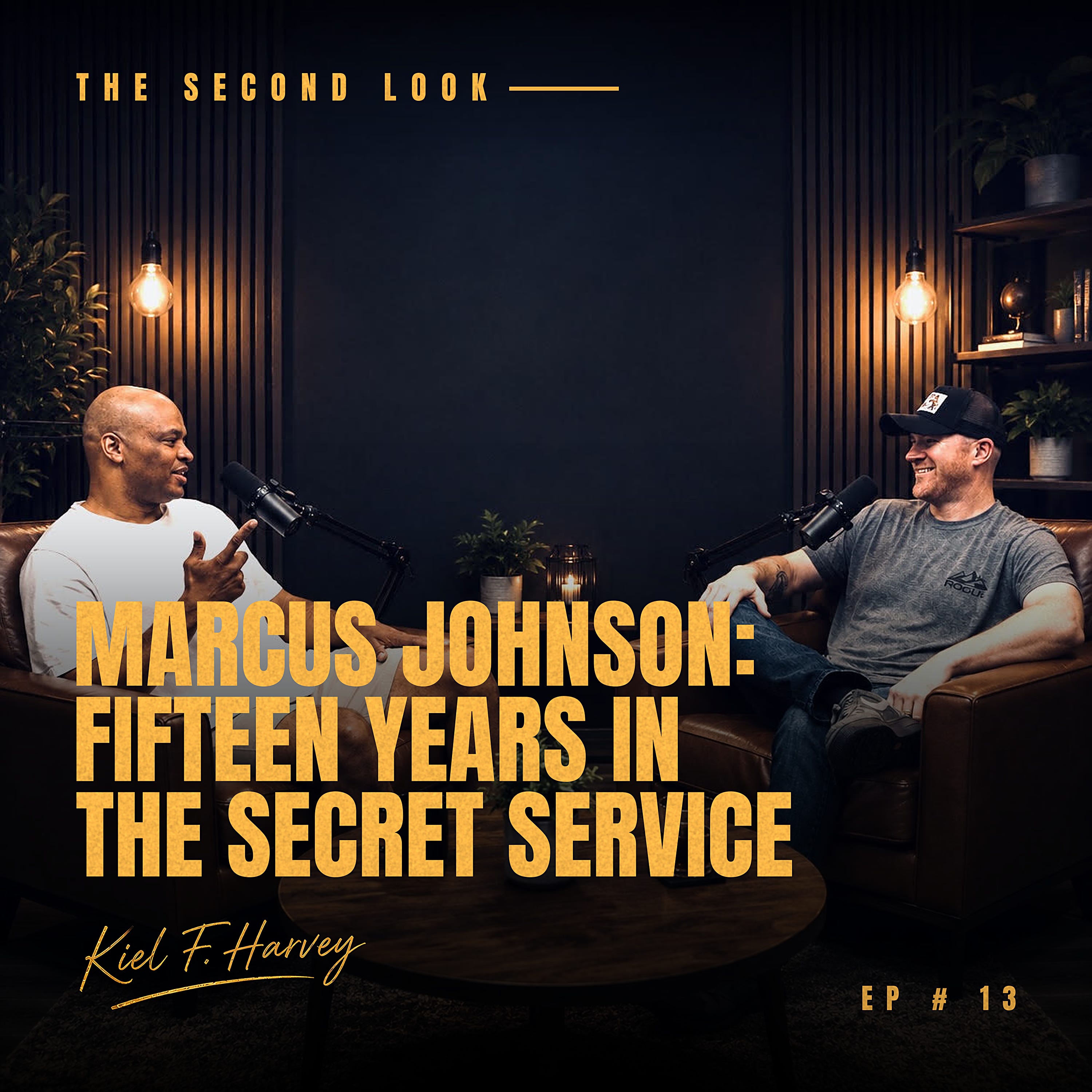
Buying Cocaine Undercover, Protecting Presidents, and the Cost of Duty- Marcus Johnson Interview | The Second Look Ep# 13
Sep 2, 2026 · 2h 16m
DescriptionAlmost everything the country believes about the Secret Service was assembled from two sources. One is a movie. The other is a piece of footage where something went badly wrong. Neither one...
Losing Your Way By Accident | TSL EP # 12
Aug 31, 2026 · 10m
DescriptionMost people who stop living by a conviction never decide to. There is no argument, no crisis of belief, no moment where the thing gets examined and set down. You would still defend it out...
Take these sermons with you.
Follow The Second Look in the Getsermons app to get every new sermon, build playlists, and pick up right where you left off.

